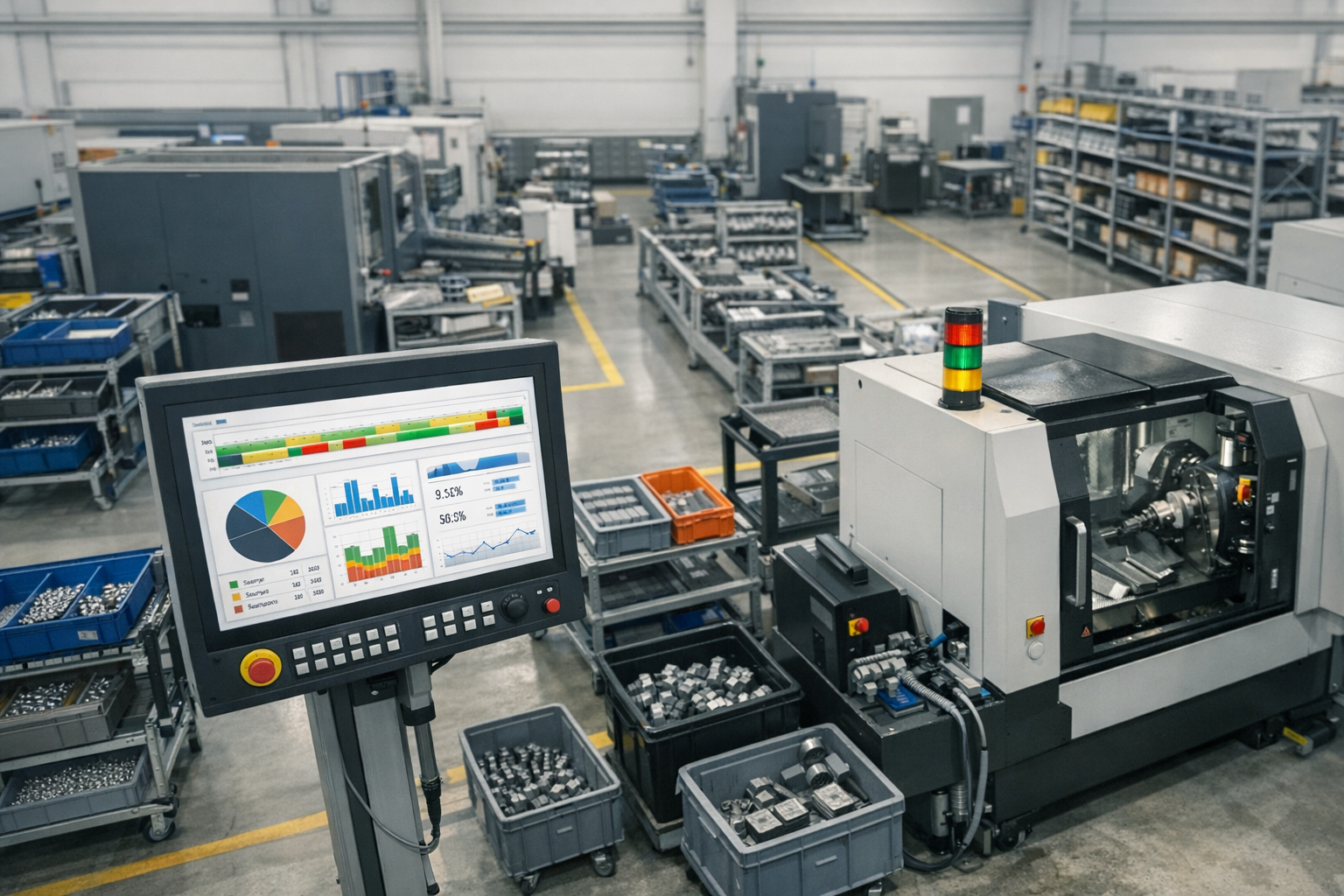
Modeling Manufacturing KPIs with ISO 22400: Time, States, and Quantities
ISO 22400 gives aerospace manufacturers a precise vocabulary for how key performance indicators (KPIs) are structured, not just what they are called. For production, MRO, and space hardware lines that must coordinate across multiple plants, suppliers, and digital systems, this structure is what keeps “utilization” or “availability” comparable from one site to another. This article explains how ISO 22400 models KPIs from raw signals through indicators to aggregated KPIs, and how time categories, equipment states, and quantity relationships shape data models used in aerospace manufacturing platforms such as ISO 22400 manufacturing KPI frameworks.
The focus here is conceptual: how to design a KPI model that is faithful to ISO 22400, while leaving room for aerospace-specific metrics, regulatory constraints, and digital thread requirements.
For teams putting this topic into daily operation, Connect981’s aerospace execution solutions, real aerospace execution examples, ISO 22400 KPI governance help connect the concept to traceability, work-order reality, and audit-ready evidence.
For teams putting this topic into daily operation, ISO 22400 KPI governance, a connected execution platform help connect the concept to traceability, work-order reality, and audit-ready evidence.
The same operating model also depends on Connect981’s aerospace operations guidance, practical aerospace operations FAQs, especially when decisions have to move across quality, production, suppliers, and program leadership without losing context.
From Raw Data to Standardized KPIs in ISO 22400
ISO 22400 distinguishes clearly between what happens on the factory floor, how it is captured, and how it is eventually represented as KPIs. For aerospace engineering and manufacturing teams, understanding these layers is crucial for building traceable, auditable performance data across complex, multi-part assemblies and long product lifecycles.
Raw signals: events, counters, and timestamps
At the lowest level, production systems emit raw signals. These are direct outputs from control systems, machine controllers, test rigs, automated fastening cells, and inspection stations. Typical examples include:
- Binary equipment status (ON/OFF, RUN/STOP bits)
- Cycle counters (number of fastening cycles, pressure tests, or cure cycles completed)
- Timestamps for state transitions (start of test, end of cure, pause/resume events)
- Piece count pulses (part passed a sensor, panel left a station)
- Alarm and interlock events (door open, vacuum loss, E-stop)
These signals are typically stored in historians, SCADA archives, or MES event logs. On their own they are not KPIs; they are facts about what equipment did and when. ISO 22400 treats them as the foundation from which more meaningful indicators are derived.
Derived indicators built from raw signals
Derived indicators are intermediate measures created by processing raw signals. Common examples in aerospace environments include:
- Time spent in a given equipment state (e.g., minutes in RUN vs. IDLE for a drilling cell)
- Duration of a production order, operation, or test sequence
- Total quantity produced, accepted, rejected, or reworked for a work order
- Number of changeovers or configuration switches for a test stand
These indicators are often calculated in MES or a manufacturing data platform by grouping raw events by order, work center, or resource and applying rules aligned with ISO 22400 definitions. The critical point is that indicators are still not KPIs; they are standardized building blocks from which KPIs are constructed.
Aggregated KPIs as standardized conceptual objects
KPIs in ISO 22400 are selected, aggregated indicators that have a specific meaning in manufacturing operations management. Examples include equipment utilization, order execution effectiveness, and quality-related performance indicators. They are characterized by:
- Clear definitions: what they measure and which indicators they depend on
- Time behavior: whether they apply to a shift, day, campaign, or order lifecycle
- Scope: work unit, line, area, plant, or enterprise
- Intended users: operator, supervisor, engineering, or management
An ISO 22400-aligned aerospace data model therefore needs explicit objects (or tables) for raw events, derived indicators, and KPIs, with traceable relationships among them. This traceability is especially important in regulated environments (e.g., AS9100-compliant plants) where performance numbers must be auditable back to their underlying production evidence.
Time-Based Foundations of ISO 22400 KPIs
Time is the backbone of many ISO 22400 KPIs. For aerospace and defense manufacturing—where long takt times, complex assemblies, and certification-critical tests are common—time structure must be modeled carefully to avoid misleading utilization or turnaround metrics.
Planned time vs. actual time
ISO 22400 draws a strong distinction between planned time and actual time:
- Planned time represents the scheduled availability of a resource or work unit—for example, a composite layup cell planned to run from 06:00 to 14:00 with a specific crew and product mix.
- Actual time captures what really happened during that horizon—when the cell was running parts, in setup, in scheduled maintenance, blocked by missing material, or waiting for quality signoff.
In a compliant data model, planned time and actual time should be represented as separate but related concepts, often linked by production order, resource, and calendar. KPIs such as utilization or schedule adherence draw on both, making it essential that the model preserves their differences.
Busy, operating, and downtime categories
ISO 22400 defines multiple time categories, including concepts such as busy time, operating time, and various forms of downtime. While the exact categorization is specified in the standard and supporting literature, the typical aerospace interpretation includes:
- Operating-related time: intervals when the resource is technically able to operate, regardless of whether it is currently producing.
- Busy time: sub-intervals of operating-related time where the equipment is actively performing its intended operation (e.g., machining, curing, testing).
- Planned downtime: scheduled maintenance, calibration, or qualification runs that intentionally take the resource out of normal production.
- Unplanned downtime: failures, quality holds, missing parts, and other disruptions.
In KPI modeling, these categories are usually computed from sequences of equipment states and calendar rules. For example, a test stand in state RUN during planned production hours contributes to busy time, while the same RUN state during an off-shift period might be treated differently depending on the organization’s definition of planned operating time.
Mapping time categories to performance concepts
Many ISO 22400 KPIs can be understood as relationships among these time buckets. For instance, indicators related to utilization, availability, or schedule fulfillment can be conceptually defined as ratios involving busy time, operating-related time, and planned time. ISO 22400 does not mandate specific formulas; instead, it describes which time concepts are relevant to a given KPI.
For aerospace plants, this mapping has practical implications:
- Long-duration processes like autoclave curing must clearly distinguish between active process time and waiting or setup intervals.
- Shared resources (e.g., metrology labs) require unambiguous rules for how time is allocated to different orders and programs.
- MRO lines may need different time categorizations for turnaround commitments versus deep-dive inspections.
A data model aligned with ISO 22400 therefore needs explicit structures for time segments, their categories, and their relationships to equipment, orders, and shifts.
Equipment States and Their Role in KPI Calculation
Time categories are derived from equipment states, which act as the bridge between automation signals and management-level KPIs. For aerospace and space hardware production, properly modeling these states is critical when multiple systems (test cells, tooling, handling robots) must report performance in a consistent way.
RUN, STOP, IDLE, SLOW and other state concepts
ISO 22400 uses conceptual states such as RUN, STOP, IDLE, and SLOW to characterize what equipment is doing. In practice, an aerospace facility might map detailed PLC codes or machine-status words into these generalized states:
- RUN: machine is executing its defined operation on a work order (e.g., drilling a fuselage panel, performing a structural load test).
- STOP: equipment is halted and not available to produce; cause codes may include fault, safety stop, or interlock.
- IDLE: equipment is technically available but not currently processing—waiting for material, schedule, or operator.
- SLOW: equipment is operating below its defined nominal rate, potentially due to conservative process settings, rework, or part complexity.
These conceptual states do not replace detailed fault codes or process statuses; they sit above them as standard categories that can be interpreted consistently across sites and vendors.
How states map to standardized time buckets
To compute ISO 22400-aligned indicators, each interval in which a resource is in a given state is mapped to one or more time categories. For example:
- RUN during planned production is usually part of busy time.
- STOP during planned production may fall under unplanned downtime.
- IDLE within planned operating hours might correspond to waiting or micro-downtime categories.
- RUN during calibration may be counted as planned downtime or a specialized category depending on policy.
The mapping logic is where MES, SCADA, and integration platforms implement business rules. ISO 22400 describes which combinations of time and state concepts a KPI depends on, but it leaves organizations free to tailor detailed mapping as long as the conceptual meaning is preserved.
Consistency across automation and MES systems
In aerospace manufacturing, it is common to operate mixed equipment fleets—legacy test stands, new digital workstations, and custom rigs from different suppliers. Without a clear state model, each system may use its own vocabulary, making multi-site KPIs impossible to compare.
By adopting ISO 22400 state concepts as a common abstraction, manufacturers can:
- Map heterogeneous PLC and controller states into a unified state set.
- Ensure that utilization or downtime KPIs mean the same thing for a composite cell and a final assembly line.
- Provide auditors and customers with a transparent explanation of how performance metrics are constructed.
Platforms that integrate MES, historians, and supervisory control—such as a digital infrastructure used in aerospace plants—benefit from keeping this state model explicit and configuration-driven, rather than hard-coding vendor-specific semantics.
Quantity-Based Elements: Good Units, Scrap, and Rework
While time is central to many KPIs, ISO 22400 also structures quantity-based elements—produced units, scrap, and rework—especially important in aerospace where traceability, serial-number control, and configuration management are mandatory.
Material-related quantities in ISO 22400
ISO 22400 introduces standardized notions of material-related quantities such as:
- Input quantity: material or units entering an operation or work center.
- Output quantity: material or units leaving the operation, which may be further categorized.
- Good quantity: output that meets defined quality requirements and is accepted into the next step or inventory.
- Scrap quantity: output that cannot be used and is discarded or downgraded.
- Rework quantity: output that requires additional processing before acceptance.
In aerospace, these quantities must often be tracked at the level of serialized components, build positions, or configuration-controlled assemblies, not just bulk counts. An ISO 22400-aligned model should therefore link quantities to orders, product definitions, and serial numbers while preserving the standard’s conceptual roles.
Relating quantity measures to time categories
Many performance indicators relate quantities to time: for example, output per hour, accepted units per shift, or rework load relative to busy time. ISO 22400 encourages expressing these relationships using time categories and material-related quantities that have consistent definitions.
In an aerospace setting, such relationships are crucial when comparing:
- Different programs with varying levels of complexity and inspection intensity.
- Prototype phases with high rework levels against stabilized series production.
- MRO lines handling different fleet ages and modification packages.
By modeling time categories and material quantities explicitly, engineers can construct KPIs that distinguish between true performance shifts and changes driven by mix or configuration.
Conceptual links to quality and throughput KPIs
Quality-related KPIs—such as first-pass yield or defect ratios—are conceptually built from good, scrap, and rework quantities. Throughput indicators combine these quantity measures with time segments to highlight the pace at which acceptable units flow through the system.
ISO 22400 does not prescribe how aerospace organizations should act on these KPIs, but it ensures that the meaning of “good quantity” or “rework” is unambiguous. When a prime contractor and a tiered supplier both reference ISO 22400-aligned definitions, their reported quality and throughput figures can be compared or combined without semantic confusion.
Designing a Data Model Aligned with ISO 22400
For architects and data engineers building aerospace manufacturing platforms, the key challenge is turning ISO 22400 concepts into a coherent data model that remains stable over time and flexible enough for program-specific extensions.
Representing indicators, KPIs, and relationships
A practical ISO 22400-aligned model typically introduces distinct structures for:
- Events and states: raw signals, state transitions, and alarms, linked to equipment, order, and timestamp.
- Time segments: contiguous intervals of a given state and category (busy, planned downtime, etc.).
- Quantity records: material movements and quantity outcomes per order, operation, and resource.
- Indicators: computed aggregates (e.g., total busy time, scrap quantity) with clear derivation rules.
- KPIs: structured objects that reference indicators, define their scope, and capture metadata such as unit of measure and trend direction.
Keeping indicators and KPIs separate is important. It allows aerospace plants to introduce new KPIs—such as program-specific readiness metrics—without disrupting the underlying event or indicator structures that support other standards and reports.
Dealing with multiple levels: work unit to plant
ISO 22400 is consistent with hierarchical models used in manufacturing integration standards. KPIs can be defined at multiple levels: work unit, work center, area, site, or enterprise. Aerospace operations often add another set of slices: by program, platform, major assembly, or aircraft tail number.
To reconcile these views, a robust data model should:
- Maintain clear relationships between equipment and organizational units (lines, cells, areas, plants).
- Support aggregations by physical hierarchy (e.g., test stands in a lab) and by logical groupings (e.g., all resources supporting a specific program).
- Allow KPIs to be defined at one level and rolled up or drilled down without redefining their meaning.
This multi-level design is especially important for OEM–supplier networks, where each organization may report ISO 22400-based KPIs at different granularities while still needing a consistent structure for contract performance reporting.
Supporting future extensions without breaking the model
ISO 22400 intentionally does not cover every aerospace-specific metric. Plants may need indicators tied to regulatory audits, customer-specific milestones, or advanced digital thread use cases. A well-structured data model should therefore:
- Store KPI definitions as configurable metadata rather than hard-coded columns.
- Allow additional attributes (e.g., safety relevance, certification impact) to be attached to KPIs.
- Keep clear lineage from KPIs back to raw events, enabling review when definitions change.
This approach lets organizations extend their KPI portfolios—adding, for example, metrics focused on engineering change-cycle time or test re-run rates—while maintaining alignment with the ISO 22400 concepts already in use.
Using an ISO 22400-Aligned Model in Connected Environments
Aerospace manufacturing operates as an interconnected network of systems: ERP for orders and contracts, PLM for product definition, MES for execution, QMS for nonconformance and corrective action, and specialized tools for test, inspection, and configuration management. ISO 22400 provides the shared KPI vocabulary these systems can use when exchanging performance data.
Interfacing with ERP, MES, SCADA, and historians
In a connected environment, each system contributes part of the data needed to construct ISO 22400 KPIs:
- ERP supplies production orders, planned quantities, due dates, and sometimes planned calendars.
- MES orchestrates operations, tracks execution, and records completion quantities and statuses.
- SCADA and historians capture real-time equipment states, alarms, and process variables.
- QMS manages inspection results, nonconformances, and dispositions that influence good/scrap/rework quantities.
An ISO 22400-aligned manufacturing data infrastructure must consolidate these sources, align identifiers (orders, resources, serial numbers), and then compute indicators and KPIs according to the standard’s conceptual model. The goal is that a utilization figure or quality KPI computed from this integrated dataset carries the same meaning regardless of which plant, supplier, or system contributed the inputs.
How platforms like an aerospace digital operations layer consume and expose KPI structures
A digital manufacturing platform used in aerospace environments typically implements ISO 22400 concepts in its data layer while providing domain-specific experiences on top. It may:
- Ingest state and quantity data from existing MES and test systems.
- Normalize time, state, and quantity semantics to align with ISO 22400.
- Expose KPIs through dashboards, APIs, and reports that can be filtered by program, tail number, or supplier.
Because the KPIs are grounded in the standard’s structure, engineering and operations teams can compare performance more reliably across programs, plants, and external partners, even if their underlying automation landscapes differ.
Maintaining conceptual purity when adding custom KPIs
Aerospace organizations nearly always need KPIs beyond the 34 defined in ISO 22400-2—examples include metrics for airworthiness signoff cycle time, configuration-change backlog, or digital thread completeness. When adding such KPIs, it is important to maintain a clear separation:
- Label ISO 22400-conformant KPIs explicitly, including references to the relevant parts of the standard where appropriate.
- Mark organization-specific KPIs as custom while still building them on the same indicator and state/quantity structures.
- Document how any custom KPIs relate to, or differ from, standard KPIs to avoid confusion in supplier and customer reporting.
This approach preserves the integrity of ISO 22400 semantics while still giving aerospace plants the flexibility they need for regulatory, contractual, and engineering-driven performance measures.
Conclusion: ISO 22400 as a Structural Guide for Aerospace KPI Modeling
ISO 22400 does not tell aerospace manufacturers which KPIs they must use or how to run their factories. Instead, it defines how KPIs should be structured—how time categories, equipment states, and quantity concepts relate to each other and to the underlying raw data. By modeling these elements explicitly, aerospace organizations can build performance reporting that is consistent, auditable, and interoperable across plants, programs, and suppliers.
For data architects and engineering teams, the value of ISO 22400 lies in treating KPIs as well-defined conceptual objects rather than ad hoc formulas. That discipline makes it possible to align digital thread initiatives, supplier scorecards, and internal improvement programs around a shared, standards-based understanding of manufacturing performance.