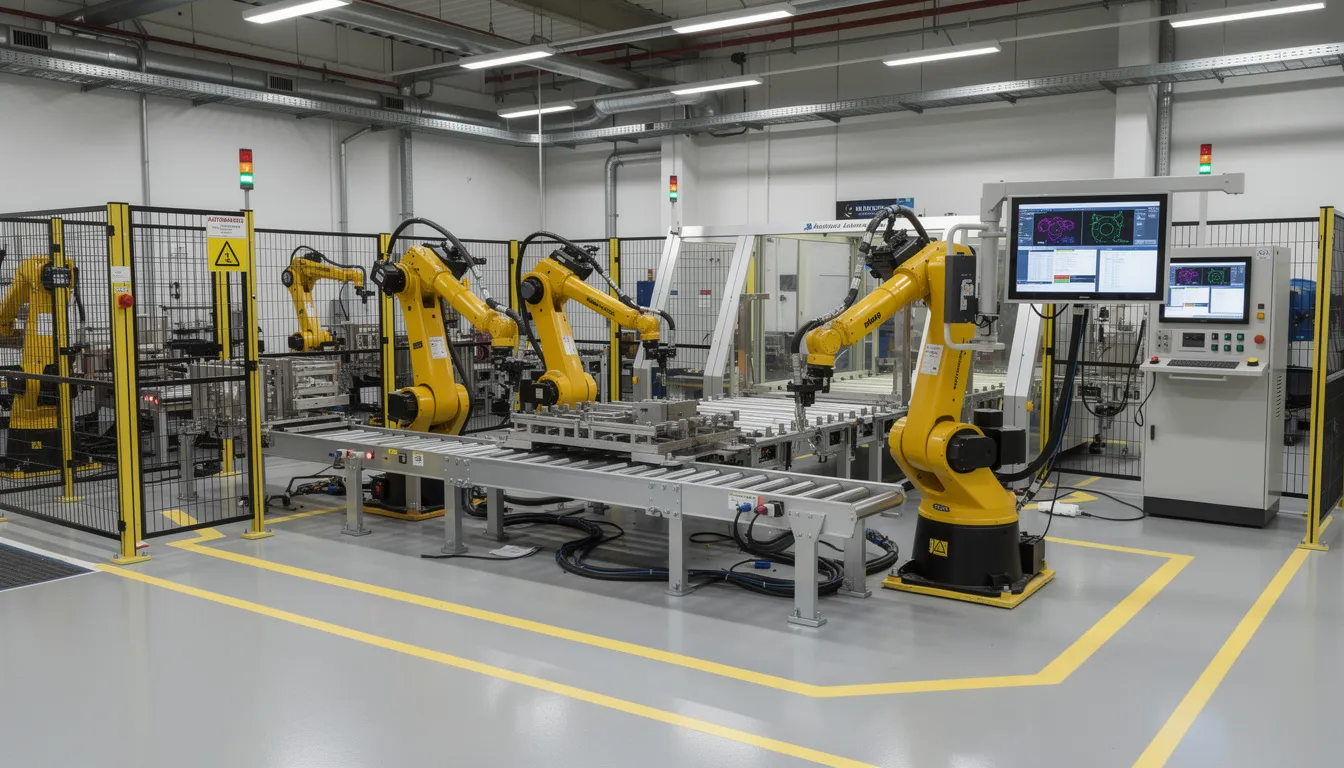
CMMC does not “certify” or “approve” manufacturing execution systems as products, but it does directly affect how MES is deployed, configured, secured, and governed in any environment that handles Controlled Unclassified Information (CUI) or supports DoD contracts. The obligations sit with the organization and its systems boundary, not the MES vendor. In practice, if MES touches CUI, connects to systems that process CUI, or supports contract performance, its design and operation must satisfy the relevant CMMC practices. You cannot treat MES as out-of-scope just because it is a production system rather than a traditional IT application.
CMMC impacts MES wherever it stores, processes, or transmits information related to DoD work, such as digital work instructions, NC/CAPA records, configuration data, or genealogy/traceability records tied to defense programs. It also applies when MES is tightly integrated with systems that clearly fall in scope, such as ERP, PLM, QMS, or document control handling CUI. Even when MES itself holds minimal CUI, it can still be in scope as a critical system supporting contract performance or as a pathway into in-scope networks. As a result, CMMC considerations usually cover user access, role design, authentication methods, logging, integration interfaces, and change control for MES.
In practice, this connects to shop floor execution control when teams need to turn the answer into repeatable execution habits.
From a CMMC perspective, MES user and role management must align with access control and identification/authentication requirements across the broader environment. That typically means enforcing least privilege in MES roles, time-bound access for temporary users, and timely revocation when personnel changes occur. Depending on your boundary design and MES capabilities, you may need central identity (e.g., directory or SSO) or compensating controls if native MES functions are limited. You should also expect to document how MES access controls are managed, audited, and periodically reviewed, and how that ties into your formal account management procedures.
Many MES platforms provide detailed audit trails for quality and regulatory purposes, but these are not automatically sufficient for CMMC. You need to confirm which events are logged (logins, failed logins, privilege changes, configuration changes, and integration activity) and how those logs are retained, protected, and correlated with other security logs. Some plants will need additional tooling to centralize or normalize MES logs for security monitoring, which can be non-trivial in older or proprietary systems. Where MES logging is weak or opaque, you may need network-level monitoring or procedural controls to partially compensate. You should also define how MES events feed your incident response process and how you would reconstruct a timeline if a compromise occurred.
CMMC has direct implications for how MES is connected to the rest of the environment, especially when it spans IT and OT networks. You will likely need clear segmentation between production equipment, MES servers, and corporate or cloud systems, with controlled interfaces for data exchange. Legacy integrations (e.g., flat-file shares, open database links, hard-coded credentials) often present issues under CMMC and may require rework or compensating controls. Because MES typically integrates with ERP, PLM, QMS, SCADA, historians, and test stands, each interface needs to be evaluated for data classification, authentication method, encryption, and change control. The more tightly coupled and undocumented the integrations, the harder it is to show that the overall system meets CMMC expectations.
Manufacturing environments often run MES platforms for a decade or more, with heavy customization and regulated validation burdens. CMMC requirements do not remove those realities, but they add another layer of constraints on how and when you can change MES configurations, interfaces, or infrastructure. Security-driven changes (e.g., stronger encryption, new authentication, extra logging) may require regression testing, validation, and production downtime, which has real cost and scheduling impacts. This is one reason why aiming for a full rip-and-replace of MES “for CMMC” usually fails in aerospace-grade environments: the combined validation, qualification, downtime risk, and integration rewrites become impractical. Incremental hardening and containment architectures are more realistic than wholesale system replacement.
If your MES is cloud-based or vendor-hosted, CMMC still applies to how that service is used and integrated, and you remain responsible for your compliance posture. You will need clear contractual terms and technical evidence around where data resides, how access is controlled, how logs are exposed, and how incidents are handled. Multi-tenant architectures can complicate boundary definitions and may make it harder to get the level of transparency some CMMC assessors expect. Even if the vendor markets themselves as “built for CMMC” or “CMMC ready,” that does not transfer compliance to you or guarantee an assessment outcome. You must still design your overall environment, network paths, and procedures so that the MES service fits coherently into your CMMC boundary.
Whether MES is explicitly in your CMMC assessment scope depends on your defined system boundary and data flows, but in most defense-related plants some part of MES ends up in scope. Treating MES as out-of-scope while it holds production records, routing data, or work instructions tied to CUI is unlikely to withstand scrutiny. A more sustainable strategy is to map which MES functions and integrations actually touch CUI or critical processes, then prioritize controls and hardening there. For segments of MES that do not handle CUI, containment and clear separation can help limit the scope and reduce the breadth of required changes. All of this needs to be backed by current architecture diagrams, data flow documentation, and traceable decisions about what is in or out of the CMMC boundary.
In a brownfield manufacturing site with a long-lived MES and multiple legacy integrations, you should assume some level of rework will be needed to align with CMMC, but not necessarily a wholesale MES replacement. The realistic path usually involves tightening MES access control, tuning audit trails, segmenting networks, formalizing integration patterns, and bringing MES changes under stronger configuration and change management. You will also need to accept that some older components cannot be made fully compliant and instead require compensating controls and risk documentation. Success depends less on picking a “CMMC-ready MES” and more on understanding your existing MES footprint, its connections, and the extent to which it touches CUI or contract performance data.


Whether you're managing 1 site or 100, Connect981 adapts to your environment and scales with your needs—without the complexity of traditional systems.



Whether you're managing 1 site or 100, Connect981 adapts to your environment and scales with your needs—without the complexity of traditional systems.