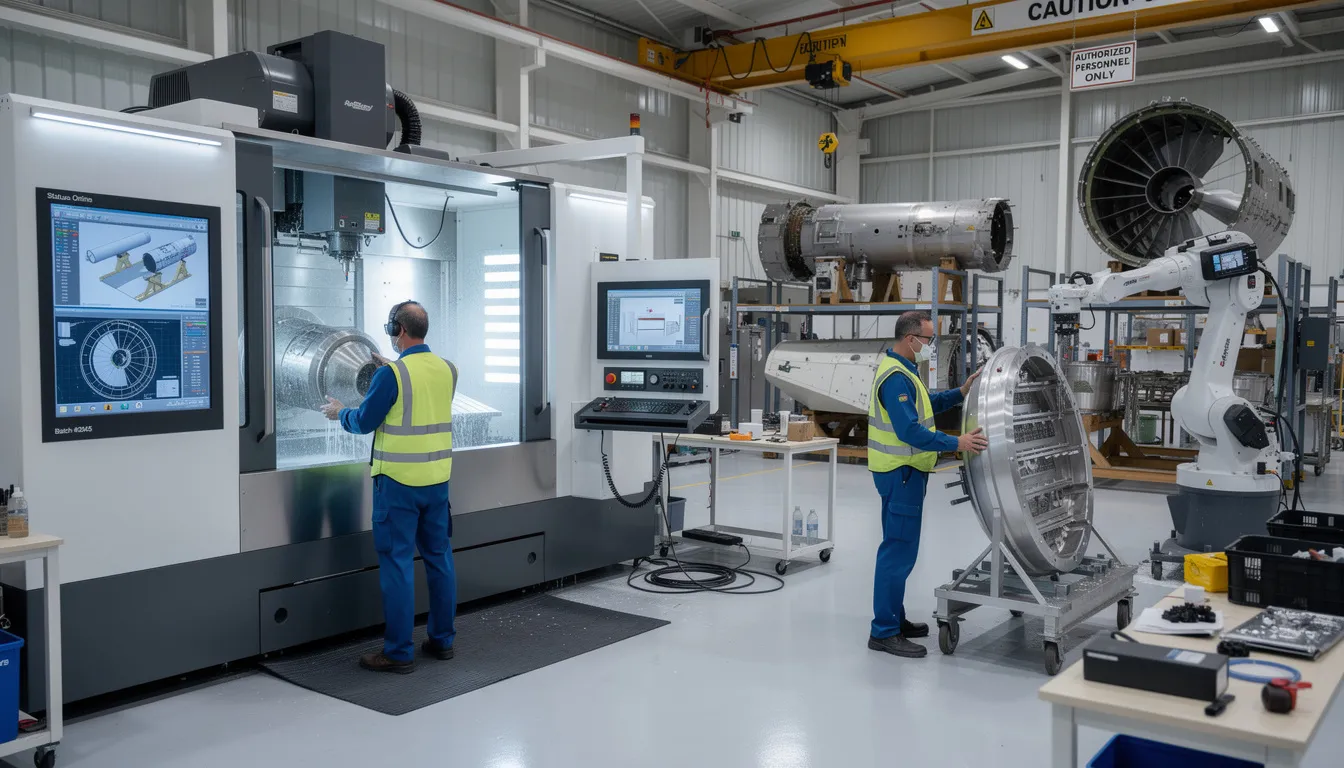
Special processes such as heat treatment and non-destructive testing (NDT) affect scrap rates in two different but related ways:
- They can create or worsen defects that drive scrap (especially heat treatment).
- They often reveal defects late in the route, so each failure carries a high scrap cost (especially NDT).
How heat treatment drives scrap
Heat treatment is both a transformation step and a risk amplifier. It changes material properties and can introduce nonconformances that are difficult or impossible to rework within spec. Typical scrap drivers include:
In practice, this connects to scrap and rework reduction when teams need to turn the answer into repeatable execution habits.
- Distortion and dimensional out-of-tolerance: Warping, growth, or shrinkage can push critical features outside tolerance. This is common for long, thin, or asymmetrical parts and assemblies. Poor fixturing, inconsistent load configuration, or unvalidated recipes increase risk.
- Nonconforming hardness or strength: Incorrect soak time, temperature control issues, quench delay, or furnace uniformity problems can lead to under- or over-hardening. Often this cannot be fully corrected without violating route or specification limits, especially in regulated sectors.
- Microstructural defects: Improper heat treat can cause undesirable phases, grain growth, decarburization, or case depth issues. These are typically caught via metallography or hardness mapping and usually result in full-part scrap.
- Surface and quench-related damage: Cracking, quench burns, scaling, and intergranular attack can convert high-value, nearly finished parts into scrap late in the process.
- Batch effects: A single furnace load, if processed out of spec, can simultaneously scrap a large group of parts. This magnifies the impact of any control or operator error.
The net effect is that heat treatment tends to increase the probability of scrap per part and, when something goes wrong, can drive large batch scrap events. Because it usually happens late in the route, the financial and schedule impact per scrapped part is high.
How NDT influences scrap
NDT (e.g., radiography, ultrasonic testing, penetrant, magnetic particle, eddy current) generally does not create defects, but it does change when and how you see them:
- Late discovery of defects: In many routes, NDT is scheduled near final inspection or post-heat treat. Any defect detected at this point often leads to scrap after significant value has already been added.
- Increased detection sensitivity: A more capable or stricter NDT process will identify defects that previously passed. Apparent scrap rates may rise, even though the underlying process quality is unchanged. This is often misinterpreted as “NDT is causing scrap” when it is actually exposing upstream issues.
- Operator and interpretation variability: Borderline indications and interpretation differences can push parts into scrap instead of rework. Inconsistent techniques, lighting, calibration, and qualification can change the “effective” scrap rate over time.
- Specification creep: Customer or internal demands for tighter acceptance criteria, more coverage, or additional NDT methods can raise the number of nonconforming findings, again shifting apparent scrap rates.
Practically, NDT controls the timing and visibility of scrap. Where NDT is the final gate, it concentrates scrap at the most expensive point in the route and can expose systemic issues in casting, welding, forging, machining, or heat treatment.
Interactions between heat treatment and NDT
The impact of these processes on scrap rates is often coupled:
- Heat treatment makes latent issues visible: Quenching or thermal cycling can open up microcracks or amplify defects formed in upstream steps. NDT after heat treat will then show an apparent spike in defects, even though the root cause lies earlier.
- NDT placement changes where scrap shows up: If NDT is moved earlier (e.g., pre-heat treat), some defective parts are removed before expensive downstream processing. If it is only post-heat treat, the same defects convert into high-cost scrap.
- Feedback loops often break: In brownfield environments, NDT findings are not always tightly linked back to furnace loads, recipes, fixtures, or heat treat equipment conditions. Without that feedback and traceability, the same special-process issues quietly drive repeat scrap.
Key factors that determine actual scrap impact
The true influence of heat treatment and NDT on scrap rates varies significantly by plant, product, and regulatory context. It depends on:
- Process capability and validation: High-capability, well-validated special processes (qualified procedures, equipment, and personnel) typically have lower scrap, but require substantial up-front qualification, periodic requalification, and disciplined change control.
- Fixture and load design: Stable, validated fixturing and load patterns reduce distortion and variability in heat treatment. Poor fixture design can dominate scrap drivers even when furnace controls are nominally in spec.
- Route design and NDT placement: Where NDT sits in the routing directly affects the cost per scrap event. Multiple NDT gates or in-process checks might reduce late scrap but add capacity and cost burdens.
- Integration and data quality: In mixed MES/ERP/QMS environments, the ability to link NDT results, scrap records, and special-process parameters (load, recipe, equipment, operator, calibration status) is often limited. This weakens root cause analysis and slows scrap reduction.
- Rework allowances and specifications: Some heat treat and NDT-related nonconformances can be reworked (e.g., re-heat treat within limits, local repair plus re-test), but regulated sectors often constrain this. The tighter the specification and rework rules, the higher the scrap share.
- Outsourcing vs in-house: External heat treaters or NDT providers add logistics time, queueing, and communication gaps. Scrap can be harder to trace back to specific process conditions without robust data exchange and supplier controls.
Typical scrap patterns in regulated, long-lifecycle environments
In aerospace, defense, medical devices, and similar sectors, several patterns are common:
- Scrap spikes tied to special-process changes: New heat treat recipes, furnace repairs, or NDT technique changes can cause temporary spikes in scrap. Inadequate revalidation and change control make this worse.
- Chronic, low-level special-process scrap: Even well-run operations see a persistent background level of scrap linked to distortion, hardness variation, or NDT indications. Eliminating this entirely is rarely realistic; the focus is on reducing and containing it.
- High-cost late scrap events: A single furnace excursion or systematic NDT mis-setup can affect many high-value parts. Recovery is often limited by specification and certification requirements, so the financial impact is disproportional.
Full replacement of existing heat treat or NDT systems is rarely a quick solution to scrap issues in these environments. New furnaces or NDT platforms typically require significant qualification, correlation, and validation effort, plus downtime and integration risk. Many organizations instead focus on improving recipes, fixturing, calibration, data capture, and feedback loops on their existing assets.
Practical ways to manage scrap from heat treatment and NDT
To influence scrap rates in a controlled way, many plants focus on:
- Improving traceability between part genealogy, furnace loads, recipes, NDT results, and scrap records, even across mixed MES/ERP/QMS and external processors.
- Analyzing scrap by special-process context, not just part number, so that patterns by furnace, operator, shift, or NDT technique become visible.
- Adjusting route design to pull at least some NDT earlier in the process where feasible, balancing cost, capacity, and regulatory constraints.
- Strengthening change control and revalidation for any modifications to heat treat parameters, fixtures, NDT techniques, or acceptance criteria.
- Targeted capability improvements (e.g., better fixturing for distortion-prone parts, refined quench practices, or more consistent NDT setups) driven by structured root cause analysis rather than ad hoc fixes.
The net effect is that special processes themselves may not be the sole root cause of scrap, but they are critical leverage points. Their control, validation, and integration with upstream and downstream steps strongly influence both the quantity of scrap and its timing and cost.