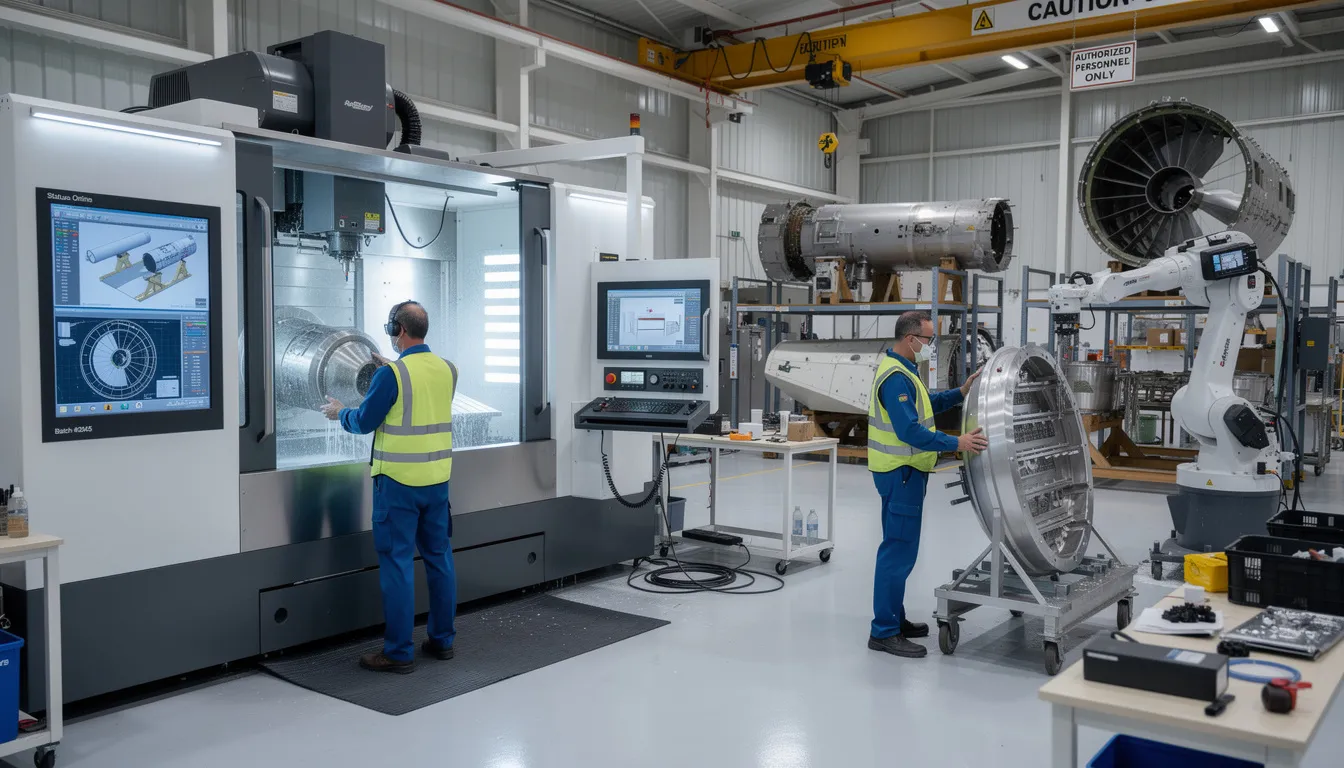
AS9100 applies to small aerospace machine shops primarily through customer requirements and flowed-down controls, not automatically through regulation. Many small shops operate under AS9100-based requirements from primes and Tier 1s, whether or not they pursue formal AS9100 certification.
1. Applicability: requirements vs certification
AS9100 is a voluntary aerospace quality management standard. For a small machine shop:
In practice, this connects to AS9100 compliance when teams need to turn the answer into repeatable execution habits.
- Requirements apply when customers reference AS9100 in purchase orders, quality clauses, supplier manuals, or long-term agreements.
- Certification is customer- or market-driven: you usually seek certification only if key customers require it or you want access to higher-tier work.
- Being uncertified does not remove obligations: if a PO or supplier quality agreement says you must follow AS9100-derived controls (e.g., traceability, FAI, configuration control), you are contractually responsible.
In practice, many small shops:
- Run an ISO 9001-style system plus customer-specific aerospace clauses, or
- Incrementally align with AS9100 over time before deciding on full certification.
2. Core AS9100 expectations for small machine shops
Whether certified or not, a small aerospace machine shop will typically be expected to show:
- Documented processes for quoting, contract review, purchasing, machining, inspection, packaging, and shipping.
- Configuration and revision control for drawings, models, work instructions, and CNC programs, including controlled updates and version history.
- Risk- and change-aware planning of jobs: capacity, special processes, qualification, and inspection balanced against due dates and constraints.
- Control of externally provided processes (e.g., heat treat, plating, NDT) including approved suppliers, purchase order requirements, and cert review.
- Product identification and traceability appropriate to part criticality: lots, serials, material heat lots, and sometimes operator/machine traceability.
- First Article Inspection (FAI) to AS9102 or customer-equivalent for new parts, drawing revisions, or key process changes when specified.
- Inspection and test controls: calibrated gages, defined sampling plans, documented acceptance criteria, and recorded results.
- Nonconformance and corrective action: clear MRB authority (internal or customer), controlled use of rework/repair, and basic RCCA when problems recur.
- Training and competency evidence for machinists, inspectors, and programmers, including authorization for key inspections or special processes.
- Internal audit and management review at a scale appropriate to the shop size, with follow-up actions tracked.
3. What “scaled” AS9100 looks like in a small shop
AS9100 allows proportionality: a 15-person shop is not expected to mirror a prime contractor’s bureaucracy. However, customers and auditors still expect that:
- Processes are defined, repeatable, and documented, even if they are simple.
- Controls are right-sized but effective, not ad hoc or person-dependent.
- Evidence is retrievable in a reasonable time: travelers, certs, NC records, audits, and training files.
Typical practical approaches for a small machine shop:
- A compact quality manual that references a small set of core procedures.
- Paper or basic digital travelers to carry requirements, inspection points, and signoffs across the floor.
- A simple job file structure (physical folders or a shared drive) with consistent contents: PO, drawing, revision notes, setup sheets, certs, FAI, and inspection data.
- Basic ERP or job-tracking software plus spreadsheets, with attention to version control and backups.
4. Common gaps when primes benchmark small machine shops
When large customers assess small shops against AS9100 expectations, they often find:
- Poor drawing and CNC program control: no formal revision tracking, outdated programs used by mistake, tribal knowledge edits not documented.
- Weak traceability: part marking inconsistencies, missing link between finished parts, raw material, and certs.
- Inconsistent FAI practice: partial or incomplete AS9102 forms, unverified ballooning, or FAIs not updated after significant changes.
- Nonconformance handling via informal rework, with limited documentation, unclear MRB authority, and no systemic corrective actions.
- Calibration gaps: no clear recall system, missing records, or shop-made gages used without validation.
- Internal audits done rarely or superficially, often just before customer or certification audits.
These are frequently the difference between “good machining” and “AS9100-conformant system.”
5. Brownfield reality: coexisting with existing systems
Most small shops run on established processes and low-complexity systems: a legacy ERP or accounting package, paper routers, and manual filing. Aligning with AS9100 in this context usually means tightening controls around what already exists, not replacing everything with a new system.
Typical coexistence patterns:
- ERP + paper travelers: keep the ERP for order entry and inventory, but formalize traveler content, signoffs, and retention. Add unique IDs to link travelers with digital job folders.
- Shared drive job folders: apply basic document control (read-only released drawings, revisioned filenames, controlled access) rather than introducing a full PLM system.
- Incremental digital work instructions: start with digital PDFs for complex setups while keeping simpler jobs on paper, documenting the governance for both.
Full replacement of ERP, introduction of a large MES, or a full PLM stack is rarely practical for a small shop due to cost, downtime risk, and the overhead of re-qualifying workflows. Incremental, well-documented changes are usually more realistic and easier to keep aligned with AS9100 and customer expectations.
6. When does it make sense to pursue AS9100 certification?
For a small machine shop, the decision to seek certification is usually shaped by:
- Customer mandates: a key customer requires AS9100 certification for existing or future work.
- Target market: seeking more complex or higher criticality aerospace work where buyers look for certified suppliers as a screening criterion.
- Internal readiness: management’s willingness to support audits, internal QMS maintenance, and formal change control on processes and documentation.
Tradeoffs to consider:
- Benefits can include easier supplier approvals, clearer internal processes, better defect and scrap visibility, and potentially less intense customer oversight once the system is stable.
- Costs and risks include audit fees, internal time for documentation and evidence, added formality around changes, and the risk of over-complex procedures that operators cannot realistically follow.
For many small shops, a phased approach is practical: first make sure the current system reliably meets customer clauses; then align procedures with AS9100; then, only if justified, engage a certification body.
7. Practical steps to align a small shop with AS9100 expectations
Without offering legal or certification advice, some pragmatic moves often help small machine shops align with AS9100-style requirements:
- Clarify customer-specific requirements: build a simple matrix by customer listing FAI, traceability, special process, and documentation expectations.
- Stabilize configuration control: define how drawings, models, CNC programs, and setup sheets are released, changed, and retired, and who is authorized.
- Strengthen travelers and job packets: ensure every job has clear requirements, revision, key characteristics, special processes, and inspection checkpoints documented.
- Formalize NC and MRB: document how nonconformities are identified, dispositioned, communicated to the customer when required, and trended.
- Institute a basic internal audit plan: cover the highest-risk processes at least annually, and document follow-up actions.
8. Key dependencies and limitations
How AS9100 applies in detail will depend on:
- Contract language and flowed-down requirements from primes and Tier 1s.
- Part criticality (flight safety, structural, engine vs non-critical hardware) and associated traceability and control demands.
- Existing process maturity: ad hoc, operator-dependent processes are much harder to align than already-documented workflows.
- Integration quality between any existing ERP, scheduling tools, and document repositories. Weak integration increases the risk of using the wrong revision or losing traceability.
No general statement can guarantee compliance, certification, or specific audit outcomes; each shop’s situation is determined by its customers, contracts, and how consistently it executes and documents its system.