Integrating ISO 27001 (information security management) with AS9100 (aerospace quality management) can reduce duplication, but it introduces non-trivial challenges, especially in brownfield, highly regulated manufacturing environments. The two standards are compatible in principle, yet they focus on different risk domains and operate on different technical realities on the shop floor.
1. Different primary risk focus and language
AS9100 is centered on product quality, safety, and regulatory conformity across the lifecycle of aerospace products. ISO 27001 is centered on confidentiality, integrity, and availability of information. When integrating, organizations often struggle with:
- Different risk lenses: AS9100 risk thinking is often focused on nonconforming product and process failures, while ISO 27001 is focused on information assets, threat actors, and cyber events.
- Terminology gaps: “Information asset,” “threat,” and “vulnerability” mean little to many production-focused stakeholders, while quality terms have less meaning to security teams.
- Ownership conflicts: Quality usually owns AS9100; IT / security usually owns ISO 27001. Integrating into a single management system requires clear governance boundaries.
If these perspectives are not reconciled deliberately, you tend to get parallel systems that share documents but not a common understanding of risk.
2. Aligning risk assessment and risk treatment
Both standards require structured risk assessment and treatment, but with different emphasis and tooling. Challenges include:
- Different risk models: AS9100 often uses FMEA-type approaches and product/process risk matrices. ISO 27001 uses asset–threat–vulnerability models mapped to Annex A controls.
- Single vs multiple risk registers: A forced single register can become unusable if it mixes deeply technical cyber risks with process and supplier risks without clear structure.
- Risk acceptance criteria: The organization may tolerate higher cyber risk than product safety risk, or vice versa. Integrating systems requires explicit, documented criteria for each domain.
Practically, many organizations keep separate but linked risk registers (quality/process vs information security) and define how risks interact, rather than trying to force one blended model.
3. Overlapping documentation and document control
Both standards require documented policies, procedures, and records under robust document control. In brownfield environments with legacy QMS and IT documentation, integration challenges include:
- Redundant procedures: Separate change control, incident handling, and supplier evaluation procedures for quality vs. security are common. Integrating them without breaking existing approvals and training can be difficult.
- Fragmented repositories: QMS documents may live in a validated document control system, while ISO 27001 policies live in IT tools or file shares. Harmonizing without revalidating everything is a recurring issue.
- Traceability and versioning: When a common procedure is used as evidence for both standards, change control and traceability need to satisfy both sets of auditors, which increases documentation rigor and review overhead.
Organizations often choose a single controlled repository for top-level policies and processes, while allowing domain-specific work instructions and technical configs to remain in specialized systems, linked by references.
4. Integrating internal audit and management review
Both standards require internal audits and management reviews. Integration saves effort but introduces complexity:
- Audit competence: Auditors who are strong in AS9100 may not be competent to audit information security controls, and vice versa. Trying to use the same small team for all topics can create superficial audits.
- Scope and sampling: A combined audit program must cover both production processes and information security controls (e.g., backup, access management, SOC processes). Proper sampling across both domains is harder to plan.
- Management review content: A combined review must address quality KPIs and information security performance (incidents, vulnerabilities, control test results). That requires cross-functional input and more structured preparation.
Many organizations adopt partially integrated audit programs, with joint planning and reporting but domain-specific audit execution where specialist knowledge is needed.
5. Applying ISO 27001 controls to shop-floor and OT environments
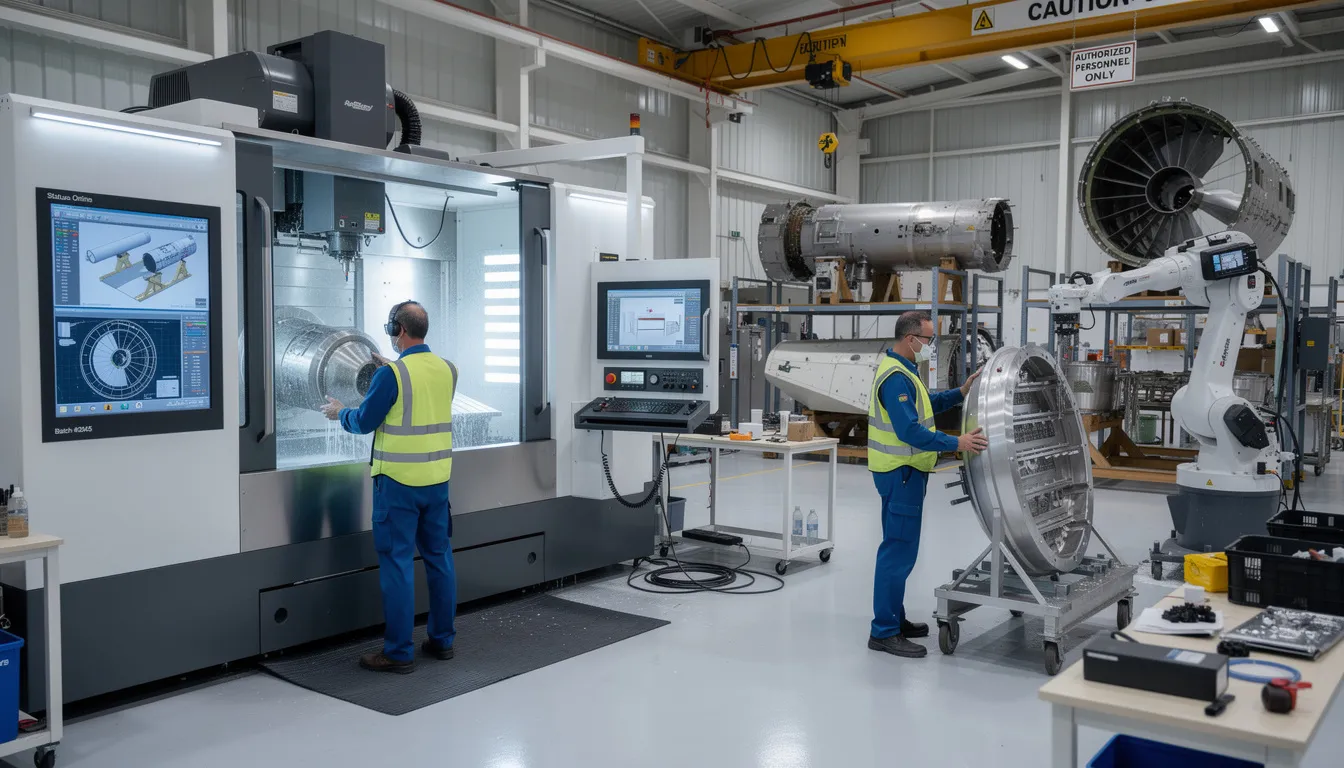
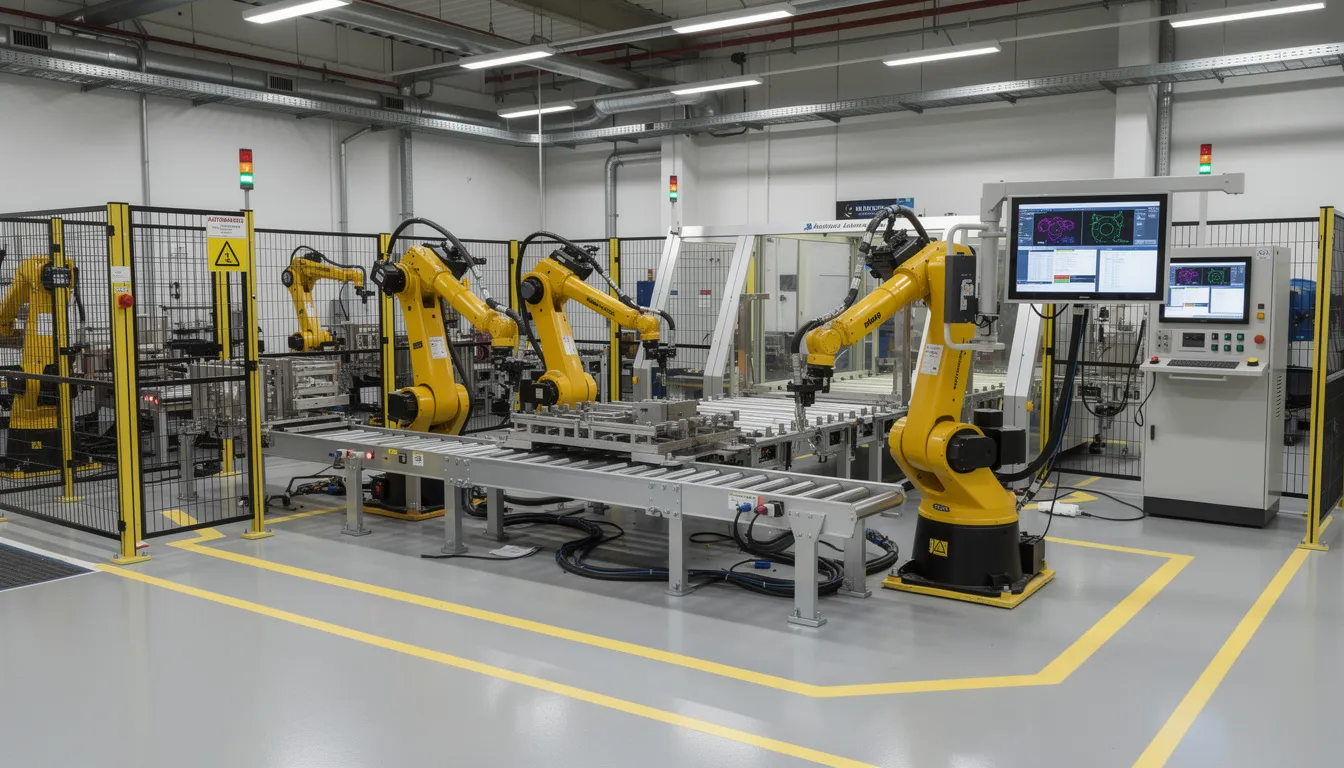
The largest practical challenge in industrial and aerospace manufacturing is mapping ISO 27001 controls to operational technology (OT) and production systems that are already constrained by AS9100 requirements and long lifecycles:
- Legacy equipment: Plant assets may run unsupported operating systems, vendor-locked configurations, or certified software that cannot be changed without requalification and downtime risk.
- Validated / qualified states: In aerospace and other regulated sectors, making cyber-hardening changes can trigger requalification, validation, or at minimum new evidence for configuration control and process capability.
- Availability vs. security tradeoffs: ISO 27001 controls that look straightforward in IT (e.g., aggressive patching, network segmentation, strict access lockouts) can disrupt production, test systems, or calibration processes if not adapted carefully.
In practice, many organizations implement ISO 27001 with explicit scoping decisions that limit the treatment of some OT risks, documenting compensating controls (monitoring, physical controls, procedural checks) where technical changes are not feasible without unacceptable production or compliance impact.
6. Supplier, outsourcing, and data-sharing challenges
Both standards have requirements around suppliers and external providers, but with different emphases:
- AS9100: Focus on supplier quality, configuration control, flow-down of technical requirements, and traceability of materials and processes.
- ISO 27001: Focus on third-party access to information, confidentiality, and security controls for service providers (including cloud, IT outsourcing, and data centers).
Integrating these perspectives raises issues such as:
- Contract language: Existing aerospace contracts and quality clauses may not include security requirements for handling design data, test data, or production data. Updating contracts at scale is slow and can face supplier pushback.
- Supplier segmentation: Some suppliers are critical to product quality but have limited access to information; others handle sensitive design data but have minimal product impact. A single unified supplier risk model can obscure these differences.
- Evidence collection: Quality often relies on certificates of conformity, process audits, and PPAP-like evidence, while security may require SOC reports, penetration test summaries, or security questionnaires. Maintaining both can be resource intensive.
Practically, many organizations build a coordinated but dual-lens supplier program, where quality and security each have defined responsibilities but share a common supplier master data set and risk tiering.
7. Change control across quality and security domains
Both standards place strong emphasis on controlled change, but the drivers differ. Integrating them in a brownfield environment introduces specific hurdles:
- Security-driven changes: Security teams may need to make urgent changes (e.g., blocking ports, patching a vulnerability, altering access) that affect validated test rigs, NC machines, or inspection systems that are subject to AS9100 controls.
- Engineering-driven changes: Product or process changes may require new information flows, access patterns, or tools that alter the information security risk profile.
- Multiple change boards: Parallel CABs (Change Advisory Boards) for IT and MRBs/ECBs for engineering/quality can cause misalignment or delays if not coordinated.
The integration challenge is to define when a change must be evaluated under both frameworks, how impact is assessed, and how evidence is captured to satisfy both sets of requirements without paralyzing operations.
8. Evidence, audit trails, and tool integration
In mixed MES/ERP/PLM/QMS stacks with long equipment lifecycles, evidence management is a recurring pain point:
- Fragmented systems: Quality evidence often resides in QMS, MES, and PLM; security evidence resides in ticketing tools, SIEM, or identity platforms. Aggregating evidence for combined audits is labor-intensive.
- Validation burden: Replacing or centralizing tools (e.g., moving all CAPA and incident management into one platform) can trigger validation and qualification work that is costly and risky.
- Traceability across domains: A single event (e.g., cyber incident affecting an inspection station) may require both an information security incident record and a nonconformance / CAPA record. Linking those traces in a defensible way is a real integration challenge.
Most organizations end up with an integrated management system at the process and governance layer, while accepting that underlying tools will stay heterogeneous for the foreseeable future. Interfaces and cross-references become more realistic than total system replacement.
9. Cultural and organizational challenges
Beyond the technical aspects, integration depends heavily on culture and roles:
- Competing priorities: Production and quality teams may see security controls as obstacles to throughput; security teams may underestimate constraints from validation and aerospace qualifications.
- Training overload: Staff can experience fatigue from overlapping trainings (quality, safety, security, export controls), particularly if content is not harmonized.
- Leadership focus: If top management treats ISO 27001 as an IT issue and AS9100 as a quality issue, the integrated system will be nominal only, with limited cross-domain decision-making.
Deliberate cross-functional governance (e.g., a joint quality & security steering group) is usually needed to make tradeoffs explicit and recorded.
10. Why full replacement strategies usually fail here
Some organizations attempt to solve integration by replacing legacy QMS, MES, and security tooling with a single new platform. In aerospace-grade and similar contexts, this often fails or stalls because:
- Qualification and validation burden: New tooling must be qualified, integrated, and often revalidated to satisfy both quality and regulatory expectations, which is expensive and time-consuming.
- Downtime and cutover risk: Replacing systems that control production or manage aerospace product records carries substantial downtime and traceability risks.
- Integration complexity: Existing interfaces to ERP, PLM, lab systems, and test rigs are typically brittle and bespoke; rebuilding them is non-trivial.
Incremental integration of processes and evidence, while leaving core legacy systems in place and under control, is usually more realistic than a big-bang replacement when aligning ISO 27001 with AS9100.