An Industry 4.0 course is a structured training program that explains how digital technologies are applied in manufacturing and industrial operations. In practice, it should cover how connectivity, data, analytics, and automation change day-to-day work in production, quality, and engineering, not just buzzwords like IoT or AI.
Typical topics in an Industry 4.0 course
Most courses will address some mix of:
In practice, this connects to a connected execution platform when teams need to turn the answer into repeatable execution habits.
- Connectivity and data collection: Industrial networking basics, OPC UA, IIoT gateways, historian concepts, and how to extract data from CNCs, PLCs, test stands, and legacy cells.
- Data platforms and integration: How shop-floor data can be linked to MES, ERP, QMS, PLM, and LIMS, and why integration architecture and master data quality matter.
- Analytics and AI: Use of dashboards, OEE analytics, anomaly detection, predictive maintenance, and limitations when data is sparse, noisy, or unstructured.
- Digital workflows: Electronic work instructions, eDHR/eBR, digital logbooks, defect capture, and basic concepts like traceability and genealogy.
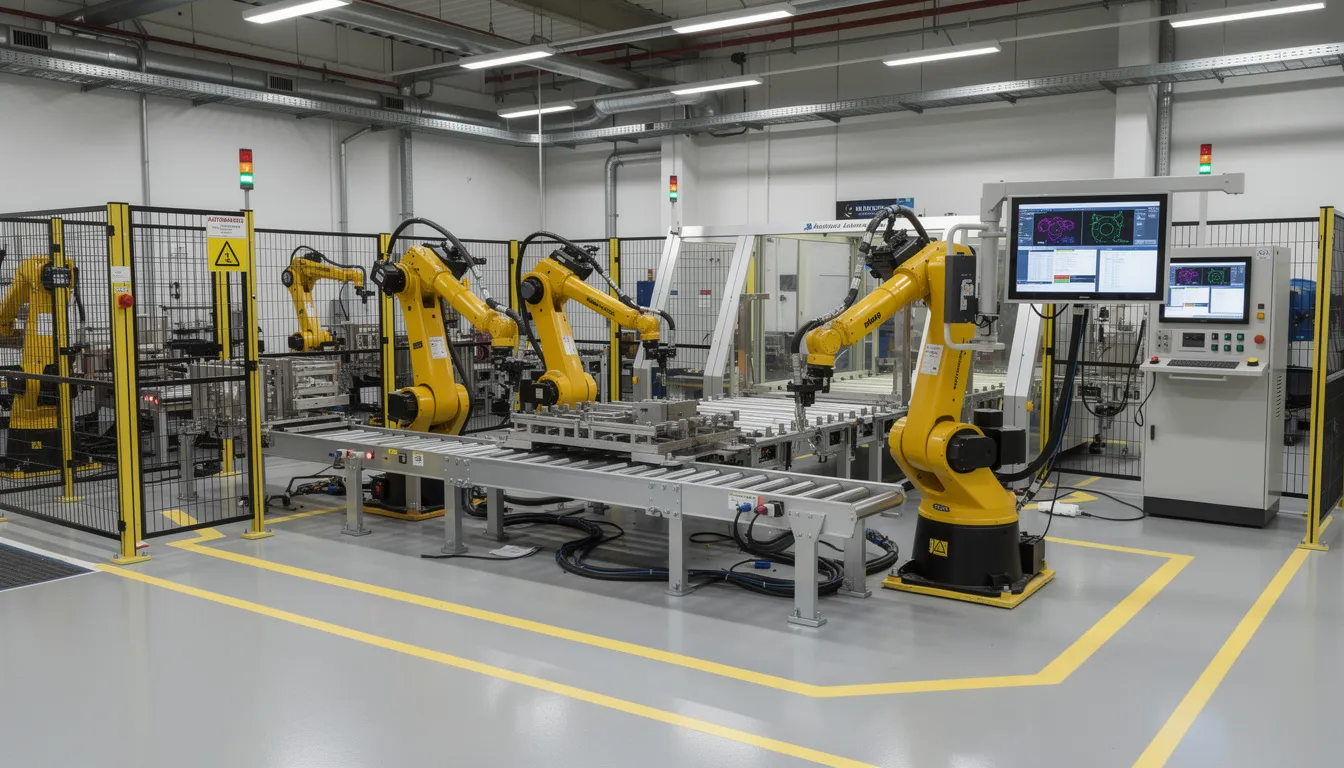
- Automation and cyber-physical systems: Collaborative robots, automated material handling, and how they interact with safety systems and quality controls.
- Cloud and edge computing: Tradeoffs between running workloads on-premises vs in the cloud, with attention to latency, security, and plant IT constraints.
- Change management and organization: Skills, roles, and governance needed to make digital projects stick rather than remain pilots.
What matters in regulated, brownfield environments
For aerospace, medical, defense, or similar regulated sectors, a generic Industry 4.0 course is often too optimistic or greenfield-focused. To be practically useful, it should explicitly address:
- Validation and qualification impact: How new digital tools affect equipment qualification, software validation, and documented testing. A course should not imply that any technology is “compliant” by default.
- Change control and traceability: How configuration changes to MES, data pipelines, or analytics models are controlled, documented, and traceable over long asset lifecycles.
- System coexistence: Strategies for layering new capabilities on top of legacy MES/ERP/QMS/PLM rather than trying to rip and replace, given downtime, integration, and requalification risks.
- Data integrity and auditability: How timestamps, user attribution, versioning, and access control are handled so that digital records can support investigations and audits.
- Cybersecurity in OT: Alignment with plant security controls, segmentation, remote access policies, and how to avoid introducing unmanaged devices on the network.
- Lifecycle planning: The reality that equipment, test systems, and validated software may stay in use for 10–20+ years, so solutions must accommodate that horizon.
Different types of Industry 4.0 courses
Depending on the audience, courses may be structured as:
- Executive or leadership overviews: Focused on strategy, portfolio selection, and governance. Useful for deciding where Industry 4.0 actually fits the plant roadmap.
- Technical deep dives: For OT/IT, process engineers, and data teams, covering architectures, protocols, reference designs, and common failure modes.
- Operations-focused training: Aimed at supervisors and engineers, centered on concrete use cases like digital work instructions, NCM management, OEE, and line monitoring.
- Vendor-specific programs: Training around a particular platform or product. These can be helpful but are often biased toward idealized implementations and may not fully cover integration, validation, or coexistence issues.
How to assess whether a course is actually useful
For plants with complex legacy systems and regulatory expectations, an Industry 4.0 course is more credible if it:
- Shows how to integrate with existing MES/ERP/QMS instead of assuming a greenfield stack.
- Discusses how to handle partial, inconsistent, or unstructured data and the impact on analytics quality.
- Addresses validation, documented testing, and change control as first-order topics, not afterthoughts.
- Uses realistic examples with constrained downtime, mixed vendors, and long-lived equipment.
- Separates what can be proven today from aspirational use cases or vendor roadmaps.
In short, an Industry 4.0 course should help your teams understand how digital tools fit your specific operational and regulatory constraints, not just teach generic concepts or promise full system replacement that is unlikely to be feasible in a brownfield, regulated environment.