
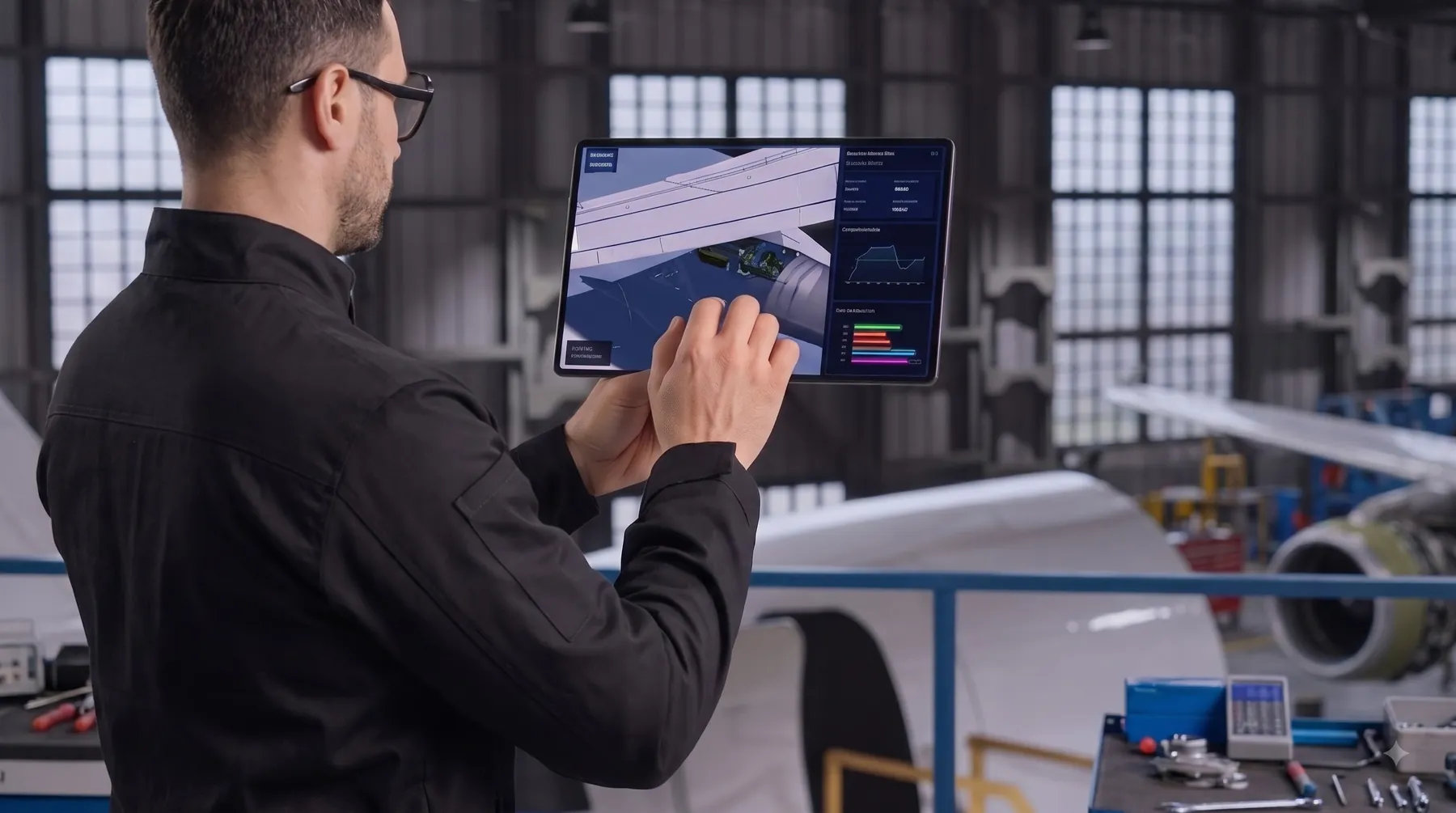
In aerospace manufacturing, identifying a part by number or serial alone is not enough. When a quality issue, supplier concern, or audit request surfaces, teams need to know exactly which raw material went into a component, which operations transformed it, which intermediate assemblies it joined, and which finished serialized unit ultimately received it. That full relationship chain is part genealogy.
Part genealogy is one of the most practical expressions of the digital thread in aerospace traceability. It links design definitions, manufacturing events, inspection evidence, operator actions, and quality dispositions into a usable as-built history. For regulated aerospace programs, that history supports containment, root cause analysis, airworthiness evidence, and customer confidence.
For teams putting this topic into daily operation, part genealogy and traceability, part traceability and as-built evidence, a connected execution platform help connect the concept to traceability, work-order reality, and audit-ready evidence.
The same operating model also depends on Connect981’s aerospace execution solutions, real aerospace execution examples, Connect981’s aerospace operations guidance, practical aerospace operations FAQs, especially when decisions have to move across quality, production, suppliers, and program leadership without losing context.
This article explains how aerospace manufacturers design and run part-level genealogy systems. The focus is not just on labeling or serial assignment, but on the data structures, shopfloor workflows, and system integrations required to prove what material and process history sits behind any given part number or serial number.
Why Part Genealogy Matters in Aerospace Programs
Regulatory and customer drivers for detailed genealogy
Aerospace programs operate under strict traceability expectations from regulators, primes, defense customers, and internal quality systems. Requirements may be interpreted through AS9100-aligned procedures, customer contracts, engineering specifications, and program-specific quality plans rather than one universal mandated genealogy format. Still, the operational expectation is clear: manufacturers must be able to trace what was built, from what, under which controlled process, and with what evidence.
This matters most where material pedigree, special process status, serialized installation, and configuration control affect safety or certification. A team may need to retrieve heat lot certifications, inspection records, tool histories, operator sign-offs, and nonconformance dispositions tied to a specific delivered unit. If those records exist but are not linked, retrieval becomes slow and unreliable.
Recent incidents highlighting genealogy gaps
Recent aerospace manufacturing failures have reinforced the cost of fragmented traceability. Public attention around assembly documentation gaps and supplier material record issues has shown that organizations can have large volumes of data while still lacking a trustworthy chain of relationships. In practice, genealogy breaks down when the industry cannot quickly answer questions such as: which exact assemblies used this suspect material batch, which serialized units passed through a rework loop, or where a removed and replaced component was reintroduced.
The risk is not only compliance exposure. Genealogy gaps increase containment scope, delay root cause analysis, and can force broad inspections when a narrow targeted response would otherwise be possible.
How genealogy underpins airworthiness and safety cases
Airworthiness decisions rely on evidence, not assumptions. Genealogy provides the as-built chain that connects a finished aircraft assembly or serialized component back to approved materials, controlled process steps, inspections, and deviations. For safety-critical hardware, that relationship map helps prove that the physical article conforms to the approved baseline or that any departures were formally dispositioned.
Without part genealogy, teams may know the intended configuration but not the real production path. In aerospace, that distinction matters.
Defining Part Genealogy in an Aerospace Context
Core entities: part numbers, revisions, serials, and configurations
At minimum, an aerospace part genealogy model needs to connect several core entities:
- Part number: the designed item definition
- Revision: the approved design state or manufacturing definition in effect
- Serial number: the unique identity of an individual unit where serialization applies
- Lot or batch: grouped material or production quantity where tracking is collective rather than unit-unique
- Work order or traveler: the execution container for manufacturing steps
- Operation record: evidence of what occurred at a process step
- Configuration context: the approved options, effectivity, substitutions, and dispositions that define what was acceptable for that build
The genealogy record is built from relationships among these entities. A serialized bracket may consume material from a specific titanium lot, pass through machining and inspection operations, get installed into a subassembly, be removed during rework, and then be replaced by another serialized unit. Good genealogy preserves each of those events.
Differences between genealogy, traceability, and configuration management
These concepts overlap, but they are not the same. Traceability is the broad ability to follow relevant records forward or backward across the lifecycle. Configuration management controls what the product definition should be at a given revision and effectivity. Part genealogy focuses on the actual parent-child relationships and execution history that describe how a specific unit was built.
A useful way to distinguish them is:
- Configuration management answers: What was approved?
- Traceability answers: Can we find the evidence?
- Genealogy answers: What exactly went into this specific built unit, and how did it get there?
This distinction is important because many organizations store identifiers and revisions but still lack the relationship modeling needed for true genealogy.
Typical genealogy depth for structures, engines, and avionics
Genealogy depth varies by product type and risk profile. Structural components may require strong linkage to raw material certs, heat lots, machining history, and special processes. Engine hardware often demands deeper control over serialized components, process parameters, inspections, and life-limited part histories. Avionics and electromechanical assemblies may add board-level or module-level traceability, software or firmware configuration references, and installation relationships into higher-level line replaceable units.
The practical rule is to capture genealogy deeply enough to support containment, compliance, and service-life decisions at the level the program actually manages risk.
Data Model for Aerospace Part Genealogy
Linking BOM structures to manufacturing routings
Aerospace genealogy starts with two different but related structures: the engineering bill of materials and the manufacturing routing. The BOM defines what should exist in the product. The routing defines how the product is built. A genealogy system must connect both.
That means the system should not only store that assembly A contains components B and C, but also which operation introduced B into A, under which traveler, at what revision, and with which inspection or sign-off. This becomes especially important when the same part number can be installed in different routing branches or when alternative approved process paths exist.
In practice, manufacturers often need a relationship model that ties:
- planned BOM parent-child relationships
- as-built installation events
- consumption of raw and intermediate materials
- inspection and test records
- nonconformance and rework events
Capturing parent-child relationships across operations
The core of aerospace part genealogy is the parent-child chain. Every time one item is consumed into another, transformed into a new state, or associated with an operation record, the system should create a relationship event. For serialized assemblies, that event should record the parent serial, child serial or lot, operation step, timestamp, operator or machine context, and applicable revision.
Consider a machined fitting produced from a controlled raw stock lot. The genealogy should show the raw material lot consumed into a work order, the resulting serialized fitting generated after machining, the anodize process linked by cert and load, final inspection acceptance, and installation into a higher assembly serial. This is more than inventory movement; it is a causal chain of manufacturing evidence.
Representing rework, splits, merges, and scrapped units
Many genealogy implementations fail because they assume a clean one-direction build path. Aerospace production rarely behaves that way. Real shops split lots, merge kits, replace damaged components, disassemble for inspection, scrap partial units, and route hardware through rework loops. The data model must support these realities explicitly.
Examples include:
- Split: one material lot yields multiple serialized or batched downstream units
- Merge: several child items combine into a serialized parent assembly
- Rework: an existing relationship is superseded but retained historically
- Removal and replacement: a child is de-installed from one parent and another child takes its place
- Scrap: a lineage branch terminates but remains searchable for audit purposes
Genealogy systems should preserve history rather than overwrite it. In aerospace, replaced relationships are often just as important as current ones.
Capturing Genealogy on the Shopfloor
Role of digital work travelers and MES in genealogy capture
Most genealogy data is created on the shopfloor, not in a conference room. Digital work travelers and MES workflows provide the execution layer where material consumption, operation completion, inspection results, and assembly events can be recorded in real time. If genealogy is left to retrospective manual compilation, completeness and accuracy usually degrade quickly.
A good traveler workflow prompts the operator or inspector to capture only the relationships that matter at that step: which serial was installed, which lot was consumed, which tool or machine was used where required, and whether any deviation occurred. This minimizes free-text dependence and makes the resulting genealogy more consistent.
Scanning, labeling, and station-level data entry practices
Reliable genealogy depends on disciplined identification practices. Aerospace manufacturers commonly use barcode or data matrix labels, traveler-driven scans, controlled serialization logic, and station-level validations to reduce data entry errors. The objective is not to force operators into excessive transactions, but to make the correct relationship capture the easiest available action.
Operationally, strong genealogy capture often includes:
- scan-to-consume material and component records
- forced serial verification before assembly closeout
- revision checks tied to active traveler steps
- inspection gates before parent-child commitment is finalized
- reason-coded rework and removal transactions
These controls are especially important in mixed-mode environments where some records still originate from paper, spreadsheets, or legacy terminals.
Ensuring operators record the right relationships without friction
The biggest implementation mistake is designing genealogy around ideal data models while ignoring operator workflow. If the system asks for too many fields, hides the purpose of each transaction, or requires duplicate entry across systems, users will work around it. Effective aerospace genealogy capture is selective and contextual.
For example, a station assembling serialized actuators may need to record child serial installation and torque sign-off, but not re-enter upstream material cert details already inherited through previous operations. The platform should expose what the operator must confirm, while preserving linked upstream evidence in the background.
Integrating Genealogy Across PLM, ERP, MES, and QMS
Using the digital thread to connect design intent to as-built history
Part genealogy becomes far more useful when it spans systems rather than living in a single application silo. PLM holds the design definition and revision logic. ERP manages orders, inventory, and supply transactions. MES or execution tools capture shopfloor events. QMS stores nonconformance, corrective action, and audit evidence. A practical genealogy capability depends on connecting these layers into one coherent relationship chain.
That is why manufacturers often treat genealogy as a specific operational layer within a broader digital thread in aerospace traceability strategy. The digital thread provides continuity across systems; genealogy provides the exact as-built parent-child lineage inside that continuity.
Synchronizing identifiers and revisions across systems
Integration problems usually begin with inconsistent identifiers. The same item may appear under a part number in PLM, an inventory code in ERP, a traveler reference in MES, and a quality record number in QMS. If those identities are not mapped consistently, the genealogy chain will fragment.
Manufacturers should define authoritative rules for part numbers, revisions, serial formats, lot IDs, operation codes, and supplier references. They also need event logic for when relationships are created, updated, superseded, or closed. Integration is not just about moving data; it is about preserving meaning across systems.
Handling changes to routings and alternative process paths
Aerospace programs rarely run one static routing forever. Engineering changes, concession paths, customer options, supplier shifts, and temporary rework instructions all affect how a part is built. Genealogy systems must record the actual executed path without losing the approved baseline context.
That means capturing both the planned route and the performed route, along with the authorization for any departure. If a serialized unit followed an alternate process path, the genealogy should show that clearly, including applicable approvals and resulting evidence. This prevents confusion during audits and gives root cause teams the context they need.
Using Genealogy for Containment, RCA, and Audits
Targeted recall and containment scenarios
The fastest proof of genealogy value often comes during containment. If a supplier cert issue, process drift event, or inspection escape affects a material lot or operation window, teams need to identify impacted units immediately. Strong genealogy allows them to query from the suspect source forward into all affected intermediate and finished assemblies, or backward from a delivered serial into all upstream contributors.
Without that capability, organizations often widen the containment scope to stay safe, increasing disruption and cost.
Leveraging genealogy in root cause and corrective action workflows
Genealogy also improves root cause analysis. When quality teams can compare failed units against unaffected units across material source, routing path, machine history, operator steps, rework events, and installed child components, patterns emerge faster. The genealogy chain provides structure for investigation instead of leaving teams to manually reconstruct history from disconnected files.
In corrective action workflows, genealogy helps verify exposure, determine recurrence risk, and confirm whether process changes need to apply to all units or only a defined lineage branch.
Producing audit-ready genealogy reports in hours, not weeks
Audit readiness is not just about storing records; it is about assembling evidence quickly and defensibly. A mature genealogy system can produce reports showing a serialized part’s upstream material pedigree, operation history, special process references, inspections, nonconformance dispositions, and assembly installation path with timestamps and approvals. That shortens response time for customer inquiries, regulator visits, and internal compliance reviews.
The goal is not a single giant report for every case. It is the ability to retrieve the right chain of evidence, on demand, with minimal manual reconciliation.
Implementing Part Genealogy with Connect981
Configuring genealogy capture in Connect981 workflows
Connect981 can support aerospace genealogy by acting as a connected operations layer between engineering, planning, execution, and quality systems. In practice, that means configuring workflow steps that capture parent-child installation, material consumption, inspection acceptance, rework events, and disposition history without requiring a full rip-and-replace of ERP or PLM.
Because many aerospace environments are hybrid, the value is often in orchestrating the relationship logic: prompting the right data capture on the floor, validating identifiers and revisions, and maintaining a searchable event chain across systems already in use.
Visualizing parent-child chains for complex assemblies
For complex assemblies, genealogy becomes difficult to use if it is only available as raw tables. Teams need visual lineage views that show where-used impact, upstream provenance, removed-and-replaced histories, and operation-level context. A usable interface helps quality, manufacturing, and engineering teams answer practical questions quickly instead of exporting records for manual reconstruction.
This is especially useful in serialized aerospace assemblies where a single issue can affect multiple build stages, suppliers, and quality records at once.
Rollout patterns for brownfield aerospace environments
Most aerospace manufacturers implement genealogy incrementally. A common rollout pattern starts with one high-risk product family or process area, such as serialized assemblies, special processes, or critical material pedigree. From there, teams standardize identifiers, digitize key traveler events, connect nonconformance and inspection records, and expand coverage across adjacent work centers and suppliers.
The practical objective is to improve relationship visibility step by step. Mature part genealogy is usually built through disciplined integration and workflow design, not through one large software switch-over.
For aerospace manufacturers, the payoff is significant: faster containment, stronger audit response, clearer as-built evidence, and more confidence that every delivered unit can be traced back through the material and process history that created it.