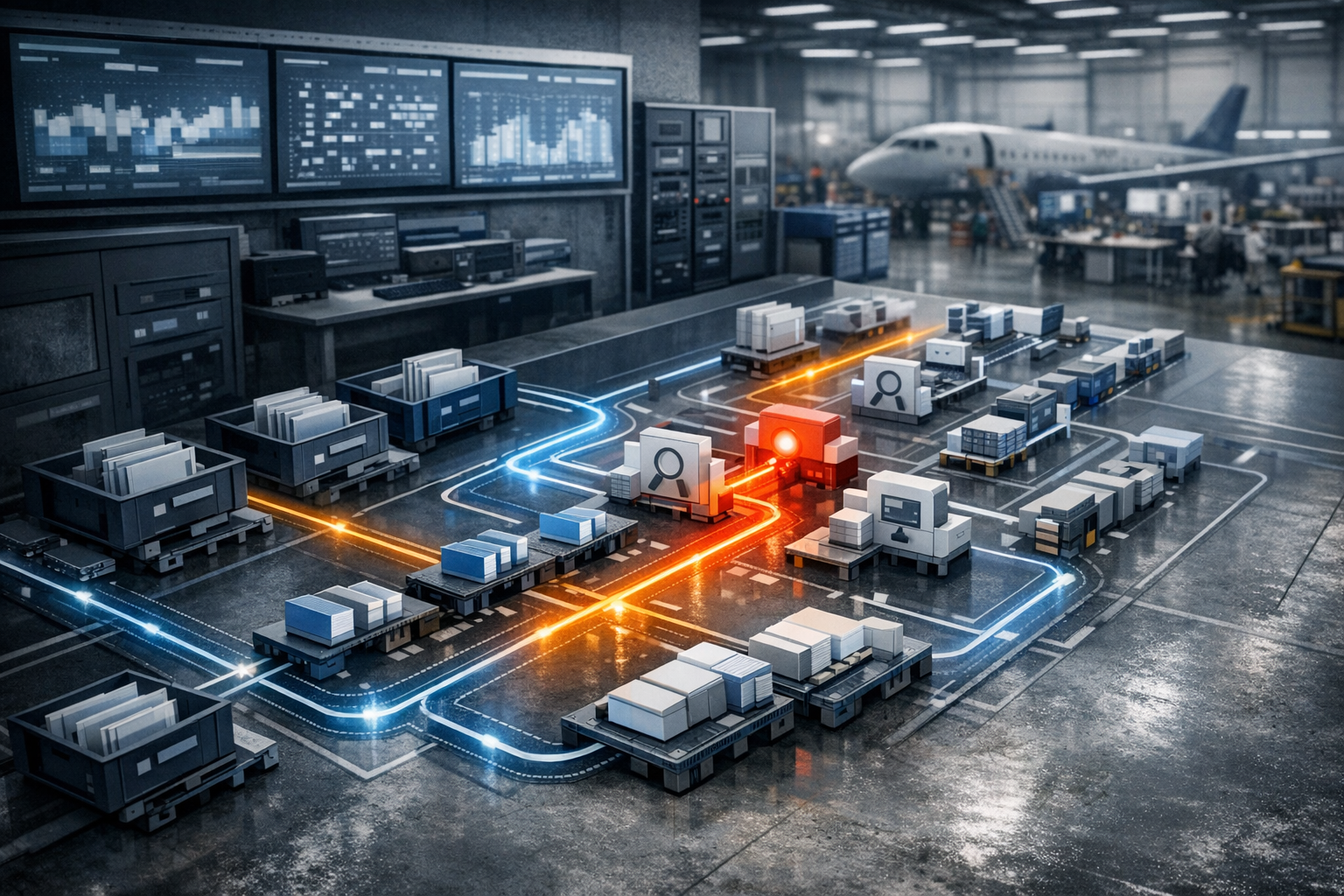
In most aerospace headlines, a growing aircraft backlog is treated as proof of strength. Years of production already sold. Market share locked in. A reassuring signal to investors and boards that demand is secure.
But in regulated aerospace and defense manufacturing, backlog is not just a demand metric. It is a time-distributed execution liability: a stack of promises that must be converted into certified, conforming hardware under changing regulatory, supply chain, and design conditions.
For teams putting this topic into daily operation, Connect981’s aerospace execution solutions help connect the concept to traceability, work-order reality, and audit-ready evidence.
For teams putting this topic into daily operation, execution systems for aerospace manufacturing, shop floor execution control help connect the concept to traceability, work-order reality, and audit-ready evidence.
The same operating model also depends on a connected execution platform, Connect981’s aerospace operations guidance, practical aerospace operations FAQs, closing the Engineering Change Execution Gap, especially when decisions have to move across quality, production, suppliers, and program leadership without losing context.
In the aerospace scoreboard critique, we argued that deliveries, revenue, and backlog tell only a thin story about program health. This article goes deeper on backlog specifically: what actually lives inside those numbers, why they can mask operational fragility, and how a connected execution layer changes how you read and manage backlog risk.
Why Backlog Is Misunderstood in Aerospace
The traditional narrative: backlog as proof of market dominance
On the surface, backlog is simple: customer orders that have been contractually secured but not yet delivered. A large backlog suggests strong demand, pricing power, and predictable future revenue. In commercial aviation, it is often discussed as “years of production at current rates.”
For aerospace leaders, that narrative is only partially useful. A 10-year backlog on a major aircraft family does not just represent revenue; it encodes:
- Capacity assumptions across OEM final assembly, major structures, and critical systems
- Supplier health and capital investment that has not yet occurred
- Future labor, skills, and certification requirements that will move over time
- Configuration and variant complexity that may not be fully visible today
Seen this way, backlog is less a trophy and more a long-duration constraint problem. You are not just selling airplanes; you are committing your entire industrial system to a specific future.
Why long program lifecycles distort backlog meaning
Aerospace programs routinely span decades. A backlog booked today may convert into deliveries five, ten, or even twenty years from now, crossing multiple regulatory regimes, technology refresh cycles, and macroeconomic environments.
This time scale distorts traditional interpretations of backlog:
- Forecast horizons are inherently uncertain. Demand, route structures, and fleet strategies shift faster than hardware can be designed and certified.
- Industrial footprints evolve. Sites open, consolidate, or retool, changing where and how backlog will actually be executed.
- Regulatory expectations increase over time. What was acceptable five years ago may require deeper traceability and configuration control when a later backlog tranche is built.
As a result, the further out backlog extends, the more it should be seen as a risk portfolio, not a fixed promise that the current system can easily fulfill.
How regulated environments amplify backlog uncertainty
Unlike many industrial sectors, aerospace, defense, and space hardware operate under tight certification, export, and quality regimes. Every aircraft in the backlog is not just a unit of demand; it is a unit of regulatory exposure.
Long backlogs magnify questions such as:
- Will today’s process qualifications, suppliers, and special processes still be approved and available at the time of build?
- Can we demonstrate uninterrupted traceability and configuration control across design changes, supplier transitions, and rate increases?
- What happens to backlog scheduling if a key supplier faces an audit issue, or a quality escape halts a production line?
Without a clear execution layer connecting backlog commitments to live production and supplier data, these questions are often answered with static assumptions, not operational evidence.
What Actually Lives Inside an Aircraft Backlog
Execution risk over 5–20 year horizons
Each line in an aircraft backlog is a multi-year execution plan hidden inside a financial metric. That plan spans design maturity, industrialization, ramp-up, steady-state production, and eventual rate changes or sunset strategies.
Over a 5–20 year horizon, the underlying execution risk accumulates from multiple sources:
- Process drift: Work instructions, routings, and inspection plans evolve. If these changes are not tightly controlled and connected to the digital thread, you risk building later backlog under a process definition that no longer matches certification intent.
- Knowledge loss: Critical know-how sits with individuals and local teams. As staff rotates, tribal knowledge gaps can transform a stable line today into a fragile one later while the backlog number appears unchanged.
- Unmodeled dependencies: Test equipment, tooling, and special process capacity that nobody explicitly tied to backlog volumes when the contracts were signed.
The longer the horizon, the more your backlog becomes a bet on your ability to keep execution aligned with intent under constant change.
Supplier stability and capacity constraints
Most aircraft content is produced in the supply chain, not inside OEM final assembly buildings. A large backlog therefore implies that hundreds or thousands of suppliers will sustain certified, capable production for many years.
Execution exposure hides in questions such as:
- How many critical parts are effectively single-sourced due to qualification complexity or unique processes?
- Where does current quality performance already suggest that a supplier will struggle at higher rates?
- Are there sub-tiers (forgings, castings, specialized treatments) whose constraints are invisible in OEM-level planning?
Without integrated supplier traceability and production visibility, backlog implicitly assumes that supplier networks will behave as modeled, even when factory reality is already signaling issues.
Regulatory, certification, and design change exposure
Backlog is booked against a program baseline, but that baseline is rarely static. Over a 10-year horizon, you can expect block changes, service bulletins, weight reduction efforts, performance upgrades, and regulatory-driven modifications.
Each change creates variants in the backlog:
- Different configurations for different operators and missions
- Retrofit and modification work scopes interwoven with new production
- Multiple software loads and hardware revisions that must remain tightly correlated
If your configuration management and digital thread are not robust, the backlog number obscures a growing set of execution paths, each with its own risk profile and certification obligations.
Contractual commitments versus real production capability
Commercial and defense contracts typically embed schedule, performance, and availability commitments based on a model of what the industrial system can do. When that model is optimistic, backlog becomes a liability.
Common gaps include:
- Assumed learning curves that do not match actual ramp-up behavior on the shop floor
- Underestimated non-conformance and rework that quietly consumes capacity needed for future backlog
- Planned automation or capital projects that slip or under-deliver, leaving manual processes in place longer than expected
The more your backlog is decoupled from live execution data, the greater the risk that contractual commitments drift away from what your factories and suppliers can reliably deliver.
Backlog as a Supply Chain Stress Test
How tiered supplier networks absorb (or fail to absorb) demand
Every time you publicize a multi-year backlog figure, you are implicitly stress-testing your supplier network. The question is not just “Can we build this many aircraft?” but “Can every critical tier absorb and sustain this load?”
In practice, backlog acts like a slow-motion stress test:
- Tier 1 integrators must align capital spending and staffing with the projected demand profile.
- Tier 2 and Tier 3 providers of forgings, machined parts, composites, and electronics must decide whether to invest based on partial or lagging visibility.
- Special process houses must balance aerospace work against other regulated industries with different demand cycles.
When that coordination is weak, backlog converts into late deliveries, expediting, and reactive rescheduling instead of predictable output.
The impact of single-source and specialty process suppliers
In many programs, a small number of suppliers control disproportionate leverage because they operate certified special processes, build key structures, or own legacy intellectual property. Your backlog is only as executable as their capacity, quality system, and financial health allow.
Execution risk intensifies when:
- Critical processes (e.g., heat treatment, bonding, coating) exist at only one or two approved sites.
- Qualification of alternates takes years and ties up engineering and certification capacity.
- Supplier quality data is siloed, so systemic issues become visible only after they constrain production.
Without a shared execution layer that exposes real-time performance, work-in-process, and non-conformance patterns, backlog reporting will overstate how robust those bottleneck nodes actually are.
Backlog concentration by program, platform, and customer
Backlog is rarely evenly distributed. It clusters around specific platforms, engine choices, cabin options, and customer fleets. That concentration matters operationally.
For example:
- A heavy concentration of a single high-complexity variant may strain particular work cells and inspection resources.
- Backlog tied to a few fleet operators can drive irregular modification and retrofit campaigns that ripple into new production schedules.
- Defense contracts with option years can rapidly increase demand on specific configurations if exercised unexpectedly.
These patterns do not show up in a headline backlog number, but they have direct implications for line balancing, staffing, and supplier scheduling.
How OEM Metrics Hide Backlog Quality
Backlog value versus backlog executability
Financial reporting emphasizes backlog value: the aggregate revenue associated with firm orders and, in some cases, options or letters of intent. From an execution perspective, a more relevant dimension is backlog executability—the probability that each unit can be delivered on time, at cost, and in compliance given the state of your system.
Two aircraft programs might report similar backlog values but have very different execution profiles because of:
- Higher design churn and immature configurations
- Less stable suppliers or greater exposure to constrained commodities
- Weaker production visibility and fragmented traceability
Without metrics that explicitly connect backlog to operational capability, dashboards can look strong while factories operate at the edge of control.
Cancellation, deferral, and reprioritization dynamics
Backlog is not static. Airlines and operators cancel, defer, or swap slots as their own strategies evolve. Defense customers adjust profiles around funding cycles and mission needs. On paper, net backlog may appear stable even as the internal profile becomes more complex.
Operationally, this creates churn:
- Final assembly lines must adapt to variant mixes that were not originally planned.
- Suppliers must reshuffle production sequences while protecting lead times and shelf-life-limited materials.
- Configuration management and planning teams must keep bills of material and routing definitions synchronized with shifting demand.
If these dynamics are not connected directly into an execution layer that updates work orders, material reservations, and inspection plans, the risk of misbuilds and delays increases while backlog reports remain deceptively calm.
Why paper stability can mask operational fragility
A program can report a steady backlog, steady deliveries, and stable revenue while living with high rework, extensive out-of-station work, and frequent schedule recovery actions. The system is fragile but still producing outputs that look healthy in aggregate.
Common indicators of this hidden fragility include:
- Heavy reliance on offline spreadsheets to track real production status
- Traceability reconstructed for audits rather than captured inline with work
- Quality escapes that are found late, triggering quarantines and travel work
Backlog, by itself, has no way to reveal these patterns. Only real-time production visibility and integrated quality data can distinguish between a system that is truly in control and one that is barely keeping up with paper commitments.
Managing Backlog as Deferred Execution Risk
Translating backlog into capacity and capability requirements
To treat backlog as a managed risk, you need to translate financial units into operational units. That means asking, for each significant slice of backlog, “What specific capacity and capability must exist, where, and when?”
Practically, this translation involves:
- Breaking backlog down by configuration, major assembly, and key options.
- Mapping those units onto actual lines, work cells, and suppliers.
- Identifying which stations, processes, and certifications are rate-limiting for each profile.
This reframes backlog planning from a volume problem to a networked capability problem, which can then be monitored and adjusted as live data comes in.
Using real-time production visibility to validate backlog assumptions
Most backlog plans are built from models and historical performance. As production ramps, those assumptions must be challenged with live data from factories and suppliers.
An effective execution layer enables:
- Cycle time and WIP visibility at the operation level, not just at the aircraft or shipset level.
- Real-time constraint identification based on queues, overtime, and non-conformance patterns.
- Automated feedback loops that flag when assumed rates or yields no longer match observed performance.
When that visibility is connected back to backlog views, leaders can distinguish between segments of backlog that are operationally supported and those that are already at risk.
Scenario planning with integrated supplier data
Scenario planning around backlog—rate increases, customer mix changes, new variants—only becomes meaningful when supplier data is part of the picture. That means going beyond high-level capacity declarations to include actual performance, constraints, and material flows.
With an integrated execution layer that connects OEM production systems to supplier status, you can simulate, for example:
- How a 20% rate increase on one program propagates through shared suppliers and special processes.
- What backlog segments become vulnerable if a key supplier slips by two weeks on average.
- How configuration changes would affect tooling, inspection resources, and first article workloads at each tier.
This shifts scenario planning from spreadsheet exercises to model-based operational planning grounded in current data.
Aligning quality and configuration control with backlog horizon
Quality systems and configuration management are often treated as compliance domains, but they are central to backlog executability. Over a long horizon, even small misalignments can compound into major schedule risk.
Key practices include:
- Ensuring that non-conformance trends are linked back to specific backlog segments and configurations, not just aggregated at program level.
- Maintaining a continuous digital thread so that every aircraft in the backlog can trace forward to how it should be built and backward to the design and process assumptions that justify it.
- Embedding configuration checks in the execution workflow, so that as options, blocks, and change notices evolve, shop-floor work instructions and inspection plans remain synchronized.
When quality and configuration control are integrated into daily execution, the long tail of backlog becomes more predictable and auditable.
The Role of a Connected Execution Layer
Connecting ERP backlog to actual factory status
ERP systems are effective at capturing contracts, orders, and planned schedules. They are not designed to reflect minute-by-minute factory reality: which jobs are truly started, where WIP is held, which operations are blocked by missing parts or non-conformances.
A connected execution layer fills that gap by:
- Tracking production status at the operation and unit level across lines and cells.
- Associating each work step with material lots, serial numbers, inspection results, and operator actions.
- Feeding summarized status and risk signals back to planning systems that manage backlog and order books.
Platforms like Connect981 operate in this space—not replacing ERP, but making its backlog and schedule constructs reflect what is actually happening on the factory floor.
Surfacing supplier constraints early through shared visibility
Many backlog failures originate outside OEM walls. A connected execution layer that extends into the supply chain can surface constraints long before they become delivery crises.
With shared production visibility between OEMs and key suppliers, you can:
- See real WIP positions and queue times at critical suppliers.
- Identify chronic non-conformance loops that point to process capability issues.
- Align backlog-driven demand profiles with supplier capacity decisions based on operational evidence, not just forecasts.
This turns backlog from a set of static promises into a joint execution plan, continuously adjusted as conditions change.
Linking backlog changes to digital thread and traceability
Backlog evolves: customers switch options, regulators issue new guidance, engineering introduces cost or performance improvements. Each of these changes has implications for the digital thread and traceability obligations.
A robust execution layer connects these domains by:
- Ensuring that changes to backlog configuration are reflected in bills of material, routings, and inspection plans.
- Capturing part genealogy and process data automatically as work occurs, so that variants and block changes remain fully traceable.
- Providing a single operational view where engineering, quality, and production can see how backlog changes translate into actual work orders and hardware.
This reduces the risk that late design changes or option swaps create hidden compliance or rework exposure in later backlog deliveries.
Why platforms like Connect981 sit between contracts and reality
The distance between an order booked in ERP and a conforming aircraft on the flight line is where most execution risk lives. Traditional systems of record capture intent and history, but they do not orchestrate the day-to-day conversion of backlog into hardware across multiple organizations.
A platform such as Connect981 is designed to inhabit that space: the execution layer between contracts and reality. By integrating production visibility, traceability, and supplier coordination, it allows aerospace manufacturers to read backlog as an operational signal, not just a financial metric, and to intervene early when the system’s ability to deliver diverges from what the backlog implies.
Reading Backlog Correctly: Questions Aerospace Leaders Should Ask
Which parts of our backlog are execution-limited today?
Instead of treating backlog as a monolithic number, segment it by program, configuration, and supplier exposure, then ask where you are already constrained. Look for evidence in cycle times, rework rates, supplier misses, and the amount of manual coordination required to hit schedule.
The goal is to identify backlog segments that are rate-limited by specific bottlenecks or immature processes, then focus improvement and investment where it changes actual deliverability rather than headline figures.
Where are we blind to supplier and configuration risk?
Every gap in visibility between OEM systems and supplier operations is a place where backlog assumptions can silently decay. Likewise, every manual handoff in configuration management is an opportunity for mismatch between what was sold, what was planned, and what is built.
Map where you rely on static declarations or periodic reports instead of live data, and where configuration changes are applied through email or spreadsheets rather than system-enforced workflows. Those are the blind spots that turn backlog into sudden crises.
How would our view of backlog change with live execution data?
Finally, consider how your backlog conversations would shift if every key stakeholder could see the same real-time operational picture: station status, WIP positions, supplier queues, non-conformance hotspots, and configuration variants in work.
In that environment, backlog stops being a celebratory number on a slide and becomes an input to continuous coordination. The question is no longer “How big is our backlog?” but “How well is our system positioned today to execute the backlog we have?” That is the question aerospace leaders ultimately need to answer.