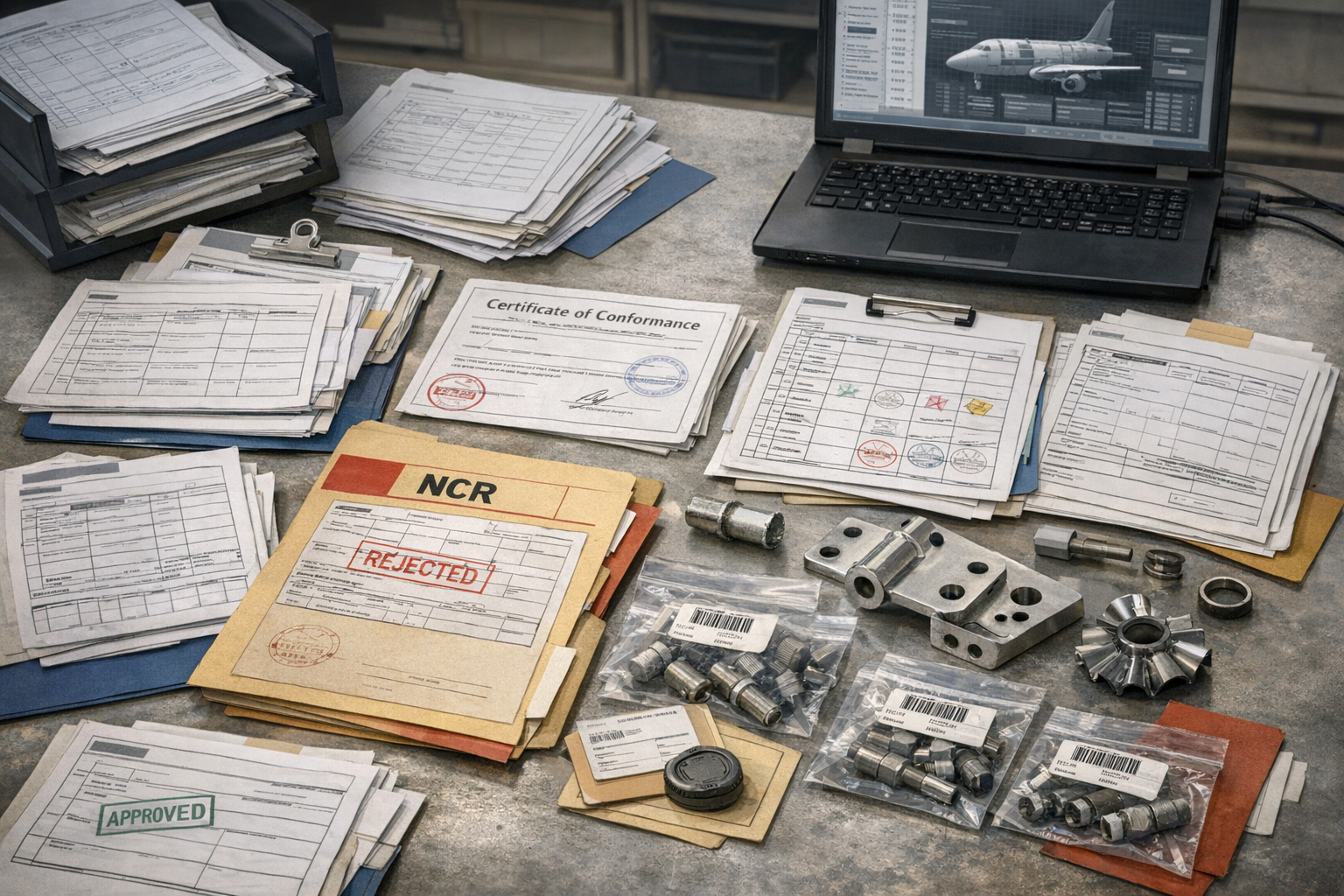
Digital thread comes up in nearly every aerospace strategy deck. Diagrams show elegant loops from concept to design to manufacturing to MRO. But on most programs, the reality still looks like this: PLM and ERP are reasonably structured, execution happens in a mix of travelers, spreadsheets, and tribal knowledge, and quality and compliance teams stitch the story together after the fact.
To make sense of the gap, you first have to recognize that aerospace is not a scoreboard business. Deliveries, backlog, and revenue are lagging indicators of something more fundamental: how well you understand and control execution across internal factories and suppliers. That execution layer is where a real digital thread either exists or quietly breaks. This article explains what digital thread in aerospace actually is, how it fails in practice, and how a connected execution layer—of the kind discussed in the underlying aerospace execution story—turns the idea into something operational.
For teams putting this topic into daily operation, Connect981’s aerospace execution solutions help connect the concept to traceability, work-order reality, and audit-ready evidence.
For teams putting this topic into daily operation, execution systems for aerospace manufacturing, shop floor execution control help connect the concept to traceability, work-order reality, and audit-ready evidence.
The same operating model also depends on a connected execution platform, Connect981’s aerospace operations guidance, practical aerospace operations FAQs, closing the Engineering Change Execution Gap, especially when decisions have to move across quality, production, suppliers, and program leadership without losing context.
Why Digital Thread Matters More in Aerospace Than Anywhere Else
Almost every manufacturing sector talks about traceability and data continuity. Aerospace, defense, and space hardware production live under constraints that make digital thread more than a nice-to-have. It is directly tied to safety, certification, and program survivability over decades.
Long Program Lifetimes and Frequent Configuration Changes
Aircraft, spacecraft, and mission systems often stay in service for 20–40 years. Over that lifetime, designs evolve, part numbers change, suppliers shift, and regulatory expectations move. A single airframe or propulsion unit may embody hundreds of engineering change notices (ECNs), service bulletins, and retrofit campaigns.
Without a connected data story—who built what, using which configuration, under which process, at which revision—operators and OEMs face two recurring problems:
- Unclear baselines: You know a tail number or serial number, but not which exact configuration and concessions apply to the physical asset in front of you.
- Expensive retro-discovery: Every modification or investigation becomes a mini-forensic effort across PLM, ERP, quality systems, and archived travelers.
A functioning digital thread keeps configuration intent and as-built reality aligned over that entire lifecycle.
Safety-Critical Hardware and Regulatory Scrutiny
Aerospace hardware is designed, built, and maintained under tight regulatory oversight from authorities such as FAA and EASA, and in defense environments under additional customer and export constraints. AS9100, DO-178/254 (for software and electronics), and program-specific requirements all converge on the same expectation: you must be able to demonstrate how a given part or assembly was produced, inspected, and controlled.
This is not just about storing records. Regulators and customers increasingly expect that records are coherent—that configuration, process, and quality data can be tied together quickly and unambiguously. That is only possible when the digital thread connects the systems where these data originate, not just where they are archived.
Complex, Multi-Tier Supplier Ecosystems
Modern aerospace programs depend on deep, multi-tier supply chains. Critical hardware, from structural components to flight-critical electronics to propulsion subsystems, is often designed and produced across multiple organizations and regions.
In practice, this means that no single company controls the entire data landscape. Part genealogies are fragmented, revision states differ by partner, and the intent encoded in OEM specifications may be implemented through several layers of process translation. A robust digital thread creates a shared operational picture of configuration and evidence, even when the underlying production network is distributed.
Defining Digital Thread in Practical Aerospace Terms
Conceptually, digital thread is the connected flow of data that links requirements, design, manufacturing, testing, delivery, and in-service operations. Practically, in aerospace manufacturing, it comes down to three concrete questions:
- Are your configuration and process definitions consistently expressed all the way to the point of work?
- Is the as-built and as-tested record captured as work happens, or reconstructed later?
- Can you trace a physical part or assembly back through its genealogy, including the suppliers and processes involved?
From PLM and Engineering Data to Manufacturing Instructions
Most aerospace programs start with reasonably structured engineering systems. PLM holds product structures, CAD, specifications, and often ECNs. But the digital thread only becomes real when that engineering intent is translated into precise, controlled manufacturing instructions.
In execution terms, this means:
- Engineering bill of materials (EBOM) is transformed into a manufacturing bill of materials (MBOM) that reflects how the work is actually done.
- Process plans and routings are defined with clear operations, resources, inspection points, and required evidence.
- Work instructions are versioned, structured, and directly traceable back to the underlying engineering definitions.
The digital thread starts when those links are explicit and managed, not inferred from filenames and email trails.
Linking BOMs, Routings, and Process Plans to Real Work
Once the product and process definitions are in place, the next question is whether they remain intact when work is scheduled and executed. In many factories, ERP or planning tools generate work orders and travelers with limited awareness of the full process context.
A practical digital thread ensures that for each work order or serial number, you can answer:
- Which configuration baseline does this unit belong to (aircraft block point, engine standard, mission configuration, etc.)?
- Which revision of the MBOM, routing, and work instructions were in effect when the work was done?
- Which deviations or waivers were authorized, and by whom?
This is where an execution-layer system becomes essential. When the production environment knows which configuration and process definition apply to a given serial or lot, the digital thread is preserved down to the station level.
Capturing Genealogy and As-Built Records Along the Way
Finally, digital thread requires that you capture what actually happened as work progressed—not just what was planned. For aerospace, this includes:
- Part genealogy: How subcomponents, materials, and serialized items were combined to form higher-level assemblies.
- Process evidence: Who performed each step, which tools or equipment were used, and which parameters or measurements were recorded.
- Quality outcomes: Non-conformances, dispositions, repair actions, and rework paths tied to specific units and operations.
When these records are linked back to the correct configuration and process definitions, you have an as-built and as-inspected view that can support future investigations, retrofits, and audits without reconstruction.
Where Digital Thread Breaks in Real Factories
Most aerospace organizations already own the core systems that could contribute to a digital thread: PLM, ERP, quality systems, document control, and sometimes legacy MES. The failures usually occur in the handoffs and in the execution gap between planning and reality.
Paper Travelers and Disconnected Work Instructions
In many regulated factories, the traveler is still the primary arbiter of what work is done. Even when instructions are stored in a document management system, the actual flow on the floor is mediated by printed packets, static PDFs, and operator memory.
In this model, digital thread breaks because:
- There is no guarantee the latest revision of instructions is what the operator sees.
- Process changes may lag execution by days or weeks while existing paper is consumed.
- Evidence (sign-offs, measurements) is collected on paper and then manually entered, often without robust linking back to configuration and process context.
The result is a fragmented digital story: engineering lives in PLM, planning in ERP, and actual work in paper stacks.
Manual Handling of Engineering Change Notices (ECNs)
Engineering changes are where configuration control either proves itself or collapses. In many organizations, ECNs and change notices propagate through manual workflows: email distributions, spreadsheets to track impacted work orders, and physical stamps on documents.
This introduces several risks to the digital thread:
- Incomplete impact analysis: It is unclear which in-progress units and supplier lots are affected.
- Inconsistent cut-in points: Different teams apply the change at different times, creating hybrid configurations.
- Poor traceability of decision-making: Why a particular unit was allowed to proceed under an earlier revision is not always documented in a structured way.
An execution-aware digital thread tightly couples engineering changes to affected work, ensuring that cut-in points and exceptions are visible and enforceable at the point of work.
Unlinked Quality Data and Non-Conformance Records
Quality systems in aerospace are often robust on their own terms. Non-conformance reports (NCRs), corrective and preventive actions (CAPA), and concession records are carefully documented. But they are frequently operationally disconnected from the rest of the production data.
Common patterns include:
- NCRs recorded with minimal linkage to specific operations, tools, and process versions.
- Data captured in separate quality databases that are hard to correlate with real-time production status.
- Trend analysis done periodically, not embedded into daily execution decisions.
In this environment, the digital thread is incomplete. You can see where defects occurred, but not always the full context that would enable systemic improvement or fast, configuration-specific risk assessments.
The Execution Layer as the Digital Thread’s Nervous System
If PLM defines intent and ERP defines plans, the execution layer is where those plans meet reality. In aerospace, this layer is not just a traditional MES; it is a connected operational environment that distributes configuration-aware instructions, captures evidence in real time, and coordinates changes across internal and external production.
Delivering Current Configuration and Instructions to the Point of Work
For digital thread to be trustworthy, the station-level view of work must always reflect current configuration intent. That means operators, technicians, and inspectors should never have to guess which instructions or specs apply to the unit in front of them.
An execution layer enables this by:
- Binding each work order or serial to a specific configuration baseline, including block points and applicable ECNs.
- Resolving the correct version of work instructions, drawings, and inspection plans dynamically at the point of use.
- Preventing work from starting when the required documentation or approvals are not available for the current configuration.
When this is in place, the digital thread is not abstract. It directly shapes what every operator sees and does.
Capturing Evidence and Traceability as Work Happens
The other half of the equation is capturing execution data as a first-class output of production, not as an afterthought. A modern execution layer treats traceability as a byproduct of normal work.
Operationally, this looks like:
- Structured electronic sign-offs for each operation tied to user identity, timestamp, and configuration context.
- Automatic association of tooling, calibration status, and process parameters with the specific units processed.
- Inline capture of measurements and inspection results, directly linked to the operation, drawing requirement, and serial number.
This turns the execution layer into the nervous system of the digital thread: every action generates signals that are automatically contextualized and available for quality, engineering, and compliance teams.
Synchronizing Changes to Suppliers and External Partners
Because aerospace supply chains are distributed, the digital thread cannot stop at the factory door. Tier-1 and tier-2 suppliers must receive configuration and process intent in a form they can execute reliably, and they must return evidence in a way that integrates into the OEM’s data story.
A well-designed execution layer supports this by:
- Providing controlled views of configuration and documentation tailored to each supplier’s scope.
- Defining how serials, batches, and inspection data should be identified so they can plug back into the OEM’s genealogy model.
- Making it visible which supplier lots, serials, and concessions are associated with a given aircraft or mission configuration.
Instead of periodic document drops, the relationship becomes an ongoing exchange of structured execution data, keeping the digital thread continuous across organizational boundaries.
Digital Thread Across the Regulated Supply Chain
Creating a digital thread that spans OEMs, integrators, and component suppliers requires both technical and governance decisions. The goal is not one monolithic system, but a shared model of configuration, identification, and evidence exchange.
Sharing Configuration Intent with Tier-1 and Tier-2 Suppliers
Most suppliers receive technical data packages (TDPs), drawings, and specifications that define what they must deliver. In a digital-thread-aware ecosystem, those packages are more than document bundles; they are structured configuration definitions.
This means:
- Explicit definition of configuration baselines for each part family or assembly.
- Clear mapping between OEM part numbers and supplier part or model identifiers.
- Change notifications that specify not just the documents revised, but which configurations, lots, or serial ranges are affected.
Suppliers in turn align their own process plans and internal travelers to these baselines, so their execution data can be meaningfully integrated back into the OEM’s digital thread.
Aligning Part Numbering, Revision Control, and Documentation
One of the most common breakpoints in supply-chain digital thread is inconsistent identification: different part numbers, revision schemes, or document identifiers for what is essentially the same configuration. Over time, this creates ambiguity about which parts are interchangeable or which design standard a delivered lot actually reflects.
Closing this gap involves:
- Agreeing on master part identifiers and how local variations map back to them.
- Defining revision control rules that govern when a new revision is required versus when a change is managed through notes or process updates.
- Ensuring documentation bundles are machine-referencable (with IDs and metadata) instead of relying solely on filenames and unstructured notes.
With that foundation, execution data from suppliers—such as lot histories, test results, and concession records—can be joined cleanly with OEM product and configuration models.
Balancing Data Access with IP and Export Control Constraints
Digital thread initiatives in aerospace must respect intellectual property boundaries and export control regulations (such as ITAR and EAR in applicable jurisdictions). That does not mean abandoning the thread; it means being precise about which data is shared, with whom, and under what controls.
Practically, this often leads to architectures where:
- Each party maintains authoritative records for its own processes and proprietary designs.
- Only the necessary subset of execution and quality data is exchanged, governed by contracts and regulatory requirements.
- Interfaces focus on structured identifiers and evidence summaries rather than exposing full internal models.
The digital thread is thus a federation of trusted connections, not a single shared database.
Connecting Digital Thread to Compliance and Audits
For many aerospace organizations, the most immediate, tangible value of digital thread shows up during audits and investigations. When configuration, execution, and quality data are connected, compliance shifts from reconstruction to retrieval.
Supporting AS9100 Clause Expectations with Live Data
AS9100 requires control over configuration, documented processes, traceability, and non-conformance handling. A live digital thread anchored in the execution layer helps demonstrate that these are not only defined but also used.
For example, during an audit you should be able to:
- Select a serial number and immediately see its configuration baseline, process history, and inspection results.
- Show how changes were introduced and where cut-in points occurred in production and at suppliers.
- Trace any non-conformance back to root cause and corrective actions with full context.
When these views are generated from operational systems rather than offline compilations, auditors gain confidence that the controls are real.
Linking FAA/EASA Evidence to Underlying Execution Records
Regulatory authorities often require program-level evidence: certification documents, test reports, reliability data, and service history. These are traditionally maintained as curated packages separate from day-to-day production data.
A digital thread allows those high-level artifacts to be traced back to the underlying execution and quality records. For instance, a structural test campaign report can be linked to the exact units tested, including their configuration, manufacturing conditions, and any deviations. This depth of traceability becomes vital if issues arise years later and authorities ask how representative prior evidence really was.
Demonstrating Configuration Control Across Program History
When incidents or field findings occur, one of the first questions is: Which units are affected? Answering that reliably requires a historic view of configuration, including which changes were applied to which units, under which conditions.
With a robust digital thread:
- You can identify population at risk by querying for specific configuration features, supplier lots, or process conditions.
- You can see how mitigations (service bulletins, retrofits, process changes) were rolled out and verified.
- You can distinguish between similar-looking units that actually have different risk profiles because of their build histories.
This is only possible when configuration, genealogy, and execution evidence are consistently linked over time.
Starting a Digital Thread Journey Without a Big-Bang Project
Many aerospace organizations hesitate to pursue digital thread initiatives because they appear to require large, multi-system transformations. In practice, some of the most effective programs start by improving execution visibility and traceability for a limited set of high-risk areas, then expand.
Prioritizing High-Risk Components and Processes
Instead of trying to connect everything at once, focus on where gaps in the digital thread pose the highest risk or cost. Common starting points include:
- Flight-critical components with complex routings and multiple special processes.
- Assemblies with a history of escapes or persistent quality issues.
- Areas with intensive audit and customer scrutiny, where evidence is currently hard to compile.
For these scopes, define the minimum viable digital thread: which configuration data must be present at the point of work, what genealogy is required, and which evidence must be captured digitally.
Instrumenting Critical Operations with Execution Data First
Progress is fastest when you start where execution and traceability needs are clearest. That typically means:
- Digitizing work instructions and sign-offs for selected operations.
- Enforcing revision correctness at station level (no work on outdated instructions).
- Capturing key measurements, tool IDs, and material traceability inline.
As these operations become fully traceable, you can extend the same approach to adjacent steps, additional work centers, and eventually suppliers. The digital thread grows organically from a solid execution foundation.
How Platforms Like Connect981 Plug into Existing PLM/ERP Landscapes
Most aerospace organizations will not replace PLM or ERP to achieve digital thread. Instead, they introduce an execution-focused platform that sits between planning and reality, integrating with existing systems while orchestrating work on the shop floor and across suppliers.
In this model:
- PLM remains the authoritative source of product and configuration intent.
- ERP remains the system of record for orders, inventory, and financials.
- The execution layer (such as Connect981) becomes the operational backbone that:
- Resolves the right configuration and work instructions per unit.
- Guides operators and suppliers through controlled processes.
- Captures the as-built/as-inspected record as work happens.
Over time, this architecture aligns with the broader perspective described in the aerospace execution and visibility narrative: moving from scoreboard metrics to an operational understanding of how work actually gets done.
Digital thread in aerospace is ultimately not a technology label. It is the practical ability to say, for any physical unit in your fleet or backlog: we know exactly what it is, how it was built, and how it has changed over time. That capability emerges when configuration, execution, and evidence are connected through a real execution layer—not just drawn in a lifecycle diagram.