Regulatory Compliance for Aerospace Non-Conformances: FAA and EASA Documentation Expectations
How FAA and EASA oversight shapes non-conformance records, traceability, and digital approval workflows in aerospace manufacturing and MRO—without acting as legal or regulatory advice.
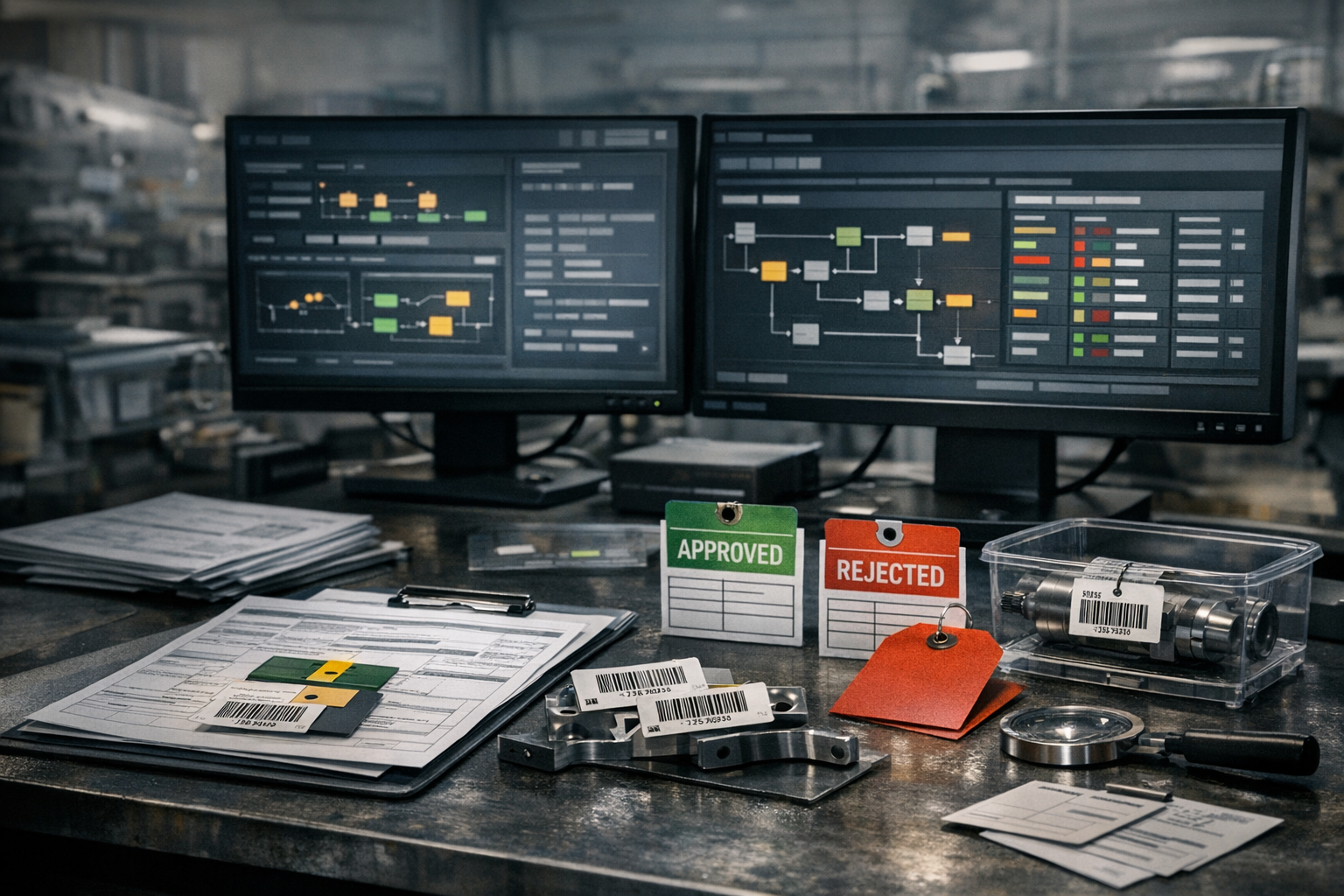
Regulatory Compliance for Aerospace Non-Conformances: FAA and EASA Documentation Expectations
Disclaimer: This article is informational only and does not constitute legal or regulatory advice. Organizations should consult official FAA/EASA publications, competent authorities, and legal counsel when interpreting or applying regulatory requirements.
In aerospace manufacturing and maintenance, non-conformance control sits directly in the sightline of regulators. FAA and EASA do not run your quality system day-to-day, but they do expect your non-conformance records, traceability, and approval workflows to reliably demonstrate that your products conform to approved design and that safety risks are controlled. When a serious issue occurs—or an audit is scheduled—your non-conformance data becomes the evidence set.
For teams putting this topic into daily operation, non-conformance management, quality management workflows, a connected execution platform help connect the concept to traceability, work-order reality, and audit-ready evidence.
The same operating model also depends on Connect 981’s aerospace execution solutions, real aerospace execution examples, Connect 981’s aerospace operations guidance, practical aerospace operations FAQs, especially when decisions have to move across quality, production, suppliers, and program leadership without losing context.
For organizations moving from spreadsheets and email-based processes to unified digital infrastructures, the challenge is to design regulatory-grade non conformance management that aligns with FAA/EASA expectations without over-complicating daily operations. This article focuses on what regulators typically look for in records and workflows, not on interpreting specific clauses as binding requirements.
Regulatory Context for Non-Conformance in Aerospace
How FAA and EASA interact with company quality systems
FAA and EASA approve designs, production organizations, and maintenance organizations under their respective frameworks. They do not prescribe every step of your non-conformance workflow, but they assess whether your quality system reliably detects, documents, and controls deviations from approved design and procedures.
In practice, this means that during surveillance, audits, or investigations, authorities may review how non-conformances are:
- Identified and categorized (e.g., minor vs. safety-significant).
- Documented in a consistent and traceable way.
- Dispositioned by appropriately authorized and competent personnel.
- Linked to corrective and preventive actions where needed.
Regulators are less interested in the specific software you use and more focused on whether your processes are systematic, controlled, and followed in practice.
The relationship between regulations, standards, and customer requirements
In aerospace production, non-conformance requirements emerge from several layers:
- Regulations and approvals (e.g., FAA production approvals, EASA POA/DOA/MRO approvals) that require effective control of non-conforming items.
- Industry standards such as AS9100 that define expectations for non-conformance control, corrective action, configuration management, and records.
- Customer requirements (OEMs, primes, and Tier 1s) that may impose stricter notification timelines, concession processes, and reporting formats.
Your digital non-conformance system needs to express this stack clearly: which dispositions require design organization involvement, which issues trigger customer notification, and how records show compliance to internal, customer, and regulatory expectations simultaneously.
When non-conformances draw regulator attention
Not every dimensional deviation or cosmetic defect will be a regulatory topic. FAA and EASA typically focus on non-conformances that:
- Have actual or potential safety impact (e.g., critical structure, flight controls, engine hardware).
- Affect airworthiness or continuing airworthiness of in-service aircraft.
- Indicate systemic breakdowns in your quality system (e.g., repeated escapes, missed inspections).
- Are linked to reports from operators (service difficulties, AOG events, incidents).
In these situations, regulators may request specific non-conformance reports (NCRs), associated concessions/deviations, and evidence of root cause and corrective action. Systems that can rapidly extract complete histories with clear traceability are far better positioned for this scrutiny than those relying on fragmented files.
Documentation and Traceability Expectations
Linking non-conformances to part numbers, serials, and tail numbers
A core expectation in regulated aerospace environments is that each non-conformance can be traced to the affected configuration. Operationally, this means your digital workflow should systematically capture:
- Part identifiers: part number, revision, and if applicable, serial or lot number.
- Manufacturing context: work order, operation step, station, and facility.
- Aircraft or assembly context: shipset, assembly number, and where applicable, aircraft tail number or operator.
When regulators or OEM customers investigate a field event, they often work backwards from the tail number or operator report to the affected components and associated NCRs. A digital system that maintains this chain without manual cross-referencing substantially shortens investigation time and reduces risk of missing affected items.
Maintaining complete histories of findings and dispositions
FAA and EASA oversight relies heavily on documented evidence. For non-conformance management, complete histories usually include:
- The original finding, with clear description, measurements, and references to requirements.
- Containment actions taken to protect downstream operations and delivered products.
- Engineering or quality dispositions (e.g., rework, scrap, use-as-is under approved deviation) and the rationale.
- Records of approvals, including who authorized concessions or departures from design.
- Links to corrective actions or change requests when systemic issues are identified.
In digital infrastructures, this is often represented as an immutable audit trail for each NCR. Regulators are more likely to trust a system where they can see each change as a timestamped event tied to a specific user rather than static documents with unclear revision history.
Importance of configuration and change control in records
Non-conformance dispositions are tightly coupled to configuration management. A use-as-is decision that was acceptable for one design baseline may not be acceptable after a design change. Therefore, your non-conformance records should clearly state:
- The design revision or configuration definition applicable when the deviation was assessed.
- Any associated engineering changes, deviations, or concessions that formally authorize the condition.
- How the affected parts are identified in your configuration management system.
Digital links between NCRs, engineering change requests, and configuration records help demonstrate to regulators that you are not managing deviations in isolation but as part of a controlled configuration environment.
Audit and Investigation Scenarios
What regulators typically expect to see during audits
During routine or special-purpose audits, authorities may sample non-conformance records to test whether your documented procedures match actual practice. Operationally, they tend to look for:
- Evidence that all required fields are consistently populated (no systemic gaps).
- Clear, objective descriptions instead of ambiguous or generic statements.
- Appropriate segregation of non-conforming items and documented release criteria.
- Proper authorization levels for dispositions and concessions affecting airworthiness.
- Reasonable closure times for risk-significant issues, with justifiable timelines.
A digital manufacturing or quality system that can quickly produce filtered lists (e.g., open safety-critical NCRs, all concessions on a given part family) helps you respond efficiently and reduces the impression of a reactive, paper-driven environment.
Supporting AOG and incident investigations with NCR data
When an operator reports an Aircraft-on-Ground (AOG) event or an incident, regulators, OEMs, and sometimes investigation bodies may request supporting data. From a non-conformance standpoint, this often involves:
- Identifying all hardware on the affected aircraft that has non-standard conditions or approved deviations.
- Reviewing prior NCRs on the same part number, lot, or supplier for patterns.
- Correlating test, inspection, and repair histories with earlier non-conformances.
If your NCR system is decoupled from production and maintenance records, this analysis becomes a manual, error-prone exercise. Integrated platforms that link non-conformance data into the broader digital thread—spanning design, production, and in-service records—provide a much stronger basis for supporting investigations and demonstrating control.
Ensuring data integrity and access control
Regulators expect records that are complete, accurate, and tamper-evident. In digital environments, this moves the focus from handwriting legibility to data integrity controls. Key design principles include:
- Role-based access control: Only authorized personnel can create, modify, or approve specific record types.
- Immutable audit trails: Edits do not overwrite historical entries; they append new versions with timestamps and user IDs.
- System time synchronization: Timestamps are consistent across systems and sites, which is essential in multi-facility organizations.
- Controlled data exports: Downloaded reports or PDFs are traceable to their source and generation date.
These features do not exist just to satisfy IT policies. They form part of how you demonstrate to FAA and EASA that your organization can be trusted to maintain reliable quality records over the long term.
Designing Compliant Digital Workflows
Timestamping, user identification, and electronic approvals
Most aerospace organizations are moving from wet-ink signatures to electronic approvals for non-conformance workflows. To align with regulatory expectations, your system should ensure that:
- Each approval step is uniquely attributable to a specific individual (no shared generic accounts).
- Timestamps are automatically captured when actions are taken, not manually entered.
- The meaning of each approval action is defined (e.g., technical disposition versus quality review versus customer approval).
Electronic signatures may be acceptable when implemented under a controlled process that defines identity management, access rights, and how signatures are bound to records. The critical point is that an auditor can understand who approved what, when, and under which authority.
Ensuring revision control and record retention
Non-conformance records rarely stay static. Measurements may be refined, dispositions updated, or corrective actions added. A digital system should:
- Maintain version history for each NCR, including changes to dispositions and attached evidence.
- Prevent uncontrolled overwriting of information that has already been used to make safety-relevant decisions.
- Support your organization’s retention policies, including controlled archival rather than deletion.
Specific retention durations can depend on product type, contractual terms, and approval basis, and should be defined in internal policy with reference to applicable regulations and standards. From a system perspective, the critical capability is to apply those policies consistently and to retrieve records reliably throughout the defined retention period.
Demonstrating systematic problem solving and closure
FAA and EASA are increasingly focused on systemic safety and quality culture rather than individual events. Your non-conformance workflow should make it easy to demonstrate that:
- Significant issues trigger structured root cause analysis, not just local fixes.
- Corrective and preventive actions are documented, implemented, and verified for effectiveness.
- Trends are reviewed periodically to identify recurring patterns across programs or sites.
Digital platforms that link NCRs to corrective action records, design changes, and process adjustments form an auditable chain. During oversight, being able to show this link—rather than searching for disconnected reports—strongly supports the argument that your quality system is robust, not just reactive.
Aligning Internal Procedures with Regulatory Oversight
Writing procedures that reflect actual practice
A common finding in aerospace audits is that procedures describe one process while teams actually operate another. With digital tools, this disconnect can surface quickly. To reduce this risk:
- Design your non-conformance workflow in the system and your written procedures in parallel.
- Use screenshots, data field definitions, and workflow diagrams to ensure procedures truly reflect system behavior.
- Periodically review NCR samples against procedural requirements to confirm alignment.
When FAA or EASA compare your documented process to what they see in the system, consistency builds trust. Misalignment suggests either a weak quality system or a digital implementation that has drifted from controlled processes.
Training staff to document non-conformances correctly
Even the best-designed digital workflow fails if front-line personnel don’t understand what to record. Effective training in a regulated environment should cover:
- How to describe discrepancies using objective, verifiable language.
- Which measurements, photos, and references are essential for engineering evaluation.
- How to select the right classification (e.g., major/minor, safety-related, customer-reportable).
- When and how to escalate issues that may affect delivered hardware or in-service aircraft.
Embedding guidance directly into the digital forms (tooltips, mandatory fields, predefined defect codes) reduces variation between users and sites and results in cleaner data for analysis and regulatory review.
Using internal audits to validate compliance
Internal audits are where you can test your non-conformance management process before a regulator or major customer does. In the context of digital systems, useful internal audit checks include:
- Sampling NCRs to verify complete traceability to parts, assemblies, and aircraft where applicable.
- Reviewing approval chains to confirm correct authority levels and segregation of duties.
- Testing whether records can be retrieved quickly by part number, tail number, supplier, or defect type.
- Validating that corrective actions are linked to NCRs and closed with documented verification.
This not only prepares you for external audits but also drives continuous improvement of your digital infrastructure, from data models to user interfaces.
Practical Design Considerations for Digital Non-Conformance Systems
Integrating with MES, ERP, and digital thread platforms
Regulatory expectations increasingly assume that aerospace organizations can follow the digital thread from design to delivered hardware. For non-conformance control, this suggests integrating NCR workflows with:
- MES or shop-floor systems for real-time capture at inspection and test points.
- ERP and inventory for automated containment of affected lots and work orders.
- PLM or engineering systems for configuration data and deviation/concession control.
Platforms like Connect 981 focus on connecting these domains so that when a non-conformance is raised, the system already knows the part definition, work order, supplier, and applicable configuration. This reduces manual data entry errors—an important factor when records may later support regulatory or safety investigations.
Standardizing data models for better trend analysis
From a compliance perspective, trend analysis is not just a quality improvement tool; it demonstrates that your organization uses data to manage risk proactively. To do this effectively, you need standardized data structures across sites and programs, including:
- Common defect taxonomies and codes.
- Standard severity/criticality classifications.
- Consistent root cause categories and corrective action types.
Unified data models allow you to answer regulator and customer questions such as “How many similar non-conformances have occurred on this part family in the last 12 months?” without extensive manual consolidation across spreadsheets and local databases.
Supporting multi-site and supplier collaboration
Aerospace supply chains are global, and regulators are aware that many non-conformances originate outside final assembly facilities. A modern non-conformance system should support:
- Secure portals or controlled access for key suppliers to respond to NCRs and submit corrective action evidence.
- Cross-site visibility so that recurring issues from a supplier are visible to all affected programs.
- Centralized governance that ensures common practices while allowing local process tailoring where justified.
When authorities ask how you manage supplier non-conformances, being able to show an integrated view—rather than isolated emails and PDF reports—provides a much stronger demonstration of control.
Connecting Non-Conformance Management to Broader Quality Performance
Non-conformance records are not just compliance artifacts; they are a high-value dataset for managing operational risk and performance. When linked into your broader digital manufacturing infrastructure, they support:
- Predictive identification of process instability before escapes occur.
- Targeted process audits and training where data shows recurring patterns.
- Evidence-based discussions with suppliers around recurring issues and improvement plans.
Platforms designed for aerospace environments, such as Connect 981, emphasize this integration: non-conformance data feeds dashboards, risk registers, and program reviews, not just audit binders. For regulators, this level of integration is an indicator that the organization treats quality management as a core operational system, not just a documentation obligation.
By grounding digital non-conformance management in clear traceability, disciplined approvals, and robust data integrity—while aligning procedures and training to actual system behavior—aerospace manufacturers and MROs can meet FAA and EASA expectations more reliably and respond faster when scrutiny increases. The goal is not to automate paperwork for its own sake, but to maintain a verifiable link from every deviation back to design intent, operational context, and the decisions that kept aircraft safe.



Related Blog



Built for Speed, Trusted by Experts
Whether you're managing 1 site or 100, Connect 981 adapts to your environment and scales with your needs—without the complexity of traditional systems.
