IEC 62443 Industrial Cybersecurity: A Standards-Based Overview for Manufacturing and OT
Executive summary: What IEC 62443 means for industrial and aerospace operationsIEC 62443 is the primary international standard family for industrial automation and control systems cybersecurity, published jointly by the International Society of Automation (ISA) and the International Electrotechnical Commission (IEC). The series provides a structured, consensus-based framework for addressing cybersecurity risks across operational technology environments,…
Executive summary: What IEC 62443 means for industrial and aerospace operations
IEC 62443 is the primary international standard family for industrial automation and control systems cybersecurity, published jointly by the International Society of Automation (ISA) and the International Electrotechnical Commission (IEC). The series provides a structured, consensus-based framework for addressing cybersecurity risks across operational technology environments, including process plants, discrete manufacturing lines, and aerospace production and MRO facilities. Its focus on OT security distinguishes it from IT-centric standards like ISO/IEC 27001, reflecting the unique constraints of systems that must maintain real-time performance, safety, and continuous operation.
The standard family is technology-neutral and sector-independent, meaning it applies equally to oil refineries, water treatment plants, power generation facilities, and aerospace manufacturing cells. Typical OT environments covered include SCADA systems, PLC-based control networks, and distributed control systems that govern everything from chemical process loops to CNC machine tools. This article provides a standards-based overview of IEC 62443: it explains the structure, concepts, and scope of the series, but does not offer prescriptive cybersecurity advice or design recommendations.
From Connect 981’s perspective, IEC 62443 aligns naturally with the operational concerns of aerospace manufacturing and MRO. Digital traceability, controlled workflows, and compliant operations depend on systems where integrity and availability are paramount. Understanding how the standard family defines requirements for industrial networks, control system solutions, and component security provides a useful reference point for organizations managing connected production environments across multiple sites and suppliers.
Background and purpose of IEC 62443
Origins in ISA99 and industrial control systems security
The foundation of IEC 62443 traces back to 2002, when ISA formed the ISA99 committee to address emerging cybersecurity concerns for control systems in critical infrastructure sectors. At the time, industrial control systems were increasingly connected to enterprise networks, yet lacked the security frameworks that had developed for traditional IT systems. The committee brought together engineers, operators, and security professionals to develop consensus-based standards suited to operational technology environments.
Adoption by the International Electrotechnical Commission
In the late 2000s and early 2010s, the work of ISA99 was adopted by the IEC, creating the ISA IEC 62443 series recognized internationally. This adoption established a formal pathway for industrial organizations worldwide to reference a common set of requirements and terminology. The collaboration between ISA and IEC continues, with the ISA Global Cybersecurity Alliance and IEC Technical Committee 65 coordinating ongoing development and maintenance of the standard family.
Purpose and lifecycle coverage
The purpose of IEC 62443 is to define a common framework for securing industrial automation systems throughout their full lifecycle. This includes design, development, integration, operation, maintenance, and decommissioning. The series creates a shared language for asset owners, automation product suppliers, IACS service providers, and integrators when discussing security requirements, capabilities, and responsibilities. Rather than mandating uniform measures across all assets, IEC 62443 enables organizations to conduct security risk assessment and tailor requirements based on their specific operational risk management profiles and threat environments.
Scope: What systems and environments IEC 62443 covers
Defining Industrial Automation and Control Systems
IEC 62443 defines Industrial Automation and Control Systems (IACS) as systems comprising combinations of hardware, software, networks, and personnel used to monitor, control, and automate industrial processes. This includes distributed control systems, SCADA systems, programmable logic controllers, safety instrumented systems, and the communication networks and software that support them.
The scope spans multiple layers of industrial architecture:
- Field devices such as sensors, actuators, and motor drives
- Controllers including PLCs, RTUs, and embedded control modules
- Network infrastructure connecting control system components
- Supervisory systems for process monitoring and management
- Engineering and maintenance workstations used for configuration and diagnostics
Covered OT environments
Typical OT environments addressed by IEC 62443 include process plants in chemicals and refining, discrete manufacturing lines, building management systems, electric power generation and distribution, water treatment facilities, transportation systems, and aerospace production and MRO operations. The standard focuses on cyber-related aspects of availability, integrity, and where relevant confidentiality of automation and control systems, distinct from but complementary to process safety standards.
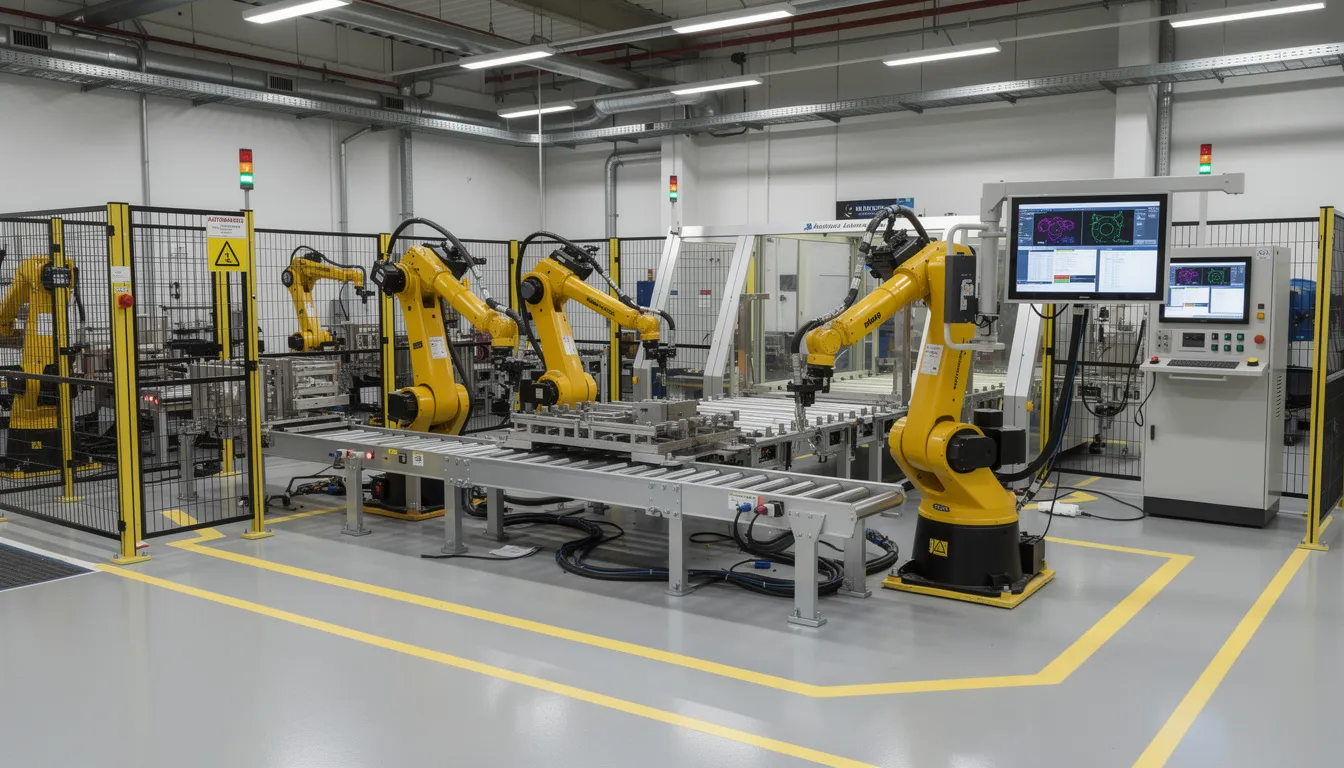
IEC 62443 applies to both new installations and legacy systems. Organizations can apply the framework to individual components, integrated systems, or complete facilities. From a Connect 981 viewpoint, concrete examples include workstations running digital work instructions, automated test stands interfacing with control systems, specialized MRO benches, and manufacturing cells controlled via PLCs and industrial networks. Each of these represents a system under consideration where cybersecurity requirements must be defined and maintained.
Modular structure of the IEC 62443 standards family
Four-part architecture
IEC 62443 is organized into four main groups, each targeting specific roles and abstraction levels within the industrial ecosystem. This modular architecture allows organizations to adopt the most relevant documents first, rather than implementing the entire family simultaneously.
The General group (part 1-x) establishes foundational terminology, concepts, and models for IACS security. The Policies and Procedures group (part 2-x) defines cybersecurity management system requirements for asset owners and IACS service providers. The System group (part 3-x) addresses system-level security risk assessment and system security requirements for integrated IACS. The Component group (part 4-x) covers secure development lifecycle requirements and technical security requirements for individual components.
Key documents in the series
IEC 62443-1-1 introduces the terminology, concepts, and models that form the vocabulary for the entire series. IEC 62443-2-1 specifies security program requirements for establishing and maintaining a cybersecurity management system within an industrial organization. IEC 62443-2-4 defines requirements for IACS service providers system integration and maintenance activities.
IEC 62443-3-2 provides the methodology for security risk assessment and defining zones and conduits within a system. IEC 62443-3-3 specifies system security requirements and security levels for integrated control systems. IEC 62443-4-1 addresses secure development lifecycle requirements for product suppliers. IEC 62443-4-2 defines technical security requirements for components, establishing component security assurance expectations.
Relationship between ISA and IEC naming
The standard family uses parallel naming conventions between ISA and IEC publications. For example, ISA-62443-3-3 and IEC 62443-3-3 contain aligned content. The series collectively spans more than 800 pages of material across technical reports and normative standards. Parts are designed to be used together, but each is formally a separate standard with its own publication and revision cycle, allowing organizations to reference specific editions as required by their governance frameworks.
Core concepts: Zones, conduits, security levels, and foundational requirements
IEC 62443 introduces a set of core concepts to describe industrial cybersecurity in a structured, repeatable way. These concepts provide the vocabulary for defining requirements, assessing risks, and aligning expectations among key stakeholder groups without prescribing specific security technologies.
System under Consideration
The System under Consideration (SuC) defines the boundary of what is being analyzed or specified. This might be a single production line, a SCADA system for a utility, or a multi-cell aerospace assembly area. Establishing the SuC is a prerequisite for conducting risk analysis and defining security controls appropriate to the operational context.
Zones and conduits
Zones are logical groupings of IACS assets that share similar security requirements. A zone might encompass a high-criticality flight-control component machining cell, a lower-criticality facility monitoring network, or an enterprise-facing data collection system. Assets within a zone share a common target security level.
Conduits are controlled communication paths linking zones. Security requirements for data flows through conduits are defined to manage the transfer of information between areas with different security postures. This approach supports network segmentation strategies that limit the propagation of cyber threats across industrial networks without requiring uniform measures throughout the entire facility.
Security levels
IEC 62443 defines security levels (SL 0 through SL 4) as a way to express the required resistance against classes of threat actors. SL 1 addresses protection against unintentional or accidental misuse. SL 2 addresses intentional attacks using simple means and moderate resources. SL 3 addresses sophisticated attacks with significant resources. SL 4 addresses advanced persistent threats with extensive capabilities. Organizations specify target security levels (SL-T) based on risk assessment, and systems or components provide capability security levels (SL-C) that indicate their inherent security features.
Seven foundational requirements
Parts 3-3 and 4-2 of the series define seven foundational requirements that structure the detailed system security requirements and technical security requirements:
- Identification and Authentication Control: Establishing and verifying identity of users, devices, and software.
- Use Control: Enforcing authorized privileges and least-privilege principles.
- System Integrity: Protecting systems and data from unauthorized modification.
- Data Confidentiality: Ensuring sensitive information is protected from unauthorized disclosure.
- Restricted Data Flow: Controlling and monitoring information flows between zones.
- Timely Response to Events: Detecting and responding to security incidents.
- Resource Availability: Ensuring critical systems remain available for intended operations.
These foundational requirements connect high-level IACS security program requirements with concrete system and component-level expectations.
Distinguishing IT and OT security in IEC 62443
Fundamental differences in priorities
Traditional IT systems environments prioritize data confidentiality, integrity, and availability in roughly that order. Enterprise networks, office applications, and cloud services can typically tolerate brief outages for patching and updates. In contrast, OT systems and operational technology environments prioritize availability and safety above all else. Control systems governing manufacturing processes, utility operations, and safety-critical functions must remain operational continuously. Unplanned downtime in OT environments can disrupt production, damage equipment, or create safety hazards.
IEC 62443 is explicitly designed around these OT constraints. Long equipment lifecycles, deterministic communication requirements, safety interlocks, and the need for continuous operation shape how security measures are interpreted and applied. The standard recognizes that aggressive patching cycles and frequent system restarts, common in IT environments, may be impractical or dangerous in operational technology environments.
Shared concepts with OT-specific interpretation
The standard family still addresses IT security concepts such as authentication, logging, data protection, and access control. However, IEC 62443 interprets these concepts in a way that reflects OT-specific requirements and risk trade-offs. For example, identification and authentication controls must function reliably without introducing latency that could disrupt real-time control loops.
Aerospace and MRO examples
In aerospace manufacturing and MRO operations, the IT/OT distinction manifests in concrete scenarios. A CNC machine tool cell where unplanned downtime disrupts flight hardware deliveries represents a high-availability OT environment. A test stand where control software interacts with high-energy systems subject to process safety standards requires careful integration of cybersecurity and safety requirements. Shopfloor terminals running digital work instructions may interface with both MES and ERP systems (IT) and machine controllers (OT), creating convergence points where both perspectives apply.
IEC 62443 provides a vocabulary to align IT security teams, OT engineers, and production management. The standard defines roles and shared concepts without prescribing a particular organizational structure, enabling organizations to coordinate control systems cybersecurity standards across functions.

Relevance of IEC 62443 for manufacturing, aerospace, and MRO operations
Connectivity and convergence in modern manufacturing
IEC 62443 is particularly relevant for modern manufacturing and aerospace operations where OT systems are increasingly connected to enterprise IT, supplier networks, and cloud-based analytics platforms. Industry 4.0 initiatives have expanded the attack surface for industrial automation control systems, making structured approaches to OT security essential. The standard provides a framework for addressing cybersecurity risks that arise when production systems, work instructions, and quality data flow across previously isolated boundaries.
Supporting key manufacturing concerns
The framework supports several operational concerns central to aerospace manufacturing and MRO:
- Maintaining predictable production schedules and turnaround times by protecting control systems that govern manufacturing execution
- Protecting integrity of process parameters, digital work instructions, and test results that feed quality and compliance records
- Ensuring traceability and auditability of control changes across facilities and suppliers participating in complex programs
Connection to aerospace regulatory and quality frameworks
Aerospace operations already navigate regulatory and quality frameworks including AS9100, FAA and EASA oversight, NADCAP audits, and ITAR requirements. IEC 62443 provides complementary IACS-focused expectations for critical infrastructure protection, but does not replace sector-specific regulations. The standard’s structured approach to defining zones, security levels, and security requirements can support regulatory compliance efforts by establishing consistent terminology and expectations for industrial automation and control systems security.
Connect 981 perspective on IEC 62443 alignment
From Connect 981’s perspective, a unified operations layer that connects ERP, MES, documentation, and shopfloor execution benefits from alignment with IEC 62443 concepts. Clear definition of systems and zones across multiple plants and suppliers supports consistent governance. Structured handling of configuration data and production records feeding traceability and quality systems reflects the integrity requirements central to the standard. Integration of supplier data and remote services into the broader OT and IT systems landscape can reference the conduit and zone concepts to maintain appropriate security controls.
Concrete manufacturing scenarios illustrate this relevance. A multi-site wing assembly program with shared routing and inspection workflows spans multiple zones, each with defined security requirements. An MRO facility managing serialized components with long service histories and distributed data sources must maintain control system solutions that protect the integrity of maintenance records across the component lifecycle.

Roles and responsibilities across the industrial ecosystem
Stakeholder categories in IEC 62443
IEC 62443 assigns expectations to different stakeholder groups involved with IACS. The standard recognizes that industrial cybersecurity is not the responsibility of any single party, but rather emerges from coordinated efforts across asset owners, product suppliers, system integrators, and service providers.
Asset owner responsibilities
Asset owners, typically the organizations operating industrial facilities, define required security levels for their systems based on security risk assessment. They establish and maintain a cybersecurity management system, coordinate cybersecurity practices across sites, and implement continuous monitoring and response capabilities. Asset owners are responsible for ensuring that the combined system meets target security levels, even when integrating components from multiple suppliers.
Product supplier responsibilities
Product suppliers, including OEMs of control system components, design and document component security capabilities in line with IEC 62443-4-1 and 4-2. Secure development lifecycle requirements ensure that products are designed with security in mind from the outset. Suppliers document the security levels components can achieve and provide information needed for integration and operation.
Integrator and service provider responsibilities
System integrators combine components from multiple suppliers into systems that meet defined security requirements. They are responsible for ensuring that the integrated system achieves the target security levels specified by asset owners. IACS service providers, including those providing maintenance, engineering, and remote support, must meet requirements defined in IEC 62443-2-4 for documentation, testing, and lifecycle support.
Coordination in aerospace environments
In aerospace manufacturing and MRO environments, multiple parties must coordinate around consistent terminology and requirements. Internal engineering teams, external equipment OEMs, specialized MRO service providers, and digital platform vendors all contribute to the security posture of connected production systems. IEC 62443 provides the shared vocabulary that enables this coordination without prescribing specific organizational structures.
Integration with broader standards and governance frameworks
IEC 62443 is often used alongside other international and sectoral standards. ISO/IEC 27001 addresses information security management for enterprise IT systems. The NIST Cybersecurity Framework provides a risk-based approach applicable across sectors. Process safety standards such as IEC 61511 address functional safety for industrial processes. Each covers distinct but related domains.
IEC 62443 focuses specifically on IACS and OT, while ISO/IEC 27001 primarily addresses information security for enterprise IT. Organizations commonly map requirements between these frameworks to achieve unified governance across IT and OT environments. The zone and conduit concepts from IEC 62443 can complement higher-level risk and compliance frameworks, providing specific vocabulary for industrial networks and critical systems within broader governance structures.
For aerospace operations already managing AS9100, FAA, EASA, and ITAR compliance, IEC 62443 offers additional structure for addressing cybersecurity risks in production and MRO environments. The standard’s terminology for security levels, foundational requirements, and system security assurance can support audit readiness and consistent reporting across industry sectors.
From the perspective of a connected operations platform like Connect 981, aligning data models and workflows with IEC 62443 concepts supports consistent reporting, documentation, and audit readiness across factories, MRO facilities, and suppliers. The framework provides a reference for coordinating digital workflows and external networks without creating conflicts with existing regulatory compliance requirements.
Practical considerations and limitations when applying IEC 62443
Phased adoption
The IEC 62443 series is extensive, covering hundreds of pages across multiple parts. Organizations typically phase their adoption according to role and priority. Asset owners may begin with IEC 62443-2-1 to establish a cybersecurity management system, while product suppliers focus on IEC 62443-4-1 and 4-2 for secure development and component requirements. This modular approach allows organizations to adopt the most relevant documents first without requiring simultaneous implementation of the entire family.
Contextual factors in industrial environments
Industrial plants and aerospace operations present contextual factors that affect how IEC 62443 requirements are interpreted and applied. Prevalence of legacy control systems with limited security capabilities, heterogeneous vendor landscapes spanning multiple generations of equipment, and multi-decade asset lifecycles all influence implementation approaches. The standard family intentionally leaves room for organizations to interpret and implement requirements in line with their own risk governance and operational constraints.
Ongoing evolution of the standard
Different parts of the standard family mature at different times, with revisions and new technical reports periodically published through the IEC and ISA. Organizations must track applicable editions and updates to ensure their practices remain aligned with current expectations. The ISA Global Cybersecurity Alliance continues to coordinate development and provide guidance on applying the series across industry sectors including the industrial process sector, discrete manufacturing, and critical infrastructure.
Conclusion: IEC 62443 as a reference point for secure industrial operations
IEC 62443 provides a structured, role-aware framework for describing and specifying cybersecurity requirements for industrial automation and control systems across industries. The series establishes clear scope, modular structure, and core concepts including zones, conduits, security levels, and seven foundational requirements. The explicit distinction between IT and OT security ensures that the framework addresses the unique constraints of critical functions in operational technology environments.
For manufacturing, aerospace production, and MRO operations, IEC 62443 offers particular relevance. Digital traceability, controlled workflows, and cross-site consistency depend on systems where integrity and availability are paramount. The framework provides vocabulary and expectations that support coordination among engineering, operations, suppliers, and enterprise governance functions managing critical assets across complex programs.
From Connect 981’s perspective, standards such as IEC 62443 form a foundational reference for designing and governing digital industrial operations. The framework enables alignment between operational technology security requirements and the connected workflows that define modern aerospace manufacturing and MRO, supporting organizations as they maintain control system solutions that meet evolving expectations for industrial cybersecurity.



Related Blog
Related FAQ
Built for Speed, Trusted by Experts
Whether you're managing 1 site or 100, Connect 981 adapts to your environment and scales with your needs—without the complexity of traditional systems.
