ISO 22400 Basics: Core Definitions, KPI Concepts, and Terminology
Learn how ISO 22400 defines the core terminology and concepts for manufacturing KPIs, and how aerospace organizations can use this shared vocabulary to align MES, ERP, and shop-floor reporting.

ISO 22400 gives aerospace manufacturers a shared language for talking about performance. Instead of each plant defining its own version of “availability” or “equipment utilization,” the standard describes how key performance indicators (KPIs) should be structured and interpreted for manufacturing operations management (MOM). It does not tell you which KPIs to use or what “good” looks like; it defines what those KPIs mean.
For aerospace and defense programs running across multiple sites, partners, and tiers of the supply chain, this common vocabulary matters. It makes it possible to compare the performance of a nacelle line in one region with a composite structures cell in another using consistent terms. Platforms like Connect 981 use these ISO 22400 manufacturing KPI concepts as a neutral layer so MES, ERP, QMS, and engineering systems can exchange performance data without semantic confusion.
What ISO 22400 Tries to Standardize (and Why It Matters)
ISO 22400 focuses on the conceptual side of manufacturing KPIs. It defines the building blocks, categories, and relationships behind performance indicators used in MOM environments. For aerospace plants, that means the terms used in OEE dashboards, turnaround-time reports, and shop-floor status boards can be interpreted consistently from program to program and site to site.
The role of common KPI language in multi-site manufacturing
In a typical aerospace enterprise, different facilities may have grown up with local KPI dialects. One final assembly line might report “uptime,” a composites facility reports “machine availability,” and an MRO shop tracks “bay occupancy.” Without shared definitions, leadership cannot be sure whether numbers are directly comparable, even when they use similar words.
ISO 22400 addresses this by standardizing:
- How performance indicators and KPIs are defined conceptually
- How time, quantity, and state concepts relate to each other
- Which attributes a KPI description should include (purpose, unit, time behavior, users, trend direction, and so on)
For aerospace programs with stringent regulatory and contractual obligations, this consistency underpins reliable reporting to airframers, defense agencies, and aviation authorities. When contracts reference KPIs that align with ISO 22400 terminology, disputes about “what was actually measured” become less likely.
How ISO 22400 fits into the standards landscape (IEC 62264, etc.)
ISO 22400 sits alongside other standards that describe how an aerospace factory’s digital infrastructure is organized. IEC 62264 (and its ISA-95 lineage) defines integration between enterprise systems (planning, finance) and control systems (equipment, cells, lines). It introduces levels such as enterprise, site, area, work center, and work unit.
ISO 22400 aligns its KPI concepts with these levels, focusing primarily on what IEC 62264 calls Level 3: manufacturing operations management. That is where MES, dispatching, detailed scheduling, and WIP tracking live. In practice, this means:
- KPIs are defined at the same structural levels you use for routing, work centers, and work units in MES
- Performance data exchanges between MES, ERP, QMS, and data historians can reference a common hierarchy
- Plant-level reports and program-level summaries can be tied back to standard, named KPI concepts
For regulated aerospace environments, this alignment simplifies building traceable, auditable flows of performance information across planning, execution, and reporting systems.
Core Performance Measurement Concepts in ISO 22400
ISO 22400 starts by clarifying the basic elements of performance measurement in manufacturing. If your teams use these terms consistently, integration projects and cross-plant benchmarking become far simpler.
Performance indicators vs. key performance indicators
The standard makes a clear distinction between “performance indicators” and “key performance indicators”:
- Performance indicator: any measurable quantity or relationship that characterizes how a process, resource, or order behaves. Examples in aerospace include time an autoclave spends in RUN state, number of accepted parts after inspection, or hours spent on unplanned rework.
- Key performance indicator (KPI): a selected subset of those indicators judged critical for understanding performance and steering operations. KPIs are not just raw numbers; they are indicators that have been named, described, and contextualized.
In ISO 22400 terms, a KPI comes with a conceptual description: what object it applies to (equipment, line, order), which time horizon it covers (shift, day, campaign), its intended users (operators, supervisors, management), and the expected trend direction (higher is better, lower is better, target band, and so on).
For an aerospace composite layup cell, “time in oven RUN state” is a performance indicator. “Oven utilization for autoclave A23 during the last shift,” normalized against planned time and described per ISO 22400, can be treated as a KPI.
From raw signals to derived indicators to KPIs
ISO 22400 also introduces a layered view of how performance data is built:
- Raw signals: direct outputs from control systems or sensors, such as machine ON/OFF, RUN/STOP state codes, part count increments, or temperature readings.
- Derived indicators: values computed from raw signals, like time in a given state, quantities produced per period, or counts of changeovers for a work unit.
- KPIs: standardized constructs created from one or more derived indicators, aligned with ISO 22400 terminology and attributes.
Consider an aerospace drilling cell producing wing skins. PLC data shows RUN, IDLE, and STOP states plus part counters. The MES aggregates these signals into derived indicators: total RUN time during a shift, number of completed skins, scrap count. ISO 22400 then provides a conceptual pattern for defining a KPI like “equipment utilization for drilling cell 4,” based on those derived indicators, with a clear description of what time buckets and quantities it uses.
This separation is important in aerospace programs with mixed equipment vintages and multiple MES instances. Different equipment can produce different raw signals, yet you can still converge on common KPIs as long as the derived indicators and definitions follow ISO 22400 patterns.
Defining Manufacturing Operations Management (MOM)
Manufacturing operations management (MOM) is central to ISO 22400. The standard uses MOM as the context in which KPIs are defined and interpreted.
MOM in relation to ERP and control systems
In an aerospace factory, enterprise resource planning (ERP) handles contracts, customer orders, high-level capacity planning, and financials. At the other end of the stack, control systems operate equipment, collect signals, and enforce process parameters on machines, cells, and test stands.
MOM sits between these layers and includes functions typically associated with MES and related systems:
- Dispatching work orders and operations to the shop floor
- Tracking WIP status for assemblies, subassemblies, and components
- Recording execution data such as start/stop times, scrap counts, and test results
- Coordinating maintenance, tool availability, and material readiness
ISO 22400 KPIs are designed primarily for this MOM layer, where execution decisions are made and where aerospace-specific constraints—such as serialized component tracking, configuration control, and inspection holds—are applied.
Typical MOM activities covered by ISO 22400
The standard spans several functional areas that matter for regulated aerospace production:
- Production operations: order execution, sequencing, changeovers, resource allocation to work units and lines.
- Maintenance operations: planned and unplanned maintenance, equipment readiness, impact of downtime on critical production assets.
- Quality operations: inspection, test, containment, and disposition activities that affect throughput and scrap/rework.
- Inventory and logistics operations: internal material flows, staging, and WIP movement that influence lead time and work center loading.
In each area, ISO 22400 emphasizes that performance indicators should be defined against a clear object (equipment, order, resource) and time context. For example, a KPI that measures the execution reliability of a batch of flight-critical actuators must explicitly state whether it is computed per production order, per work center, or per plant, and over what time base.
Key ISO 22400 Terms Manufacturers Should Know
Adopting ISO 22400 terminology starts with a few core concepts that show up repeatedly in MOM KPIs. For aerospace teams, these terms form the backbone of performance conversations between operations, engineering, and program leadership.
Availability, utilization, and equipment effectiveness
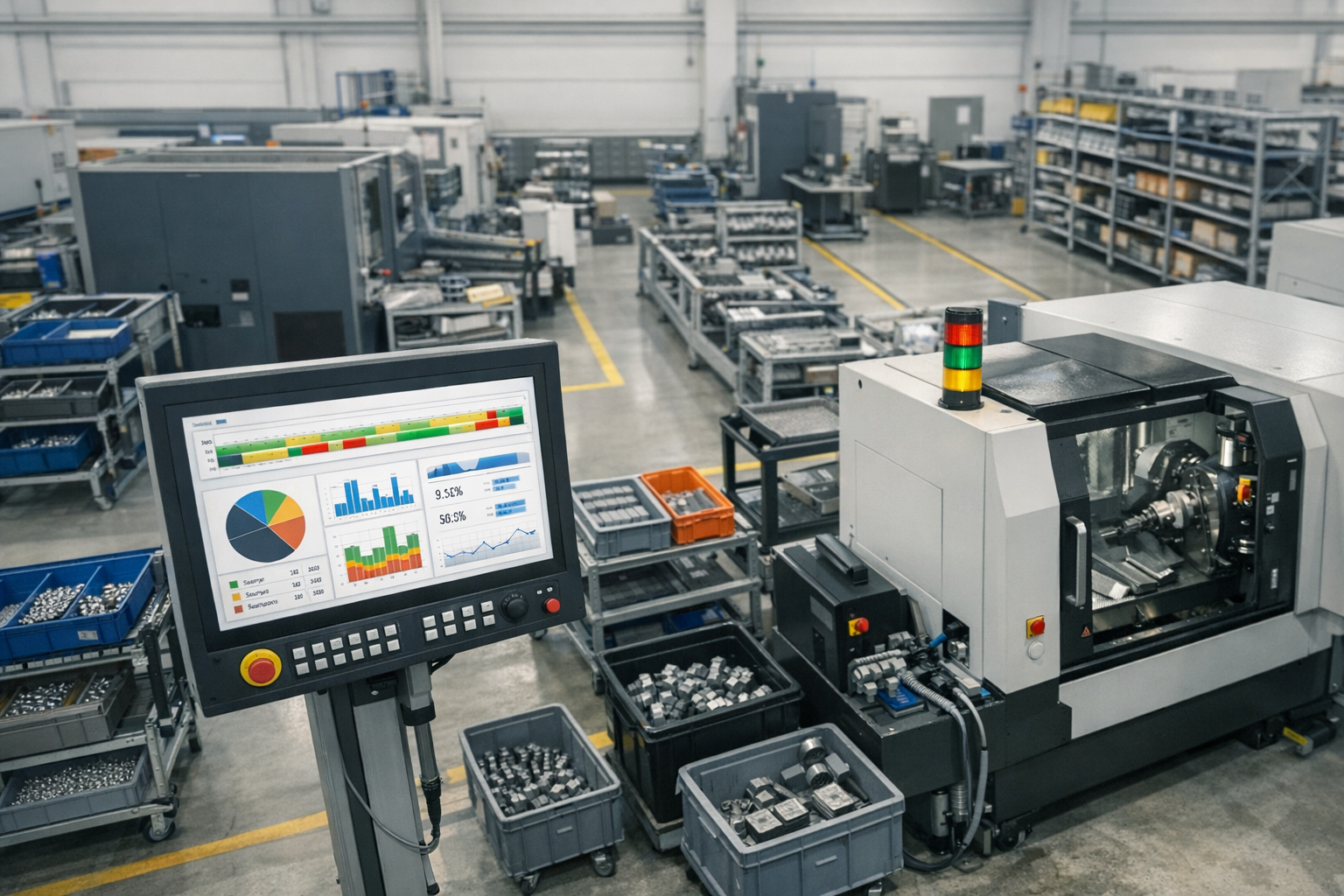
ISO 22400 devotes significant attention to equipment-focused measures because they underpin many shop-floor dashboards:
- Availability: conceptually, how much of the planned time a resource is actually in a state where it can produce. Downtime—both planned (e.g., scheduled maintenance) and unplanned—reduces availability.
- Utilization: how much of the available capacity is actually used. A machining center might be available but idle because material is missing or an operator is reassigned to another line.
- Equipment effectiveness: an aggregate concept capturing availability, performance (speed or throughput against a reference), and quality (proportion of good output). ISO 22400 describes several OEE-related models using standardized time and quantity elements.
On a composite layup line, availability might be constrained by autoclave maintenance, while utilization is limited by tooling readiness or cure cycle sequencing. Using ISO 22400 definitions helps isolate which aspect of performance is actually being affected and avoids conflating downtime with underutilization.
Work unit, production order, and state definitions
The standard also formalizes several structural and state-related terms that are particularly relevant when harmonizing KPIs across an aerospace digital thread:
- Work unit: the smallest functional production entity considered for MOM KPIs. In aerospace, this might be a specific machine (5-axis mill), a cell (drilling and fastening station), or even a test rig.
- Production order: an instruction to produce a defined quantity of a given configuration—such as a set of serialized landing gear components or a batch of engine brackets—often linked back to ERP or program planning.
- Equipment state: the abstracted condition of a work unit, such as RUN, STOP, IDLE, or SLOW. ISO 22400 uses these states as the basis for time categorizations that feed many KPIs.
State definitions matter because they determine how time is allocated across availability, utilization, and other indicators. For example, if an aircraft structure assembly station is IDLE because an engineering change is being evaluated, ISO 22400-based time models need a consistent way to classify that state—so that program reports differentiate engineering holds from pure equipment downtime.
How Clear Terminology Enables Better KPI Governance
Once terminology is aligned, aerospace organizations can treat KPIs as governed data assets rather than ad hoc report outputs. Governance is critical in environments where regulators, customers, and internal stakeholders all depend on consistent, traceable performance information.
Reducing ambiguity in internal and supplier reporting
Without standardized terminology, the same label can hide different calculation methods. One site might exclude quality holds from availability; another might include them. Over time, such inconsistencies undermine confidence in enterprise dashboards and supplier scorecards.
By adopting ISO 22400 terminology, you can:
- Specify unambiguous definitions for KPIs in internal reporting standards
- Clarify which time categories and states are included in each indicator
- Ensure that plant-level and supplier-level reports are structurally comparable
For example, a supplier delivering composite subassemblies can be required to report “equipment utilization for autoclaves” following an ISO 22400-aligned definition. This lets the prime contractor compare utilization patterns across multiple suppliers and internal sites without interpreting each data set from scratch.
Using ISO 22400 terms in contracts and SLAs
In aerospace contracts, words like “on-time completion,” “turnaround time,” and “line availability” often appear in service-level agreements (SLAs). If each party interprets these differently, disagreements multiply when performance is questioned.
ISO 22400 provides a neutral vocabulary that can be referenced in:
- Long-term agreements with tier-1 and tier-2 suppliers
- Maintenance and MRO contracts defining hangar or test stand performance
- Internal service agreements between central functions (e.g., shared coating facilities) and individual programs
By citing standard-aligned KPI definitions in these documents, aerospace organizations can make performance clauses more objective and auditable, while still tailoring thresholds and targets to the specific program or asset class.
Practical Next Steps for Adopting ISO 22400 Vocabulary
Adopting ISO 22400 terminology does not require redesigning every dashboard. It typically starts with clarifying language, then incrementally mapping existing indicators into standard-aligned structures.
Creating internal KPI glossaries and data dictionaries
A practical first move is to build an internal KPI glossary and data dictionary aligned with ISO 22400 concepts. For each KPI already in use—such as “autoclave availability,” “test stand OEE,” or “order execution reliability for flight control actuators”—document:
- The object of measurement (work unit, work center, order, plant)
- The time horizon (shift, day, rolling week, campaign)
- The underlying time buckets and quantities used in the calculation
- How state codes from control systems map to ISO 22400 states
This documentation helps engineering, production, and IT teams understand where definitions diverge from the standard and where they already align. In an AS9100 environment, such a dictionary can be treated as a controlled document, supporting auditability and change control for performance metrics themselves.
Aligning existing KPI names to ISO 22400 concepts
Most aerospace manufacturers already track a rich set of metrics in MES, QMS, and reporting tools. The challenge is not inventing new KPIs but realigning names and definitions with ISO 22400 so performance data becomes interoperable across systems and sites.
Typical steps include:
- Grouping existing metrics into ISO 22400 categories (equipment-oriented, order-related, resource-related)
- Identifying where multiple names refer to the same concept and consolidating them under a standard term
- Flagging metrics that mix conceptual dimensions (e.g., combining availability and quality into a single opaque index) and breaking them into clearer indicators
- Updating integration specifications so data exchanges use ISO 22400-aligned identifiers and descriptions
A platform like Connect 981 can help by providing a common data model that maps plant-specific tags and labels into ISO 22400 concepts. This lets existing systems retain local naming conventions, while enterprise-level analytics and cross-program dashboards work with a standardized vocabulary.
How ISO 22400 Relates to Other Levels and Standards
ISO 22400 does not operate in isolation. It is designed to slot into the layered model of manufacturing systems defined by IEC 62264 and related standards, particularly around MOM (Level 3) activities.
Hierarchy levels and KPI focus
Within the IEC 62264 hierarchy, ISO 22400 focuses on KPIs that live primarily at the MOM level:
- Level 4 (enterprise planning): business KPIs tied to financial results, customer service, and long-term capacity are largely out of scope.
- Level 3 (MOM): the core scope for ISO 22400 KPIs, where production, quality, maintenance, and inventory operations are planned and executed.
- Levels 0–2 (control and equipment): raw signals and control logic are not standardized by ISO 22400, but they feed the derived indicators and KPIs defined at Level 3.
In practice, this means aerospace organizations can use ISO 22400 to harmonize the KPI layer of their digital manufacturing infrastructure, even when they use different vendors, architectures, or deployment models at the control or enterprise levels.
Limits of KPI standardization in regulated environments
ISO 22400 deliberately avoids prescribing calculation formulas, performance targets, or improvement methods. This is especially important in regulated aerospace contexts, where organizations must tailor KPIs to program-specific requirements, regulatory frameworks, and risk profiles.
The standard does not decide:
- Which KPIs are mandatory for a given aircraft program or defense platform
- What thresholds define acceptable performance or trigger escalation
- How KPIs feed into incentive schemes or continuous improvement initiatives
Instead, ISO 22400 defines terminology and structures. Aerospace manufacturers, MRO organizations, and system integrators then layer their own domain-specific metrics—such as turnaround time breakdowns, concession rates, or first-pass yield for flight-critical assemblies—on top of that vocabulary. Where those metrics overlap with ISO 22400 concepts, the standard provides a clean way to describe them; where they are unique, they can coexist without being misrepresented as ISO 22400 KPIs.
ISO 22400 in a Connected Aerospace Manufacturing Environment
Aerospace production and MRO facilities rely on a complex ecosystem of digital systems: ERP for contracts and orders, PLM for product definitions and configurations, MES for execution, QMS for nonconformance and corrective actions, and historians or data lakes for time-series data. ISO 22400 offers a neutral KPI layer that can bind these systems together.
In this environment, a standard-aligned KPI model helps ensure that when a program manager views a dashboard combining OEE data from machining, yield data from inspection, and schedule adherence from planning, every number is grounded in consistent meaning.
Data integration and interoperability benefits
From an integration perspective, ISO 22400 supports:
- Common naming: interface specifications can use standardized KPI identifiers, reducing ambiguity when systems are integrated or replaced.
- Stable semantics: as plants modernize equipment, underlying raw signals can change without forcing a redefinition of KPIs, as long as the derived indicators still align with ISO 22400 concepts.
- Traceability of performance data: KPI definitions can be treated like other controlled data artifacts in the digital thread, supporting audits and investigations.
For example, when a new MES is rolled out to a wing assembly plant, the integration team can map its event codes and counters to existing ISO 22400-aligned KPIs, maintaining continuity for enterprise reports and supplier scorecards.
Connect 981’s role in applying ISO 22400 concepts
As a digital manufacturing platform focused on aerospace and regulated production, Connect 981 can implement ISO 22400 terminology as a shared reference layer. While each organization retains its own KPI choices and targets, the platform can:
- Map equipment states, order events, and inspection results into ISO 22400-aligned indicators
- Link KPIs to serialized components and configurations, preserving part genealogy and performance context
- Expose standard-aligned KPI definitions to downstream analytics and reporting tools
This approach supports cross-program visibility without forcing every plant or supplier to abandon their existing systems. The key is that wherever KPIs appear—in shop-floor dashboards, supplier portals, or executive summaries—their underlying terminology is consistent with ISO 22400.
Summary: Using ISO 22400 Terminology to Strengthen KPI Foundations
ISO 22400 gives aerospace manufacturers a rigorous language for describing manufacturing KPIs. It clarifies the distinction between raw signals, derived indicators, and KPIs; defines core terms like work unit, equipment state, availability, and utilization; and aligns MOM-level metrics with the broader enterprise-control hierarchy.
The standard does not replace organizational strategy or sector-specific metrics. Instead, it offers a common foundation so that performance data from diverse plants, partners, and systems can be interpreted consistently. For aerospace organizations operating in AS9100 and similar regulated environments, adopting ISO 22400 terminology supports clearer contracts, more reliable cross-site comparisons, and stronger data governance across the digital thread. Platforms such as Connect 981 can then apply this vocabulary across MES, QMS, ERP, and engineering systems, turning performance measurement into a coherent, standards-aligned capability rather than a collection of disconnected local practices.
Note: This article is an educational overview of ISO 22400 concepts in the aerospace manufacturing context. It does not reproduce the standard text or replace the need to consult the official ISO 22400 documents.



Related Blog



Built for Speed, Trusted by Experts
Whether you're managing 1 site or 100, Connect 981 adapts to your environment and scales with your needs—without the complexity of traditional systems.
