ISO 22400 Inventory Accuracy: Practical KPIs for Aerospace Work-Order Control
Introduction: Why ISO 22400 Matters for Inventory Accuracy in AerospaceIn aerospace, inventory accuracy is not an accounting preference. It determines whether a work package can start, whether a technician can complete a task without interruption, and whether the record behind a serialized part will stand up during an audit. A missing bushing, an expired consumable,…

Introduction: Why ISO 22400 Matters for Inventory Accuracy in Aerospace
In aerospace, inventory accuracy is not an accounting preference. It determines whether a work package can start, whether a technician can complete a task without interruption, and whether the record behind a serialized part will stand up during an audit. A missing bushing, an expired consumable, or a wrong-revision component can stop a narrow-body heavy check as surely as a major structural finding.
ISO 22400 gives operations teams a common way to define key performance indicators across manufacturing systems. This article focuses on one practical application: iso 22400 inventory accuracy for aerospace manufacturing and MRO work-order control. The goal is not to explain the standard in abstract terms. The goal is to identify the inventory metrics that improve decisions on the floor.
For aerospace manufacturing and maintenance operations, inaccurate stock data creates consequences beyond higher operating costs. It can trigger AOG spares escalation, missed turnaround commitments, repeated re-kitting, poor order accuracy, and audit exposure tied to traceability or revision control. Stock-outs, or instances when demand cannot be met due to insufficient inventory, can lead to lost sales and customer dissatisfaction, highlighting the importance of effective stock level management.
Connect 981 approaches this from the operating layer. The platform connects ERP, MES, WMS, supplier data, digital work instructions, and shopfloor execution events so inventory management kpis can be calculated from live work, not manually rebuilt in spreadsheets after the fact.
ISO 22400 Basics: From Standard to Day-to-Day Inventory Metrics
ISO 22400 is an international standard that defines a standardized framework for Key Performance Indicators (KPIs) used in Manufacturing Operations Management (MOM). It was developed by the International Organization for Standardization, the international organization behind many global operating standards, and ISO 22400-2:2014 provides a catalogue of KPI definitions for manufacturing operations management.
The standard mandates that every metric follow a rigid structural template to eliminate arbitrary definitions across different production sites. ISO 22400 provides precise formulas and data elements for critical KPIs to ensure consistency across different software systems, production sites, and industries. In practice, that means an inventory kpi calculated at one plant should mean the same thing at another plant if both use the same objects, time model, and data definitions.
ISO 22400 maps directly to the hierarchical models found in IEC 62264, linking inventory metric calculations with physical shop floor nodes. That matters when a KPI must be calculated for a plant, line, work center, cell, storage location, or specific work unit. ISO 22400 categorizes KPIs into specific groups to support lean manufacturing and waste reduction, and ISO 22400 emphasizes that inventory should be evaluated using standardized time models to understand inventory transit and storage delays. More detail on the standard is available through the ISO 22400-2 catalogue.
For inventory management, the useful point is simple: key performance indicators kpis should connect stock, time, orders, quality, and production performance. Key performance indicators (KPIs) in inventory management are metrics that help monitor and make decisions about stock, providing insights into turnover, sales, demand, costs, and process success.
ISO 22400 defines several specific KPIs relating to inventory operations, such as Inventory Turns and Storage Loss Ratio, to prevent production bottlenecks. These map naturally to familiar inventory metrics such as inventory turnover, inventory days, inventory to sales ratio, stock to sales ratio, lead time, and order cycle performance.
In aerospace operations management, those metrics need careful scope. A part may be physically present but unusable because it is on quality hold, at the wrong revision, missing paperwork, under repair, or assigned to another aircraft. Inventory management systems, manufacturing execution systems, automation systems, ERP, WMS, QMS, and supplier portals must agree on that status, or the KPI shows confidence that the shopfloor cannot use.
Core ISO 22400-Aligned KPIs That Directly Improve Inventory Accuracy
The first question is which ISO 22400-aligned KPIs actually matter for inventory accuracy. In aerospace factories and MRO shops, the answer is not every dashboard number. The useful metrics are the ones that expose whether available inventory is real, usable, traceable, and aligned with upcoming work.
Inventory Accuracy. This kpi measures whether the physical stock matches the electronic records. Inventory accuracy is crucial for ensuring that the physical stock matches the electronic records, which helps prevent issues such as poor order accuracy and increased costs. Available inventory accuracy can be calculated using the formula: Available inventory accuracy = (# counted items that match record / # counted items) x 100, which helps identify discrepancies between recorded and actual stock levels.
Track this at material group level for flight-critical, safety-critical, consumables, and controlled hardware. Track it at work-center level for line-side bins, tool cribs, quarantine areas, and kitting zones. In supply chain management, maintaining high Inventory Record Accuracy (IRA), typically aiming for 95% to 99%, is crucial. For critical serialized parts, many aerospace teams target the upper end of that range because one wrong serial number can invalidate a work package.
Maintaining high inventory accuracy is essential for effective inventory management, as it directly impacts the ability to fulfill customer orders and manage stock levels efficiently. In an MRO facility, this includes parts removed from an aircraft, parts under evaluation, parts awaiting disposition, and parts returned to stores after work stops.
Inventory Shrinkage. Inventory shrinkage measures the gap between book stock and physical stock after normal transactions are accounted for. The basic calculation is book quantity minus physical quantity, divided by book quantity. Aerospace causes include scrapped serialized parts not closed correctly, cannibalization not logged, parts moved between bays without scans, kits opened early, or returns placed in the wrong controlled location.
ISO 22400 supports this through its loss categories, including storage and transport loss. A storage loss ratio can be calculated as storage and transportation loss divided by consumed material. Track shrinkage by location, material class, and work center. A plant-level total inventory view is useful for business planning, but it will not show whether the receiving dock, internal transport route, or final kitting area is the source of loss.
Inventory Turnover Rate. The inventory turnover rate measures how many times a company sells and replaces its stock in a given period, typically a year, indicating how well a company manages its inventory. The inventory turnover rate measures how many times a company sells and replaces its stock in a period, indicating how well a company makes sales from its inventory. In aerospace, this can be adapted to how many times inventory is consumed, repaired, issued, or replaced against work-order throughput.
The formula for calculating inventory turnover is: Inventory turnover rate = Cost of goods sold / Average inventory, which helps businesses assess their inventory efficiency. ISO 22400 expresses inventory turns as throughput divided by average inventory. To calculate average inventory, use beginning inventory plus ending inventory divided by two for the specific period being reviewed. For value-based reporting, teams often use average inventory value rather than unit count.
A higher inventory turnover rate generally indicates efficient inventory management, as it suggests that a company is selling its products quickly and not overstocking. In aerospace, the interpretation must be segmented. Fast-moving consumables should turn quickly. Rotables, life-limited parts, and strategic AOG spares may turn slowly by design. The inventory turnover rate is useful only when tied to customer demand, actual demand, program risk, and service commitments.
Inventory to Sales Ratio and Stock-to-Sales. The stock-to-sales ratio is a key metric that compares the amount of inventory available for sale to the amount sold, helping businesses optimize their stock levels and improve cash flow. In aerospace manufacturing and MRO, the sales ratio usually maps to throughput, completed work packages, maintenance events, or shipped assemblies rather than retail sales. The inventory to sales ratio can be calculated as inventory value divided by throughput value for the same period.
Maintaining a balanced stock-to-sales ratio is crucial; a low ratio may indicate a risk of stockouts, while a high ratio can lead to increased holding costs. Tracking stock levels is crucial for maintaining a balance between supply and demand, as having too much inventory can lead to increased costs, while too little can result in missed sales opportunities. This is where excess inventory, unsold inventory, dead stock, and remaining inventory become operational risks, not just finance terms.
Track this at program level, spares warehouse level, and material group level. A high total inventory value can look safe while the floor still suffers stock outs on small but line-critical hardware. A low stock to sales ratio may improve cash flow until a high-priority aircraft cannot be released.
Inventory Days and Days Sales of Inventory. Days sales of inventory (DSI) is a related metric that indicates the average number of days it takes to sell through inventory, with lower values indicating faster turnover. Days on hand (DOH) is a KPI that indicates the average number of days inventory is held before it is sold, helping businesses understand how long cash is tied up in stock. In aerospace, inventory days should be calculated by material class and operational use.
For titanium forgings, composite materials, shelf-life adhesives, sealants, fasteners, and life-limited parts, inventory days highlights exposure to aging, expiration, storage errors, and configuration changes. It also helps identify materials that cannot be sold, consumed, installed, or released because documentation is incomplete. When days sales, inventory days, and demand forecasting accuracy diverge, planners should review stock purchases, reorder logic, and expected work-order load.
Carrying Cost. Carrying cost measures the full cost of holding stock. Inventory carrying cost includes capital costs, storage space costs, insurance, inventory service costs, handling, compliance storage, climate control, obsolescence, shrinkage, and inventory risk costs. For aerospace, holding costs also include shelf-life monitoring, temperature-controlled storage, security, serialization, and the labor needed to maintain accurate documentation.
Calculate carrying cost by class, not just across total inventory. Flight-critical rotables, AOG spares, expendables, and consumables have different risk profiles. A gross margin return view may help finance understand whether inventory value supports output, but operations needs the practical version: which stock is protecting schedule, which stock is hiding poor data, and which stock is tying up cash flow without supporting work.
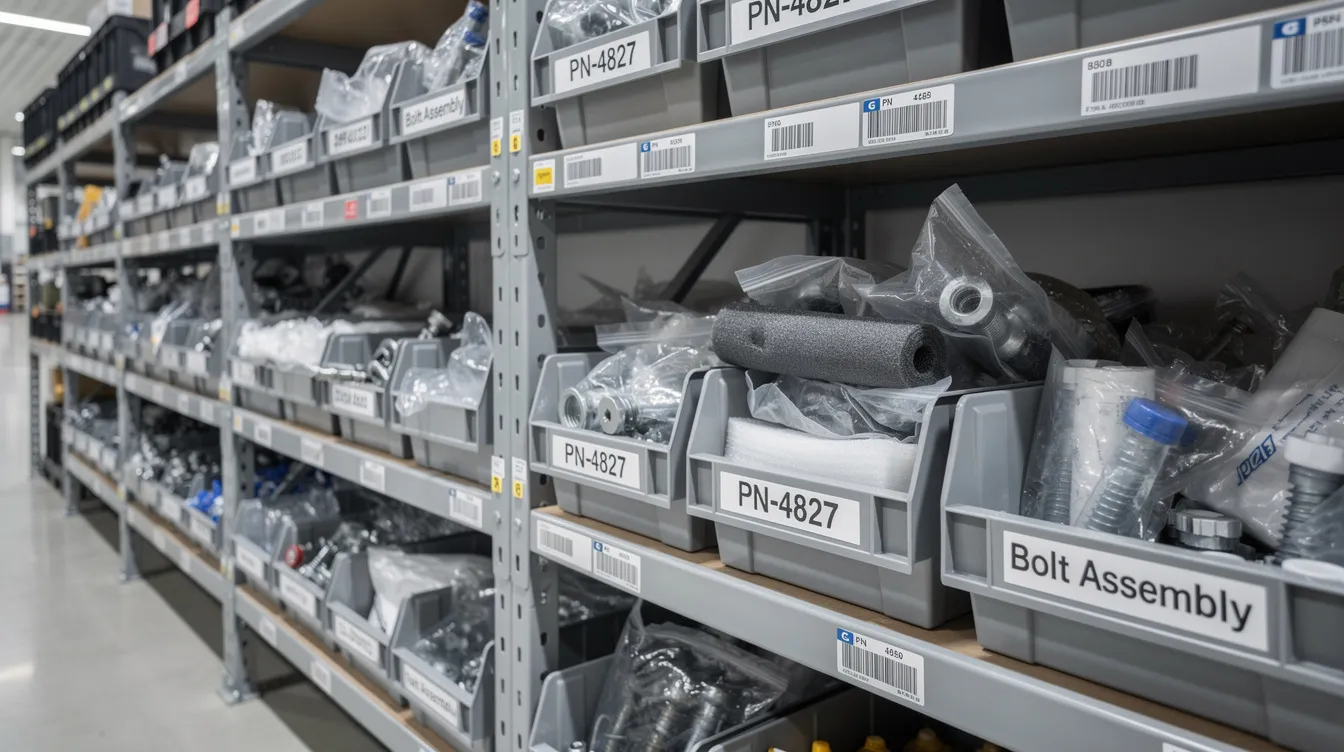
Work-Order Control KPIs: Using ISO 22400 to Keep Orders and Inventory in Sync
Inventory accuracy is only useful if it stays synchronized with work-order execution. A warehouse record can be correct at 7 a.m. and operationally wrong by 10 a.m. if a kit is short, a serial is substituted without approval, or a return is not posted after a job is paused.
Order Cycle Time / Manufacturing Order Lead Time. This kpi measures elapsed time from work-order release to completion. ISO 22400 provides time elements such as planned and actual order execution time, which support consistent lead time tracking. Teams can calculate lead time as completion timestamp minus release timestamp, then separate waiting time, queue time, inspection time, and rework time.
Long lead time often reveals inventory problems that are not visible in stock records. An order may sit because a serialized component is in inspection, a kit is physically staged in the wrong bay, or a supplier certificate is missing. In production scheduling, lead time should be reviewed beside material availability, not as a standalone labor metric.
Schedule Adherence. Schedule adherence measures the percentage of work-orders started or finished as planned. ISO 22400 event data supports this through planned and actual timestamps for order release, start, stop, and completion. When schedule misses repeat in the same cell, the cause may be phantom stock, low pick accuracy, late inspection release, or wrong configuration in the kit.
A structural repair can show this clearly. The schedule says reassembly starts Thursday morning. The ERP record says the bracket is available. At issue, the part is found at the prior revision. The schedule adherence miss is not simply a production delay. It is an inventory, configuration, and documentation failure.
Material Availability at Order Release. This measures the percentage of work-orders that launch with all required components available, reserved, traceable, and ready for use. The formula is work-orders released complete divided by total work-orders released. This KPI uses BOM, routing, inventory, reservation, quality hold, and material issue events.
High stock-out rates can lead to customer dissatisfaction, as they indicate that demand cannot be met due to insufficient inventory, resulting in lost sales and frustrated customers. In aerospace, stock outs may also trigger AOG escalation, overtime, schedule compression, or customer relations issues with an airline or prime contractor.
Pick, Pack, and Kitting Accuracy. This measures whether the correct components, quantities, serials, lots, and revisions are issued to the work-order. It is one of the most important operational controls for aerospace because the wrong part can be worse than no part. A wrong-revision bushing or unapproved substitution may create rework, nonconformance, or compliance exposure.
This KPI relies on material issue events, barcode or RFID scans, work-order requirements, and revision-controlled documents. It catches hidden inventory issues such as mislocated bins, duplicate labels, mixed lots, uncontrolled substitutions, and delayed returns to stock.
Perfect Work Order. A perfect work order is the internal equivalent of a perfect order rate. It is complete, on time, correctly kitted, correctly documented, and free of avoidable material or quality issues. Customer satisfaction is significantly influenced by the perfect order rate, which measures the percentage of orders delivered without issues such as damage, inaccuracies, or delays, with a target of 100%.
The Net Promoter Score (NPS) is a key metric for assessing customer experience, indicating how a business is perceived by its customers and highlighting the importance of fulfilling orders to maintain satisfaction. Aerospace programs may not use retail language, but the principle is the same. A company ships assemblies, aircraft sections, repaired components, or maintenance releases with the expectation that the order is correct the first time. Excellent customer satisfaction depends on that reliability.
In a C-check, a late non-destructive inspection kit can delay reassembly even if every labor step is staffed. If the kit completeness KPI shows the NDI kit is incomplete before the work-order starts, the supervisor can expedite, reschedule, or split work intelligently. Without that signal, technicians discover the shortage mid-task, and the delay becomes harder to recover.
Vanity Metrics vs. Operational KPIs: What Aerospace Teams Should Stop Tracking
Vanity metrics are numbers that look useful on a dashboard but do not change decisions, production processes, or work-order performance. In inventory management, they create false confidence because they summarize activity without showing correctness, availability, or impact.
Common examples include:
- Overall SKU count changes without segmentation. A smaller SKU list does not prove better inventory management if critical fasteners still create line stoppages.
- Total purchase order lines per month. PO volume says little about whether stock purchases matched actual demand or whether suppliers delivered usable parts.
- Generic “items moved” volume. Movement is not performance if the wrong items are moved or if material is moved without accurate documentation.
- A high-level service level that ignores partial fills, substitutions, wrong revisions, or quality holds. Teams should calculate service level only with clear rules for complete, usable, compliant fulfillment.
- Average stock value across all categories. This hides whether average inventory is tied up in excess inventory, slow rotables, or dead stock that cannot support current work.
Replace raw movement counts with pick accuracy and material availability at order release. Replace gross stock value with carrying cost by class, inventory days by class, and stockout exposure for critical parts. Replace generic service level with perfect work order, backorder rate, and schedule adherence.
The backorder rate measures the number of orders a company cannot fulfill when a customer places an order, indicating how well a company stocks in-demand products. In aerospace, the “customer” may be an airline, final assembly line, engine shop, or next internal work center. If the backorder rate is high, the operation is telling the next process that demand cannot be met.
A vanity metric can hide the real problem: technicians hunting for parts during a heavy check, frequent re-kitting for the same work package, or repeated shortages of low-cost hardware that stops high-value work. The better KPI is the one that forces a decision.
How to Select the Right ISO 22400 Inventory KPIs for Your Operation
KPI selection should begin with the operational problem, not the dashboard template. Start with recurring AOG events, overtime on weekend shifts, late work-orders, poor kit quality, concessions, rework, or customer complaints. Then select ISO 22400-aligned performance indicators that expose the process failure behind the symptom.
Step 1: Map critical value streams. Separate engine overhaul, landing gear repair, composite structures, final assembly, spares distribution, and maintenance operations. Each flow has different routing, supplier dependency, quality operations, and inventory risk. A landing gear shop may care about rotables and repair history. A composite line may care about shelf-life, freezer control, and inventory days.
Step 2: Identify where inventory errors show up. Look for delays, scramble buys, substitutions, nonconformances, repeated part searches, high adjustment counts, and late supplier paperwork. This is where data collection should be practical. If a technician must write a note in a spreadsheet after the event, the signal will be late and inconsistent.
Step 3: Choose three to five core KPIs per value stream. A strong set often includes inventory accuracy, material availability at release, pick accuracy, order lead time, and stockout rate for critical items. Add inventory turnover rate or carrying cost where cash flow and stock levels are the main constraint. Add demand forecasting accuracy where planners are repeatedly buying too much of the wrong material or too little of the right material.
Step 4: Define targets and cadence. Review cell-level KPIs weekly and site-level KPIs monthly. Use realistic thresholds. Inventory Record Accuracy around 95% to 99% is a common operating range, with higher expectations for serialized and flight-critical material. The target should support strategic goals such as turnaround time, on-time delivery, audit readiness, and customer satisfaction.
Step 5: Tie every miss to a corrective workflow. A low inventory accuracy result should trigger root cause analysis: receiving error, delayed scan, wrong bin, incorrect BOM, supplier label mismatch, unposted scrap, or uncontrolled move. If the metric only produces a report, it will not change business processes.
For a new narrow-body line in 2026, the starter KPI set might include line-side inventory accuracy, material availability at work-order release, inventory days for composite materials, perfect work order rate, and carrying cost for high-value rotables. For an MRO facility, the right move may be reducing 20 or more metrics down to six: schedule adherence, pick accuracy, material availability, life-limit compliance, inventory accuracy, and carrying cost.
Using ISO 22400 Inventory KPIs in Daily Aerospace Operations
ISO 22400-based inventory metrics become valuable when they are part of daily operations management. They should appear in shift standups, tiered meetings, shortage reviews, quality reviews, and continuous improvement cycles. The screen should show what a supervisor can act on today, not only what happened last month.
In practice, that means real-time dashboards showing inventory accuracy by area, inventory days by material class, open work-orders with material readiness badges, and alerts where the inventory-to-sales ratio or stock to sales ratio crosses thresholds. A work-order scheduled for release should be flagged automatically if material availability is below target.
Connect 981 can pull events from ERP, MES, WMS, and shopfloor workflows: order releases, material issues, receipts, returns, adjustments, quality holds, scrap, and supplier status updates. The platform then calculates ISO 22400-aligned inventory metrics without forcing planners to rebuild numbers manually. This improves trust because the KPI is tied to the same events technicians and supervisors use to execute work.
A technician preparing for a job can see a kit completeness status before opening the task. If a controlled fastener is short, the issue is visible before the technician starts the removal step. The work can be resequenced before a mid-task stockout creates lost time.
A supply chain manager can compare sell-through rate, inventory days, and inventory turnover for fast-moving consumables versus slow-moving rotables. The sell-through rate compares the amount of inventory sold to the amount received from a manufacturer, demonstrating the efficiency of a supply chain. In aerospace, this helps planners decide where to rebalance stocking policies, use vendor consignment, or pool spares across sites.
A plant manager can use shrinkage and available inventory accuracy to justify process changes in receiving and put-away. If the metric shows repeated errors between receiving inspection and stores, the corrective action may be double scanning, improved labeling, bin redesign, supplier label rules, or tighter quarantine controls.

Key ISO 22400-Style Inventory KPIs: Quick Reference
Use this at-a-glance list to select inventory management kpis that support inventory accuracy, work-order control, and customer satisfaction.
- Inventory Accuracy. Confirms that system records match physical stock. Most useful in line-side storage, tool cribs, MRO stores, and serialized parts cages; primarily supports inventory accuracy.
- Inventory Shrinkage. Shows losses from damage, misplacement, unposted consumption, scrap, or uncontrolled movement. Most useful in receiving, internal transport, and kitting areas; supports inventory accuracy and cost control.
- Inventory Days / DSI. Shows how long stock is held before use, sale, installation, or release. Most useful for shelf-life materials, life-limited parts, and expensive long-lead items; supports planning and cash flow.
- Inventory-to-Sales Ratio / Stock-to-Sales. Compares inventory value or units against throughput, work completed, or sales. Most useful at program, spares warehouse, and MRO shop level; supports stock levels, working capital, and schedule protection.
- Carrying Cost. Measures capital, storage, insurance, compliance, service, handling, obsolescence, and risk costs. Most useful for senior operations, supply chain management, and finance reviews; supports cost control and stocking policy.
- Sell-Through Rate. Shows whether consumables and expendables are being used or sold at the pace expected. Most useful in spares warehouses and consumable stores; supports inventory management and demand planning.
- Backorder or Stockout Rate. Measures demand that cannot be fulfilled when needed. Most useful for critical parts, AOG spares, and production constraints; supports customer satisfaction and schedule reliability.
- Material Availability at Work-Order Release. Confirms that required parts, documents, serials, and revisions are ready before work starts. Most useful in production scheduling, MRO planning, and kitting; supports work-order control.
- Perfect Work Order / OTIF for Internal Orders. Measures whether a work-order is on time, complete, correctly documented, and correctly supplied. Most useful for program reviews and customer-facing operations; supports excellent customer satisfaction.
- Order Cycle Time / Lead Time. Measures release-to-completion time and exposes waiting caused by material, quality, or supplier issues. Most useful in factory lines, repair shops, and maintenance operations; supports work-order flow and customer commitments.
These kpi measures should be defined by object, location, time horizon, and ownership. That is how inventory metrics become usable across manufacturing systems instead of becoming another reporting burden.
How Connect 981 Implements ISO 22400 Inventory KPIs in Aerospace
Connect 981 is a unified aerospace operations platform that sits above ERP, MES, QMS, supplier systems, and shopfloor workflows. It does not require teams to replace every core system. It creates a connected operating layer where work-orders, material events, quality checks, documentation, and supplier collaboration share the same execution context.
For ISO 22400-aligned inventory accuracy, Connect 981 ties digital work instructions to specific part numbers, serial numbers, lots, revisions, and configuration requirements. Material issue, return, inspection hold, scrap, and adjustment events are logged against the work-order. That makes inventory accuracy, inventory days, sell-through rate, stockout rate, carrying cost inputs, and work-order readiness visible from live data.
The platform also supports cross-factory and cross-supplier visibility. That helps reduce phantom stock, missed handoffs, and supplier status surprises. AI-assisted root cause analysis can connect a low inventory accuracy result in one cell to the process step causing the problem, such as receiving, put-away, kitting, return-to-stock, or documentation release.
Role-based dashboards give plant managers, supply chain directors, quality leaders, and program managers the view they need. A plant manager may focus on schedule adherence and shrinkage. A supply chain director may focus on inventory turnover, stock outs, and supplier readiness. A quality leader may focus on traceability, revision control, and accurate documentation.
To see ISO 22400-style KPIs running on real aerospace workflows, request a demo of Connect 981.
Conclusion: Making ISO 22400 Inventory KPIs Work for Your Operation
ISO 22400 is most useful when it becomes a practical toolkit for inventory accuracy and work-order control. The value is not in having more metrics. The value is in having a small set of clearly defined KPIs that show whether stock is real, usable, traceable, and available when the work-order needs it.
Aerospace teams should audit their current KPI set and remove numbers that do not change decisions. Prioritize inventory accuracy, material availability at release, pick accuracy, stockout exposure, lead time, inventory days, and carrying cost where they directly support customer satisfaction and production performance.
The next quarter is enough time to improve two or three measures if the data is connected to the workflow. Platforms like Connect 981 help automate data collection, reduce spreadsheet dependence, and keep KPI definitions consistent across sites, suppliers, and programs as production rates increase in 2026 and beyond.



Related Blog



Built for Speed, Trusted by Experts
Whether you're managing 1 site or 100, Connect 981 adapts to your environment and scales with your needs—without the complexity of traditional systems.
