
The aerospace defense manufacturing industry represents one of the most complex and strategically vital sectors in the global economy. This evolving industry encompasses the production of commercial aircraft, military systems, spacecraft, and advanced defense technologies that protect nations and enable air travel worldwide. With the fiscal year 2025 National Defense Authorization Act allocating $895 billion, the scope and significance of aerospace defense manufacturing has never been more apparent.
From Boeing’s latest commercial aircraft rolling off production lines to cutting-edge missile systems defending national interests, aerospace defense manufacturing touches every aspect of modern security and transportation. The industry comprises multiple interconnected sectors, each requiring exceptional quality standards, advanced engineering capabilities, and sophisticated supply chains that span the globe.
Overview of Aerospace Defense Manufacturing
Aerospace defense manufacturing encompasses a vast array of production activities, from the initial concept and design of new aircraft to the final product delivery of complex defense systems. The defense industry comprises manufacturers specializing in military aircraft, missiles, satellites, and various defense-related technologies that serve both government and commercial markets.

The global market size reflects the industry’s critical importance, with defense spending reaching unprecedented levels across major economies. Key manufacturing sectors include commercial aircraft production, military aircraft development, space systems engineering, and defense electronics manufacturing. Each sector demands unique capabilities, from precision engineering to advanced materials processing and systems integration.
Major manufacturing hubs have emerged across strategic locations worldwide. The United States maintains its position as the leading aerospace manufacturer, with companies like Boeing and Lockheed Martin anchoring massive production capabilities. Arizona exemplifies regional manufacturing strength, securing $14.5 billion in Department of Defense contracts during fiscal year 2023 alone. This concentration of defense companies and aerospace manufacturers creates innovation clusters that drive technological advancement and economic growth.
European manufacturing centers in France and Germany have established themselves as formidable competitors, particularly in commercial aviation. These regions leverage decades of engineering expertise and government support to maintain their positions among leading aerospace manufacturing exporters. Meanwhile, the Asia-Pacific region continues expanding manufacturing capabilities through targeted government investment and strategic partnerships with established industry leaders.
The complexity of aerospace products requires manufacturers to master multiple disciplines simultaneously. Engineers must understand aerodynamics, materials science, propulsion systems, and electronics integration while maintaining the highest quality standards. This multidisciplinary approach distinguishes aerospace manufacturing from other sectors and creates significant barriers to entry for new competitors.
Industry Leaders and Market Dynamics
Boeing leads the aerospace defense manufacturing sector with $77.8 billion in revenue during recent years, demonstrating the scale and financial significance of major industry players. The company’s dominance spans both commercial aircraft production and defense manufacturing, with the 737 family competing directly against Airbus’s A320 series in a duopoly that controls global commercial aviation manufacturing.
Airbus and Boeing together shape the trajectory of aerospace manufacturing through their production decisions, technological investments, and supply chain strategies. Their competition drives innovation across the industry, from fuel-efficient engines to advanced manufacturing techniques that reduce production costs while maintaining exceptional quality standards.
Defense primes including Raytheon, Northrop Grumman, and General Dynamics have established themselves as critical partners to governments worldwide. These defense companies specialize in sophisticated military systems, from air defense missiles to electronic warfare capabilities, that require decades of experience to develop and manufacture effectively. Their success depends on securing long-term government contracts while continuously advancing technological capabilities.
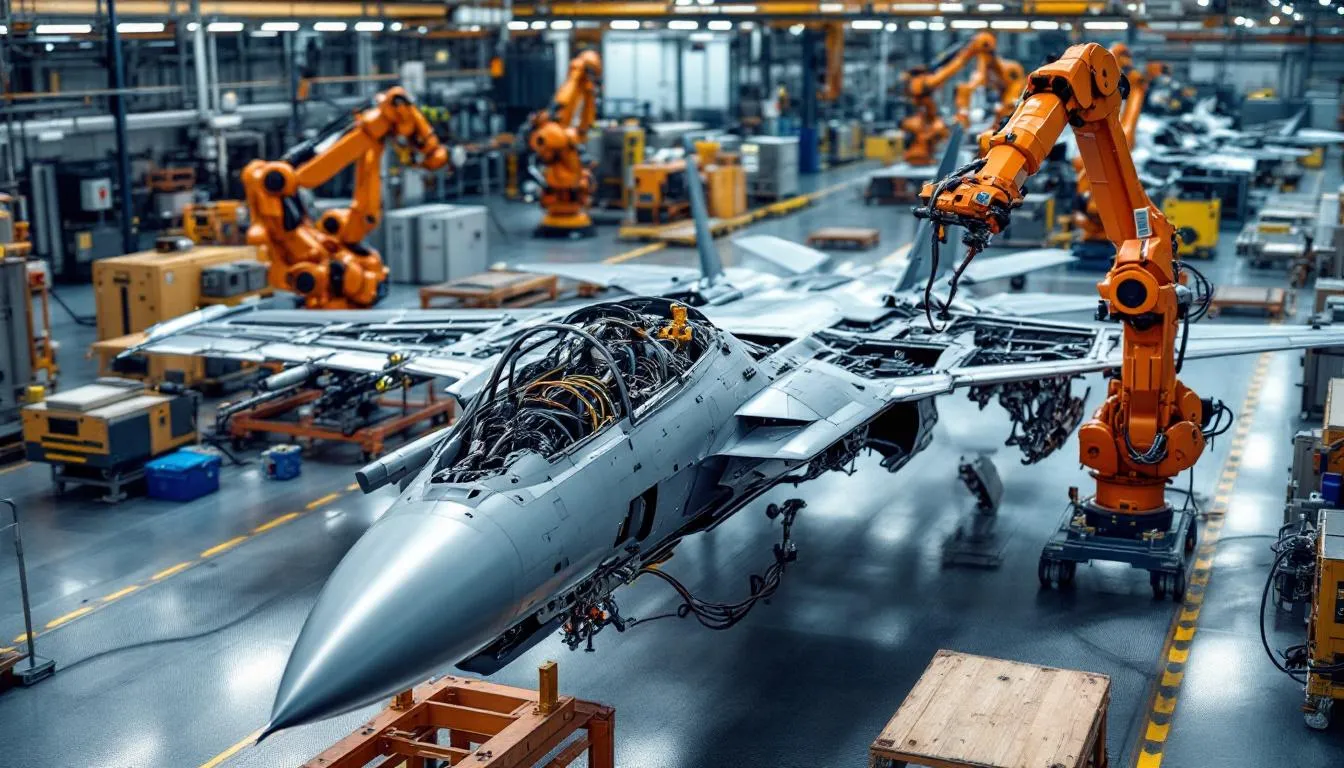
Emerging players like SpaceX and Blue Origin are transforming space manufacturing capabilities through innovative approaches to rocket production and satellite deployment. These companies challenge traditional aerospace manufacturing models by emphasizing reusability, rapid iteration, and cost reduction strategies that established manufacturers are now adopting.
Regional Manufacturing Powerhouses
The United States leads aerospace exports with $89 billion in 2021, maintaining global manufacturing dominance through strategic investments in research and development, workforce talent, and manufacturing infrastructure. This leadership position reflects decades of military and civilian aerospace innovation, supported by partnerships between defense companies, commercial manufacturers, and government agencies.
France and Germany rank as top aerospace manufacturing exporters in Europe, leveraging their participation in Airbus and other collaborative programs to maintain competitive positions. These countries benefit from coordinated European Union aerospace policies that support research, development, and manufacturing capabilities across member nations.
Arizona has emerged as a particular success story in regional aerospace manufacturing development. The state’s $14.5 billion in DoD contracts during fiscal year 2023 exemplifies how strategic location, workforce development, and government support can create thriving aerospace manufacturing centers. The concentration of defense contractors and suppliers creates synergies that benefit the entire regional economy.
The Asia-Pacific region continues expanding manufacturing capabilities through government support and strategic investment in aerospace infrastructure. Countries like Japan, South Korea, and Australia are developing indigenous capabilities while partnering with established manufacturers to gain access to advanced technologies and production techniques.
Manufacturing hubs succeed by combining multiple critical factors: skilled workforce availability, proximity to suppliers, government support, research institutions, and transportation infrastructure. The most successful regions develop comprehensive ecosystems that support everything from initial research to final product delivery and maintenance services throughout the product lifecycle.
Advanced Manufacturing Technologies and Innovation
Artificial intelligence is revolutionizing aerospace defense manufacturing, with 87% of manufacturers planning AI implementation by 2025-2026 to enhance production efficiency and quality control. This transformation extends far beyond simple automation, encompassing predictive maintenance, quality assurance, supply chain optimization, and production planning that adapts to changing demand patterns in real-time.
Digital twin technology represents another breakthrough transforming design validation and production scaling across aerospace manufacturing facilities. By creating virtual replicas of aircraft, manufacturing processes, and entire factories, engineers can test modifications, optimize workflows, and predict maintenance needs before physical implementation. This capability reduces development costs while accelerating time-to-market for new aircraft and defense systems.
JetZero exemplifies how companies are pioneering innovative aircraft designs using advanced manufacturing platforms like Siemens Xcelerator for integrated development and production planning. Their blended wing aircraft concept demonstrates how new manufacturing technologies enable previously impossible designs while reducing production complexity and costs.
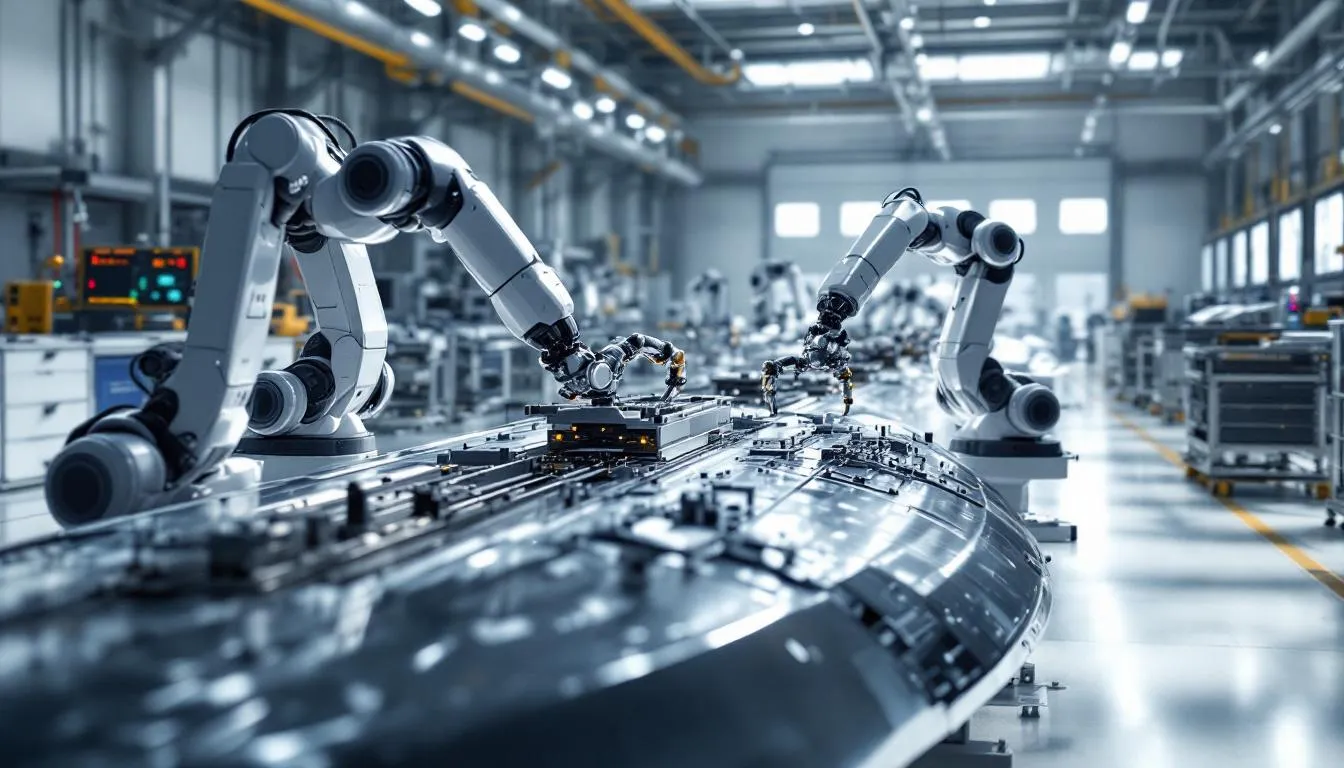
Additive manufacturing and 3D printing technologies are transforming component production and supply chain logistics throughout the aerospace industry. These technologies enable on-demand production of complex parts, reduce inventory requirements, and support rapid prototyping that accelerates innovation cycles. Manufacturers can now produce lightweight components with internal structures impossible to achieve through traditional machining.
Smart Factory Integration
Augmented reality and AI-driven systems are streamlining production workflows and worker training programs across aerospace manufacturing facilities. Technicians can access real-time information, step-by-step assembly instructions, and quality control guidance through AR interfaces that reduce errors while improving productivity. These systems prove particularly valuable for complex assembly processes that require precision and consistency.
Real-time monitoring and predictive maintenance capabilities are reducing downtime in aerospace manufacturing facilities by identifying potential equipment failures before they occur. IoT sensors throughout production lines collect data on machine performance, environmental conditions, and product quality that enables data-driven optimization of manufacturing processes.
Automated quality control systems using machine learning algorithms can detect defects and ensure compliance with stringent aerospace standards more effectively than traditional inspection methods. These systems analyze thousands of images, measurements, and sensor readings to identify patterns that indicate quality issues, enabling immediate corrective action.
The integration of IoT sensors across production lines creates comprehensive data collection capabilities that enable manufacturers to optimize every aspect of their operations. From energy consumption to production rates, workforce productivity to supplier performance, data-driven insights guide continuous improvement efforts that enhance competitiveness.
Supply Chain Resilience and Production Challenges
Complex multi-tier supplier networks characterize aerospace defense manufacturing, with original equipment manufacturers managing relationships with thousands of suppliers across global supply chains. A typical U.S. commercial aerospace OEM works with over 200 tier 1 suppliers and more than 12,000 tier 2 or tier 3 suppliers, creating intricate dependencies that require sophisticated coordination and risk management strategies.
Supply chain resilience has become a critical priority, with 69% of U.S. executives planning supply chain reshoring from Asia to reduce lead times and risks associated with geopolitical tensions and transportation disruptions. This reshoring trend represents a fundamental shift in aerospace manufacturing strategy, balancing cost considerations against supply chain security and responsiveness.
The Aviation Supply Chain Integrity Coalition works to prevent counterfeit parts using digital tracking technologies that create comprehensive documentation throughout the supply chain. These efforts address critical safety concerns while building trust among manufacturers, suppliers, and customers who depend on authentic, high-quality components for aerospace applications.

Raw material costs and delivery delays continue impacting production schedules and profitability across the industry. Manufacturers face particular challenges with specialized aerospace materials like titanium, carbon fiber composites, and rare earth elements that have limited suppliers and long lead times. These constraints require careful inventory management and supplier diversification strategies.
Workforce Development and Skills Gap
The U.S. commercial aerospace sector requires 123,000 new technicians over the next 20 years to support growing demand and replace retiring workers. This workforce challenge reflects broader demographic trends and the specialized skills required for aerospace manufacturing, from precision machining to composite materials processing and advanced assembly techniques.
Current aerospace employment encompasses over 534,000 workers in U.S. aerospace products and parts manufacturing, representing a significant portion of the skilled manufacturing workforce. However, the industry faces retention challenges, with a 13% personnel turnover rate in 2023 complicating talent retention efforts across the sector.
Public-private partnerships and apprenticeship programs are addressing early talent pipeline development through collaborations between aerospace companies, educational institutions, and government agencies. These programs combine classroom instruction with hands-on training that prepares workers for specific aerospace manufacturing roles while providing clear career advancement pathways.
Workforce development efforts must address both current skill shortages and future technology requirements as manufacturing becomes increasingly automated and digitized. Workers need training in advanced manufacturing technologies, data analysis, and digital systems operation alongside traditional aerospace manufacturing skills.
Defense Spending and Strategic Priorities
The 2025 U.S. defense budget allocates $1.5 billion specifically to strengthen defense industrial base manufacturing capabilities, reflecting government recognition of manufacturing capacity as a national security priority. This investment supports infrastructure improvements, workforce development, and technology advancement that enhance the defense industry’s ability to meet current and future requirements.
Missile and munitions procurement budgets have increased 340% over the past decade, driving demand for solid rocket motor manufacturing and related technologies. This dramatic growth reflects evolving threat environments and the need for advanced defensive and offensive capabilities that rely on sophisticated manufacturing processes and materials.
Defense spending on hypersonic research and development reached $163.4 million in recent allocations, addressing supplier challenges and thermal protection systems that require breakthrough manufacturing capabilities. These investments support development of next-generation weapons systems while creating new opportunities for aerospace manufacturers willing to invest in advanced technologies.
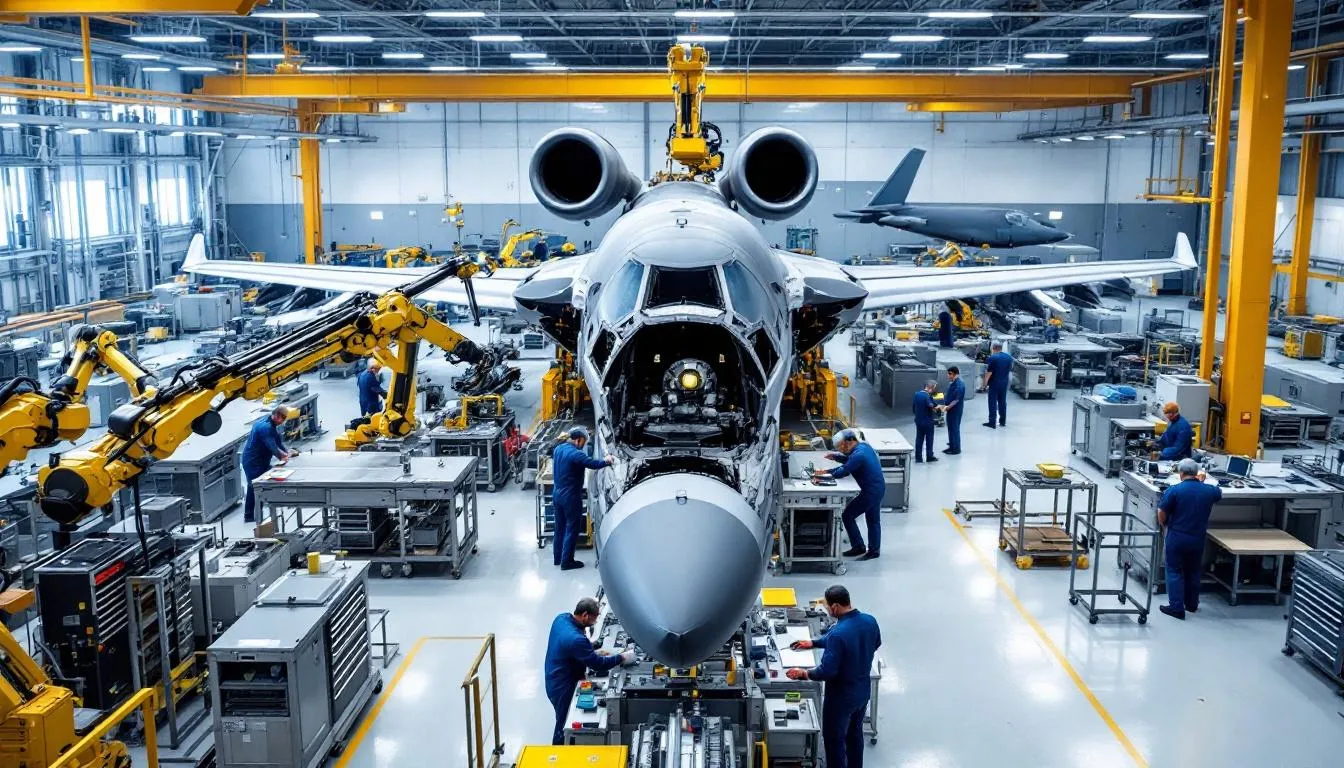
The military drone market, valued at over $20 billion in 2023, continues growing driven by geopolitical tensions and defense requirements for unmanned systems across land, sea, and air domains. This market expansion creates opportunities for manufacturers specializing in autonomous systems, sensor integration, and lightweight materials suitable for drone applications.
Space Economy Manufacturing Growth
The global space economy reached $570 billion in 2023, growing 7.4% year-over-year with commercial sector leadership driving expansion in satellite manufacturing, launch services, and space-based applications. This growth creates new markets for aerospace manufacturers while requiring capabilities that differ from traditional aircraft production.
Positioning, navigation, and timing (PNT) technologies account for 47% of commercial space revenue, creating substantial manufacturing opportunities for companies producing GPS satellites, ground systems, and related infrastructure. The PNT market is expected to grow 155% by 2035, representing one of the most significant growth opportunities in aerospace manufacturing.
Private sector investment in reusable launch vehicles and rockets is reducing costs while boosting manufacturing competitiveness through innovative production techniques and economies of scale. Companies like SpaceX have demonstrated how reusability can transform launch economics while creating new demands for precision manufacturing and rapid refurbishment capabilities.
Space manufacturing requires unique capabilities including radiation-hardened electronics, lightweight materials, and precision attitude control systems that function reliably in harsh environments. These requirements create niche opportunities for specialized manufacturers while driving innovation that benefits terrestrial aerospace applications.
Emerging Technologies and Future Manufacturing Trends
Advanced air mobility (AAM) and electric vertical takeoff and landing (eVTOL) aircraft manufacturing are attracting significant investment from major asset managers and venture capital firms. These emerging sectors promise to transform urban transportation while creating new manufacturing requirements for electric propulsion systems, advanced batteries, and lightweight structures optimized for frequent cycling.
Unmanned aerial systems continue expanding across defense and commercial applications including construction, logistics, agriculture, and public safety. The Federal Aviation Administration’s approval for beyond visual line of sight flights in 2025 supports commercial drone manufacturing growth by enabling new applications that require extended range and autonomous operation capabilities.

Solid rocket motor manufacturing is receiving increased investment from Army, Navy, and Air Force programs seeking to rebuild industrial capacity for missile production. This investment addresses critical gaps in defense manufacturing capability while supporting development of next-generation weapons systems that require advanced propulsion technologies.
The integration of artificial intelligence throughout manufacturing processes promises to enhance efficiency, quality, and responsiveness while reducing costs. AI applications span from design optimization and production planning to quality control and predictive maintenance, creating comprehensive improvements in manufacturing performance.
Manufacturing Innovation Hubs
Arizona’s Office of Defense Innovation (ODI) launched initiatives to advance dual-use technology and defense manufacturing capabilities through partnerships between government, industry, and academic institutions. These efforts create innovation ecosystems that accelerate technology development while building manufacturing capacity for both civilian and military applications.
Hadrian’s $200 million investment in creating a 270,000 square foot aerospace manufacturing hub in Mesa demonstrates private sector confidence in advanced manufacturing opportunities. This facility will employ 350 workers while showcasing automated production techniques for precision aerospace components.
Public-private partnerships are driving innovation in defense manufacturing capabilities and technology development through shared investment in research, infrastructure, and workforce development. These collaborations leverage government resources and private sector expertise to accelerate innovation while reducing individual company risk.
Regional aerospace clusters continue leveraging military installations and research institutions for manufacturing advancement, creating synergies between defense requirements and commercial opportunities. The most successful clusters combine defense contracts, commercial aerospace demand, research capabilities, and skilled workforce development to create sustainable competitive advantages.
The future of aerospace defense manufacturing will be shaped by continued technological advancement, evolving threat environments, and changing market demands. Companies that successfully integrate advanced technologies while maintaining exceptional quality standards and supply chain resilience will lead the industry’s next phase of growth and innovation.
Success in this evolving industry requires balancing multiple priorities: technological innovation, operational efficiency, supply chain security, workforce development, and strategic positioning for emerging opportunities. Industry leaders must navigate these challenges while maintaining the exceptional quality and reliability standards that define aerospace defense manufacturing excellence.
FAQs
- What is the aerospace manufacturing and defense industry?
- Is aerospace and defense Review a legitimate magazine?
- What does aerospace manufacturing do?
- What is defense and space manufacturing?
Frequently asked questions
The aerospace manufacturing and defense industry is the sector that designs, produces, tests, and sustains aircraft, spacecraft, missiles, defense platforms, and their supporting systems. It includes both commercial and military programs, along with the extensive supply chains that provide structures, avionics, propulsion systems, software, electronics, and precision components.
What it includes
In practical terms, the industry spans:
- Commercial and regional aviation: passenger aircraft, cargo aircraft, business jets, and associated systems.
- Military aircraft and rotorcraft: fighters, bombers, transport aircraft, helicopters, UAVs, and mission systems.
- Space systems: launch vehicles, satellites, space vehicles, and ground support equipment.
- Missiles and defense systems: guided weapons, interceptors, and integrated defense systems.
- Subsystems and components: structures, landing gear, engines, actuation, avionics, sensors, wiring, software, and precision-machined parts.
- Sustainment and MRO: maintenance, repair, overhaul, and modification of platforms and components over decades of service life.
Why this industry is different operationally
Compared with many other manufacturing sectors, aerospace and defense operations are shaped by:
- High regulatory burden: safety, airworthiness, and defense-related regulations drive strict requirements for documentation, configuration control, testing, and change management.
- Long product and asset lifecycles: platforms and critical production equipment often remain in service for several decades, which discourages frequent wholesale system replacement.
- Complex, global supply chains: multiple tiers of suppliers provide highly specialized parts, often under tight export control and security constraints.
- High mix, lower volume production: many programs are low to medium volume with frequent engineering changes, which complicates standardization and automation.
- Stringent quality and traceability expectations: nonconformances can have safety, mission, or national security implications, making root cause analysis, corrective actions, and full part genealogy essential.
- Security and export control constraints: technical data, software, and some manufacturing processes are controlled, which affects how IT/OT systems are integrated and where data can reside.
Systems and operational landscape
The industry typically runs in brownfield environments with a mix of legacy and modern systems:
- Manufacturing execution: MES, machine controls, and custom shop-floor systems orchestrate work, often supplemented by digital work instructions and data collection tools.
- Enterprise systems: ERP, PLM, and MRP manage bills of material, planning, configuration, and cost, but integrations are often fragmented across vendors and generations.
- Quality, compliance, and document control: QMS and document management tools support nonconformance management, CAPA, audit readiness, and version governance.
- Engineered test and inspection: specialized test stands, NDT, and metrology equipment generate critical evidence that must be tied back to specific parts, configurations, and requirements.
Because of the cost and effort to re-qualify processes and systems, full replacement of MES, ERP, or PLM is uncommon. Incremental upgrades, integration layers, and targeted digitalization around existing assets are more typical, provided they maintain traceability, validation status, and production continuity.
What this means for operations and engineering leaders
For leaders in operations, engineering, quality, and IT, the aerospace manufacturing and defense industry implies working within:
- Tight change control: every change affecting form, fit, function, or process capability usually requires formal assessment, documentation, and sometimes customer or authority approval.
- High expectations on evidence: you must be able to demonstrate what was built, how it was built, which equipment and software revisions were used, and who performed and approved each step.
- Constrained downtime: complex qualification and restart procedures mean outages for major upgrades or replacements are heavily scrutinized and often minimized or phased.
- Integration and data challenges: improving performance or compliance typically depends on connecting siloed systems, standardizing data, and preserving historical records during any transition.
In summary, the aerospace manufacturing and defense industry is not just about producing aircraft or weapons systems. It is about operating within a long-lived, tightly regulated, and risk-sensitive ecosystem where process control, traceability, and disciplined change management are at least as important as the physical products themselves.
Aerospace & Defense Review is a real, commercially operated trade publication focused on aerospace and defense vendors and technology providers. In that narrow sense, it is a legitimate magazine: it exists, publishes regularly, and is read within parts of the industry.
However, for regulated industrial and manufacturing environments, “legitimate” does not mean independent, authoritative, or validation-grade. Like many niche trade titles, much of its business model depends on sponsored content, pay-to-participate awards, and vendor-paid profiles and lists. That creates several practical implications if you are in operations, engineering, quality, or IT leadership.
What it is (and is not) useful for
- Useful as:
- Marketing exposure for vendors and solution providers.
- High-level awareness of technologies, categories, and vendor names.
- A lightweight channel to see how suppliers position themselves.
- Not appropriate as:
- Evidence of product suitability in a regulated manufacturing environment.
- Substitute for internal validation, vendor qualification, or cyber/IT review.
- Proof of compliance, certification, or audit readiness for any system or supplier.
In other words, it can be one input for market scanning, but it should not carry the same weight as peer-reviewed technical work, formal evaluations, or verified customer references in comparable regulated contexts.
How to treat awards and lists from Aerospace & Defense Review
The publication is known for “Top Solution Provider” lists, awards, and featured profiles. These are typically editorial-marketing hybrids where vendors often pay for participation, visibility, or extended write-ups. When you see a potential supplier highlighting such recognition:
- Assume it is primarily a marketing asset, not independent certification.
- Ask vendors directly whether the feature or award involved payment or sponsorship.
- Do not map any award language to compliance status, audit outcomes, or safety performance.
- Use it as a prompt to investigate further, not as a filter to short-circuit due diligence.
For plants operating under aerospace-grade or defense regulations, no external magazine award should materially influence your supplier approval, tool selection, or system validation decisions without independent corroboration.
Implications for regulated manufacturing and brownfield environments
In aerospace, defense, and other high-regulation sectors, technology and vendor decisions are constrained by:
- Validation and qualification burden for MES, QMS, PLM, and related systems.
- Change control, traceability, and configuration management requirements.
- Integration and lifecycle constraints in brownfield environments with legacy stacks.
Because of this, a vendor’s appearance in Aerospace & Defense Review should be treated as a signal that they are investing in marketing to your sector, not as a signal that they are ready for deployment in your plant. You still need to:
- Evaluate integration with your existing MES/ERP/QMS and shop-floor automation.
- Assess cybersecurity posture, export control handling, and data governance.
- Plan validation, qualification, and change control consistent with your procedures.
- Check references from operators with similar regulatory and legacy constraints.
Full replacement strategies for core systems (e.g., ripping out MES or QMS based largely on a vendor’s media presence) rarely succeed in aerospace-grade contexts because of validation cost, downtime risk, and integration complexity. Magazine coverage does not mitigate those risks.
Practical guidance
- Treat Aerospace & Defense Review as a marketing-oriented trade outlet, not an authority on compliance or technical merit.
- Use it to generate an initial list of vendors, but run your standard vendor qualification and risk assessments before engaging.
- When internal stakeholders cite the magazine as proof of quality, clarify that such coverage is not an accepted form of evidence for regulated decision-making.
So, yes, Aerospace & Defense Review is a real industry publication, but in a regulated manufacturing context it should be treated strictly as marketing media, not as an independent arbiter of vendor capability or compliance readiness.
Aerospace manufacturing is the end-to-end industrial activity required to design, build, test, deliver, and support aircraft and space hardware under strict safety, regulatory, and traceability constraints.
Main responsibilities
In practice, aerospace manufacturing organizations:
In practice, this connects to work orders and digital travelers when teams need to turn the answer into repeatable execution habits.
- Turn certified designs into physical hardware by industrializing engineering intent into routings, work instructions, tooling, and validated processes.
- Fabricate and assemble components such as structures, engines, landing gear, avionics enclosures, and interiors using machining, composites, sheet metal, welding, additive, and electronics assembly.
- Integrate complex systems (mechanical, electrical, software) into complete airframes, propulsion systems, and spacecraft modules, with strict configuration control.
- Verify and validate product quality through inspection, NDT, functional and environmental testing, and conformity checks against type design and approved data.
- Maintain airworthiness evidence by generating, collecting, and retaining build records, test data, and traceability information to support regulatory oversight and customer audits.
- Support in-service fleets via spares, repairs, modifications, and retrofits, often for decades after original manufacture.
Core activities on the shop floor
Typical shop-floor activities include:
- Process planning: translating engineering bills of materials into manufacturing bills of materials, routings, and operation sequences that can be executed with existing equipment and constraints.
- Precision fabrication: CNC machining, precision grinding, composite layup and curing, additive manufacturing, and high-spec coating and surface treatments.
- Assembly and integration: drilling and fastening, bonding, wiring harness installation, system integration, and functional checks, often at large scale with tight tolerances.
- Inspection and test: CMM checks, NDT, electrical test, system-level test, and acceptance testing, with formal signoffs and lot/serial traceability.
- Nonconformance handling: identifying defects, containing impact, running root cause analysis, and implementing corrective and preventive actions under controlled processes.
Regulated, long-lifecycle environment
Aerospace manufacturing operates in a highly regulated environment with standards and oversight that typically include aviation or space authorities and customer-specific requirements. This leads to:
- Formal configuration control: tight management of part numbers, revisions, and effectivity so each delivered configuration can be reconstructed and justified.
- Extensive traceability: lot/serial, material, special process, and test traceability to support investigations, continued airworthiness, and safety-of-flight decisions.
- Validated processes and systems: manufacturing processes, software systems (MES, ERP, QMS), and critical tools are often validated and controlled through change control and qualification activities.
- Long asset lifecycles: equipment, fixtures, and IT systems can remain in service for decades, influencing technology adoption, integration strategy, and risk tolerance.
System coexistence and brownfield reality
Most aerospace manufacturing happens in brownfield environments that already have:
- Legacy MES, ERP, PLM, and QMS systems, often from multiple vendors and generations.
- Custom integrations, homegrown tools, and Excel-based workarounds that carry historical qualification and tribal knowledge.
- Limited windows for downtime due to ongoing production and expensive test facilities.
Because of the qualification burden, validation cost, and risk to traceability and airworthiness evidence, full replacement of core systems is uncommon and risky. Aerospace manufacturers typically layer new capabilities on top of, or alongside, existing systems, using controlled interfaces and staged cutovers instead of big-bang replacements.
How this connects to operations, quality, and IT
For leadership across operations, engineering, quality, and IT, aerospace manufacturing means:
- Operations: balancing rate, cost, and schedule against rigid quality and configuration requirements.
- Engineering: designing products and processes that are manufacturable with available capability, and maintaining configuration alignment with production.
- Quality: ensuring conformance, managing nonconformances and escapes, and maintaining defensible records for audits and regulators.
- IT/OT: keeping interconnected systems secure, available, and validated, while modernizing without disrupting qualified production and traceability.
All of these functions must collaborate to deliver safe, certifiable hardware, at repeatable quality and cost, over long product and fleet lifecycles.
Defense and space manufacturing refers to the design, production, integration, test, and sustainment of hardware and assemblies used in military and space systems. This includes aircraft structures, propulsion components, avionics, sensors, satellites, launch vehicle hardware, ground systems, and associated tooling and test equipment.
Compared with commercial manufacturing, defense and space work is characterized by:
- High reliability and long lifecycles: Products are expected to operate in harsh environments for many years, often decades, with limited ability to repair or replace once deployed.
- Low to medium volume, high mix: Many programs involve small production runs, numerous variants, engineering changes, and ongoing modification programs.
- Heavy regulatory and contract oversight: Work is governed by defense procurement rules, export control regimes, quality and safety standards, and program-specific contractual requirements. These shape how data is handled, how changes are controlled, and how evidence is produced.
- Strict configuration control and traceability: There is strong emphasis on end-to-end traceability of materials, processes, test results, and changes from design through production and sustainment.
- Secure and controlled data environments: Technical data, software, and test results are often subject to export controls and cybersecurity requirements, which constrain integrations, cloud usage, and vendor selection.
Operational realities
Defense and space manufacturing usually operates in brownfield environments. Plants run mixed fleets of legacy and modern equipment, and information flows across multiple systems such as ERP, PLM, MES, QMS, and custom program databases. These systems are often program-specific, partially integrated, and heavily customized.
Because equipment and programs may stay in service for decades, full replacement of core systems or production equipment is uncommon. The qualification burden, validation effort, downtime risk, and change-control overhead mean that most improvements focus on incremental, well-justified changes that can coexist with existing infrastructure.
Implications for processes and systems
In defense and space manufacturing, process and system design must take into account:
- Evidence and auditability: Processes need to produce durable, retrievable evidence of compliance with contract and regulatory requirements, including test data, inspections, and deviation records.
- Formal change control: Engineering and process changes typically require structured review, impact analysis, and documented approval, with clear linkage to affected hardware and lots.
- Validation and qualification: New tools, software, and equipment often require formal qualification and validation before use, particularly when they affect product characteristics, data integrity, or regulatory records.
- Secure integrations: Connecting systems, machines, and data services must consider cybersecurity requirements and export control constraints, which can limit data movement and external access.
- Sustainment and obsolescence management: Processes must support long-term maintenance, spares production, and redesign for obsolescence, often long after original tools or suppliers have changed.
Overall, defense and space manufacturing is not defined only by the products made, but by the combination of high-reliability engineering, stringent oversight, and long-term support obligations that shape how operations, quality, and IT functions plan and execute work.