
Introduction: ERP vs MES in Daily Production Decisions
Most aerospace plants do not struggle because people misunderstand software definitions. They struggle because nobody has agreed which system owns the transaction at the moment work happens. This erp vs mes article focuses on that practical line: production orders, routing execution, WIP, quality holds, completions, scrap, and duplicate records.
In aerospace manufacturing and MRO, the answer matters because AS9100, FAA, EASA, and ITAR expectations require traceability by part, serial number, operator, timestamp, procedure, and revision. ERP systems, meaning enterprise resource planning, are optimized for financial management, inventory management, planning, raw materials, and customer demand. MES, meaning manufacturing execution system, and connected operations platforms like Connect981, are optimized for shop floor execution, production data, and data accuracy.
ERP creates a single source of truth for all business departments and coordinates raw material ordering with customer demand. The rest of this article walks through transaction-by-transaction examples and a practical ownership matrix for ERP and MES.

Quick Answer: ERP vs MES Responsibilities at a Glance
ERP owns the enterprise commitment. MES owns the execution reality. In most aerospace factories from 2015 to 2026, ERP is the system of record for cost, inventory value, customer orders, and planned production orders. MES systems, or a connected operations layer like Connect981, are the system of record for real-time WIP, operator actions, quality checks, equipment status, and traceability.
Use this cheat sheet: ERP owns customer orders, master data, standard routings, planned orders, procurement, and valuation. MES owns detailed routing execution, production execution, signoffs, inspections, machine status, and real time data from production operations. Production orders typically originate in ERP; routing execution, holds, and completions are driven by MES and posted back through erp integration. Confusion across mes and erp systems is the usual cause of duplicate records, mismatched inventory, and conflicting completion dates.
Most modern manufacturing businesses use both ERP and MES integrated together. Integrating ERP and MES systems creates a closed-loop system where production plans flow from ERP to MES, while actual production results flow back to ERP, enhancing visibility and efficiency across manufacturing operations. Done well, erp and mes systems improve production efficiency, operational efficiency, optimized production planning, and help teams maximize production efficiency without adding manual data entry.
ERP vs MES: Focused Definitions for Transaction Ownership
An Enterprise Resource Planning (ERP) system integrates data and workflows from various departments, including finance, supply chain, and HR, into a unified database, acting as the central nervous system of an organization. ERP systems typically include modules for managing procurement, order management, warehouse management, supply chain management, human resources, and customer relationship management, providing a comprehensive framework for business operations.
ERP systems provide a unified view of enterprise data, allowing companies to automate business processes and generate insights across multiple departments, which helps identify areas for improvement and drive efficiencies. An enterprise resource planning system integrates data and workflows from various departments, including finance, supply chain, and manufacturing, into a unified database, while an MES focuses specifically on managing production and inventory processes on the shop floor. ERP systems provide a broad overview of business operations, enabling managers to automate processes and generate insights across multiple departments, whereas MES systems offer real-time visibility and control over manufacturing operations.
Deploying an ERP requires a significant upfront investment and can take months or years to implement across all departments. MES solutions also require planning. Implementing an MES system can be complex and time-consuming, requiring significant planning, configuration, and integration with existing systems, which can lead to delays and budget overruns. This article uses MES broadly to include manufacturing execution systems mes, mes software, manufacturing operations management tools, and Connect981 where the platform governs manufacturing execution, inventory and production processes, production scheduling, and specific manufacturing processes.
Who Owns What? Practical ERP vs MES Ownership Matrix
This ownership matrix is the working rule set. The ISA-95 model separates enterprise and control systems: ERP sits with business systems, while MES connects to manufacturing systems, process control systems, and control systems.
Transaction
System of Record
Where the transaction is initiated
How the other system is updated
Production order
ERP for header, MES for actuals
ERP
MES sends confirmations, labor, and status
Routing execution
MES
MES
ERP receives variances and confirmations
WIP move
MES
MES scan or signoff
ERP receives milestone updates
Material consumption
MES for exact lot use, ERP for valuation
MES or backflush rule
ERP posts issue and cost
Completion
MES triggers, ERP records receipt
MES after inspection
ERP posts goods receipt
Scrap and rework
MES for reason, ERP for cost
MES
ERP posts scrap, rework, variance
Quality hold
MES triggers, ERP mirrors status
MES
ERP blocks planning or shipment
Production Orders and Work Orders
In SAP, Oracle, NetSuite, IFS, and similar erp software, work orders are created and numbered in ERP to align MRP, resource management, finance, and inventory. ERP is the system of record for order header, quantity, due date, BOM, standard routing, and cost structure.
MES or Connect981 consumes the order and breaks it into executable tasks. It owns timestamps, operator IDs, deviations, exception paths, labor, and machine usage. In a 2024 aerospace assembly plant using SAP ERP and a dedicated MES, SAP creates a planned production order; the MES breaks this into operator-level tasks and reports confirmations to SAP at each operation or final completion.
For a C-check in an MRO facility, the ERP work order defines aircraft tail number, scope, planned labor, and cost center. Connect981 manages task-by-task completion, signoffs, and required inspections. Duplicate production orders usually appear when a shopfloor tool creates local jobs independently of ERP without one-to-one data mapping.
Routing Execution and Operation Sequencing
ERP stores standard routings: operation list, work centers, planned time, and costing assumptions. MES owns what really happened: which operation ran first, what was skipped, what rework loop occurred, and which operator or cell performed the work.
For complex assembly processes, MES or Connect981 also owns digital work instructions, in-process checks, revision control, and signoff workflow tied to each routing step. Routing changes for one order belong in MES and return to ERP as variance. Routing template changes for all future orders belong in ERP master data.
Process engineers should standardize data formats such as operation codes, work center IDs, status codes, and inspection points. Without that discipline, confirmations become orphaned and production units appear complete in one system but open in another.
Quality Holds, Nonconformances, and Dispositions
Shopfloor quality events belong in MES because they happen in real time and require immediate control. An MES can enforce quality control procedures by capturing quality data during production, triggering alerts for quality issues, and maintaining records for analysis and traceability.
When an operator logs a defect on a turbine blade in MES, the system applies a quality hold to that serial number and operation. ERP then reflects blocked inventory so the part cannot be issued, shipped, or consumed by planning. MRB decisions, scrap, use-as-is, or rework, stay in MES with evidence; ERP receives the resulting postings.
Using ERP alone for holds delays reaction on the floor. Using MES alone without ERP updates leaves planning teams seeing blocked parts as available.
WIP, Inventory Movements, and Completion Signals
ERP tracks inventory at a macro level, warehouse storage, while MES tracks inventory at a micro level, exact material consumption on the assembly line. The primary function of an MES is to track and monitor production processes in real-time, providing detailed control over production scheduling and quality management, which is not the focus of ERP systems.
MES records each WIP move, station arrival, start, pause, completion, and inspection result. ERP remains the record for inventory value, finished goods, and financial close. In a 3-shift composites facility, MES posts every panel move between layup, cure, and trim; ERP receives a goods receipt only after inspection passes.
With integrated ERP and MES systems, companies can achieve improved inventory management, as the MES updates ERP inventory based on actual production events, leading to more accurate demand forecasting and resource allocation. This supports accurate demand forecasting without pretending ERP sees every micro-event.
Scrap, Rework, and Yield
Scrap and rework detail lives in MES: defect code, operator note, photo, operation, fixture, machine, and referenced procedure. ERP receives financial impact: scrap posting, rework order, inventory adjustment, and standard-versus-actual variance.
If 2 of 10 landing gear components fail NDT in MES, the system records defect type and location. ERP is updated with 8 completed units, 2 scrapped, and the cost variance. Capturing scrap only in ERP weakens root cause analysis. Capturing it only in MES damages margin and yield reporting.
Connect981 can support AI-assisted root cause analysis from MES-level detail while still feeding clean ERP postings.
How ERP and MES Share Data: Integration, Data Mapping, and Formats
Ownership only works when integration rules are predictable. Orders and routings usually move ERP to MES. Confirmations, quality results, material consumption, and completions move MES to ERP.
Data integration between an MES and other software systems, such as ERP or PLM, can be challenging, often requiring extensive customization and data mapping to ensure seamless data exchange and synchronization. The integration of MES with other systems, such as ERP, allows for the synchronization of information and alignment of manufacturing processes with overall business operations, enhancing efficiency.
Connect981 is designed as a unifying operations layer that maps erp data, PLM data, MES events, supplier records, and manufacturing data without forcing a full rebuild.
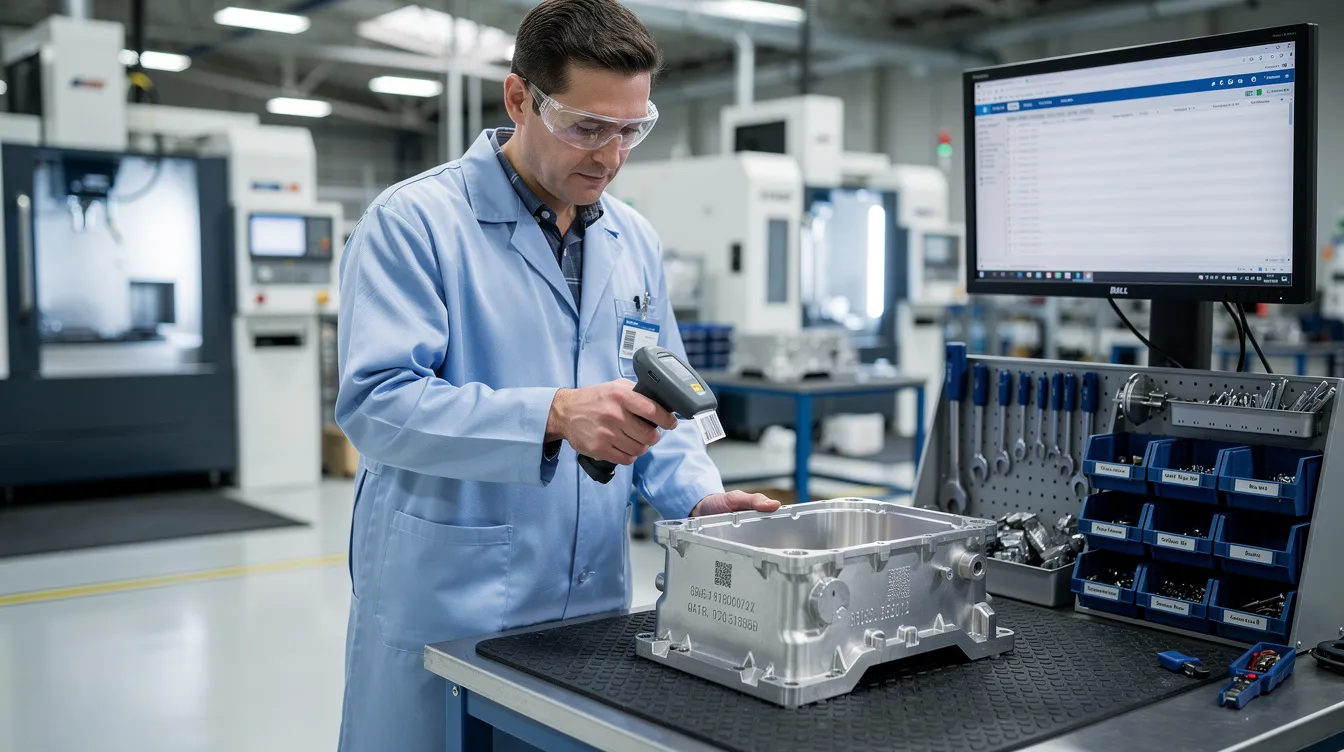
Typical ERP–MES Integration Flows in Aerospace and MRO
A 2025 airframe plant using Oracle ERP and legacy MES may use nightly batch for order updates, but real-time APIs for quality holds and final completions. That split is common. Finance can tolerate some batch. Shipping and compliance cannot.
A Manufacturing Execution System (MES) captures real-time data from various sources on the factory floor, including machines, sensors, and operators, to monitor and control manufacturing operations. MES provides real-time operational visibility, allowing users to track every work order, material movement, quality check, and process parameter as production occurs. The integration of ERP and MES allows for real-time data synchronization, providing manufacturers with up-to-the-minute insights into production processes, which facilitates informed decision-making and rapid problem resolution.
Financial management in ERP depends on accurate labor, machine time, scrap, and rework data from MES. Integration capabilities determine whether that data arrives cleanly.
Data Mapping, Data Accuracy, and Preventing Duplication
Data mapping means aligning item IDs, serial formats, lot numbers, routing steps, work centers, and quality codes so each transaction has one meaning. Common duplication causes include both systems creating work orders, separate local item codes, failed imports, and manual ERP adjustments after MES completion.
The rule is simple: one system creates each entity. ERP creates order numbers. MES creates nonconformance records. Updates can be bidirectional, but origination is controlled.
Connect981 can normalize data formats across multiple ERPs and MES instances, detect multiple active execution records for one ERP order, and reduce manual operations.
Data Security, Compliance, and Audit Trails
Combining ERP and MES raises data security stakes. Ensuring data security is crucial when implementing an MES, as these systems handle sensitive production data, and robust security measures must be in place to protect against unauthorized access and cyber threats.
MES holds operator names, timestamps, inspection results, and serial-level history. ERP holds financial and customer-level data. Together they form the audit trail. Role-based access, ITAR controls, logs, and authoritative timestamps must be explicit.
Integrating ERP with MES enhances quality management by enabling the collection and analysis of historical data, which helps identify patterns and trends, allowing companies to proactively address potential quality issues. Teams can analyze historical data for recurring defects, but only if the data collection and real time data collection are structured.
Day-in-the-Life: Transaction-by-Transaction Examples
Consider 5 shipsets of composite control surfaces due in Q4 2026. ERP transaction: create customer order, production order, BOM, material reservations, and planned cost. MES transaction: import the order, assign tasks, execute work instructions, capture inspections, and manage the entire production cycle.
Material issue is an MES scan with lot traceability and an ERP goods issue. First article inspection is MES evidence with ERP status visibility. Nonconformance is MES-controlled with ERP blocked status. Final acceptance is MES completion plus ERP goods receipt and shipment readiness.
Connect981 can orchestrate this when a plant still relies on spreadsheets, email, or tribal knowledge instead of a full MES.
Example 1: New Production Build (Greenfield Assembly Line)
A manufacturer launches a 2025 actuator production line using existing ERP and Connect981. ERP creates the production order and BOM. Manufacturing engineers build digital work instructions in Connect981. Operators execute steps, scan components, and record torque values.
If torque is out of spec, the hold is triggered in Connect981. ERP receives blocked status, preventing shipment. Operators do not log twice, finance receives one clean posting stream, and planners see one completion quantity.
Compared with paper packets and end-of-shift ERP updates, the outcome is better data accuracy and less rework in administration.
Example 2: MRO Work Package with Heavy Rework
In a 2026 C-check on a regional jet, ERP owns the work package, cost center, customer billing structure, and procurement demand. Connect981 owns hundreds of task-level operations, inspection signoffs, nonconformances, parts requests, and supplier responses.
Each finding creates an execution record. Approved material movement and cost flow back to ERP. Quality holds live in MES against affected serials and tasks; ERP mirrors blocked status so the order cannot close prematurely.
Resistance to change from employees can pose significant challenges during the implementation of an MES, as it often involves changes in business processes and workflows that may not be readily accepted by all stakeholders. A phased rollout keeps adoption practical.
Common Failure Modes: Where ERP–MES Boundaries Go Wrong
Most failures are governance failures, not product failures. The symptoms are familiar: double WIP entry, parallel work order numbering, unsynchronized holds, inconsistent routing versions, wrong inventory balances, disputed financial results, and audit gaps.
The integration of ERP and MES reduces human error by automating data collection and minimizing manual operations, which leads to more reliable data and better decision-making. Without that discipline, manufacturing companies end up reconciling software systems instead of running production.
Duplicate Records and Conflicting Truths
A rush order is created in ERP. A supervisor also opens a local MES job to start immediately. Later, both records show partial completion. Nobody trusts either record.
The fix is access control and automated checks: ERP originates the order, MES executes it, and Connect981 flags duplicate execution records before financial close.
Misplaced Quality Holds and Inconsistent Inventory Status
If a hold is applied only in ERP, operators may continue working suspect parts. If a hold is applied only in MES, planning may still see available stock.
Example: fasteners flagged for hydrogen embrittlement are quarantined in MES but appear on-hand in ERP. The rule should be clear: MES triggers the hold, ERP mirrors it, MES releases it after inspection or MRB, and ERP follows automatically.
Designing Your ERP–MES Ownership Model
Document the model. List orders, routings, WIP, holds, scrap, rework, completions, inventory, and supplier transactions. For each one, define system of record, originating system, synced attributes, timing, and security rule.
Start with operations, quality, finance, IT, and supply chain. Prioritize the transactions that reduce manual data entry, improve traceability, and protect compliance. Advanced technologies help only when the workflow is clear first.
Connect981 gives aerospace and MRO teams a practical operations layer over existing enterprise resource planning and MES environments, with templates for routing, inspection, traceability, supplier collaboration, and audit-ready execution. Request a Demo to review a sample ownership matrix for your production and MRO workflows.