The Future of Digital FAI: MBD, AI, and the Aerospace Digital Thread
How model-based definition, AI-driven analytics, and the aerospace digital thread are transforming AS9102 first article inspection from a document-heavy checkpoint into a connected, data-driven capability.

The Future of Digital FAI: MBD, AI, and the Aerospace Digital Thread
First article inspection (FAI) is no longer just a stack of AS9102 forms checked before releasing a new aerospace part to production. Over the next few years, FAI will sit at the intersection of model-based definition (MBD), AI-assisted analytics, and the broader aerospace digital thread that connects design, planning, execution, and in-service data. Teams that still treat FAI as an isolated paperwork exercise will struggle to keep pace with program complexity and customer expectations.
This article explores how digital FAI is evolving, and what quality, manufacturing, and engineering leaders should expect from the next generation of AS9102 software. It builds on foundational concepts from AS9102 software for digital first article inspection, and looks ahead to how MBD, AI, and connected factory systems will reshape day-to-day workflows.
For teams putting this topic into daily operation, digital AS9102 FAI help connect the concept to traceability, work-order reality, and audit-ready evidence.
For teams putting this topic into daily operation, digital AS9102 FAI, a connected execution platform, Connect 981’s aerospace execution solutions help connect the concept to traceability, work-order reality, and audit-ready evidence.
The same operating model also depends on real aerospace execution examples, Connect 981’s aerospace operations guidance, practical aerospace operations FAQs, especially when decisions have to move across quality, production, suppliers, and program leadership without losing context.
From 2D Drawings to Model-Based Definition (MBD)
Most aerospace organizations still anchor FAI on 2D drawings and PDF packages, even when design authority already maintains a full 3D model. That gap creates redundant work: engineers translate 3D intent back into 2D, then FAI teams balloon the drawing and re-enter characteristic data into AS9102 forms.
What MBD and PMI Mean for FAI
Model-based definition (MBD) moves the authoritative product definition into the 3D model itself. Dimensions, geometric tolerancing (GD&T), surface finishes, and notes are captured as product manufacturing information (PMI) attached directly to model features. For FAI, that means:
- The 3D model becomes the primary source for characteristic extraction, not a downstream 2D derivative.
- Balloon numbers and Form 3 rows can be generated from PMI tags rather than from optical character recognition on a PDF.
- Design changes propagate through PLM-managed models in a controlled way, reducing the risk of using the wrong revision during FAI.
In a mature digital thread, AS9102 software consumes PMI-rich models via PLM or CAD integrations, creating structured characteristic records without manual re-interpretation of 2D views.
Extracting Characteristics Directly from 3D Models
As MBD adoption increases, the logical next step is for FAI tools to extract measurable requirements directly from 3D geometry and PMI. In practice, this looks like:
- Loading a native CAD or neutral MBD format, then parsing PMI to identify all verifiable dimensions, GD&T frames, and notes.
- Assigning unique characteristic IDs that map one-to-one to Form 3 rows and can be reused across builds, delta FAI, and future programs.
- Providing 3D navigation from each characteristic to its associated feature, making it easier for inspectors and CMM programmers to understand intent.
Compared with PDF-based ballooning, 3D extraction improves consistency and reduces interpretation errors, especially for complex structures and tight GD&T schemes. It also aligns FAI more closely with how CMM and metrology software already operate in many aerospace factories.
Challenges in Transitioning from 2D-Centric Processes
Moving FAI workflows from 2D drawings to MBD is not just a tooling change; it is an organizational shift. Common challenges include:
- Mixed-revision environments: Some parts are fully MBD, others remain drawing-centric, and FAI teams must support both simultaneously.
- Standards and customer expectations: Customers may still specify 2D drawing deliverables or have not formally approved model-based FAIRs as a primary reference.
- Skills and training: Inspectors and quality engineers may be less comfortable navigating 3D PMI than reading traditional blueprints.
A pragmatic approach is to run hybrid pilots: use MBD-derived characteristics as the internal source of truth but still generate AS9102-compliant forms and, where needed, drawing-based views for customer submission. Over time, as standards and customer practices evolve, organizations can phase out redundant 2D work.
AI and Automation in FAI Data Analysis
AI is often oversold as a push-button solution that will replace engineering judgment. In regulated aerospace manufacturing environments, that is neither realistic nor desirable. The more practical direction is AI and analytics augmenting human decision-making: guiding where to focus attention, checking FAIRs for inconsistencies, and surfacing patterns that would be hard to see manually.
AI-Assisted Risk-Based Sampling Approaches
Risk-based inspection is already established in aerospace quality systems; what changes is the data and tooling that inform those decisions. Emerging AS9102 software capabilities include:
- Using historical FAIRs and in-process inspection results to estimate process capability for families of parts and operations.
- Suggesting when 100% measurement is warranted (e.g., new suppliers, unstable processes, safety-critical characteristics) versus when statistically justified sampling is appropriate.
- Highlighting characteristics with marginal capability or frequent near-miss conditions so engineers can tighten sampling or adjust control plans.
Importantly, these AI-assisted recommendations should be transparent and overrideable. Quality leaders remain responsible for approving inspection strategies; the system provides context, not commands.
Anomaly Detection in Measurement Data
FAI results often sit in a repository until an audit or customer issue forces a review. Anomaly detection changes that by scanning results as they are recorded. Typical use cases include:
- Flagging unusual distributions, such as one dimension consistently trending toward a tolerance limit across multiple builds.
- Identifying inconsistent units, extreme outliers, or patterns that suggest transcription errors.
- Surfacing systematic offsets that hint at fixture, probe, or program issues, before they propagate across a fleet of parts.
Because AI models can misinterpret rare yet valid data, anomaly alerts should be reviewed by engineers who can confirm whether the pattern reflects a true process issue or expected variation. The value lies in earlier visibility, not automatic disposition.
Automated Validation of FAIR Completeness and Consistency
One of the most immediate AI-adjacent wins is rule-based and statistical validation of FAIRs before submission. Advanced AS9102 tools can:
- Check that every ballooned or PMI-derived characteristic appears exactly once on Form 3.
- Verify that material certs and special process records are attached for all relevant Form 2 entries.
- Confirm unit consistency, tolerance format, and revision alignment across Forms 1, 2, and 3.
Much of this can be implemented today with deterministic rules, complemented by AI models that learn typical patterns for a program or supplier and highlight deviations. The result is fewer customer rejections and less manual rework on incomplete FAIRs.
FAI as a Node in the Aerospace Digital Thread
Historically, FAI data stayed within the quality function. In a digital thread architecture, first article inspection becomes a key node linking design, process planning, production execution, and in-service performance. That shift turns FAIRs from static evidence into a rich source of engineering, sourcing, and operations intelligence.
Connecting Design, Planning, Production, and In-Service Data
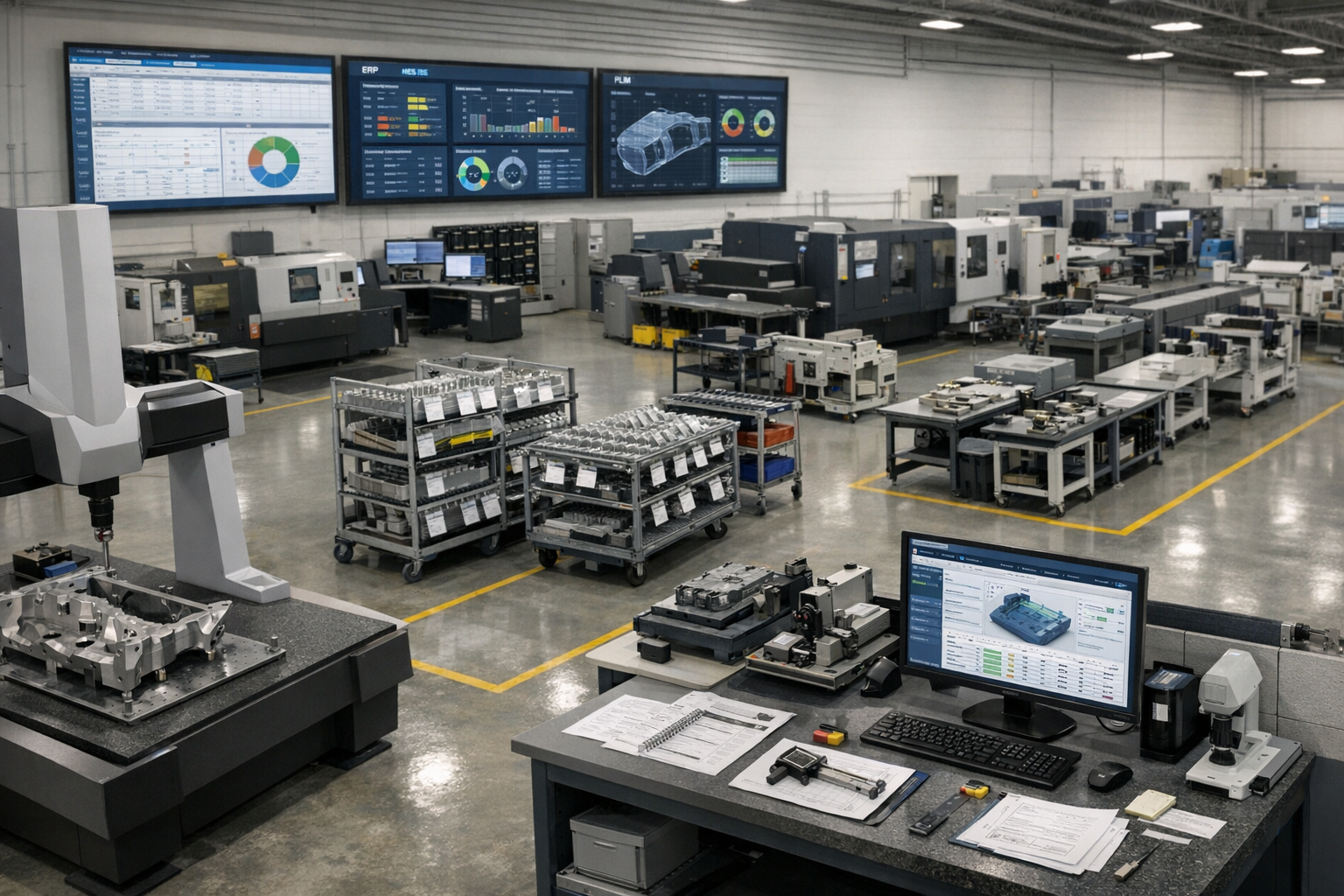
In a connected aerospace manufacturing environment, AS9102 software does not operate alone. It exchanges data with PLM, MES, ERP, and maintenance information systems:
- Design: PLM supplies the authoritative model or drawing, change history, and configuration rules.
- Planning: Process plans and operation sequences flow from manufacturing engineering tools into the FAI context.
- Production: MES links FAIRs to specific work orders, machines, tools, and operators.
- In service: Maintenance and reliability systems can reference original FAI data when investigating recurring issues.
When these connections are in place, the FAIR becomes a snapshot of how a particular configuration was realized at a moment in time, fully traceable back to design intent and forward to field performance.
Using FAI Results to Refine Tolerances and Manufacturability
First article results often reveal whether a design is realistically manufacturable with the intended processes and suppliers. By aggregating FAI data across parts and programs, engineering teams can:
- Identify features that repeatedly push process capability limits or require excessive rework.
- Highlight tolerances that are unnecessarily tight relative to functional needs.
- Feed evidence-based feedback into design for manufacturability (DFM) guidelines and design standards.
This turns FAI from a compliance gate into a feedback loop: design decisions are informed by past production reality, reducing ramp-up friction on future programs.
Linking Certifications and Process Data to Maintenance Records
For long-life aerospace platforms, the ability to trace from an in-service serial number back to its initial FAI and associated certifications is increasingly important. In a robust digital thread:
- Each FAIR is indexed by part number, serial, lot, and configuration.
- Material and special process records attached to Forms 1 and 2 are stored as structured data, not just PDFs on a shared drive.
- Maintenance events in fleet management systems can link back to the original FAIR to investigate whether initial variability correlates with field performance.
This level of linkage requires disciplined configuration management and common identifiers across systems, but it pays off in faster root-cause analysis and more targeted corrective actions.
Supplier Collaboration and Real-Time Portals
Aerospace primes are increasingly pushing digital requirements into their supply base: structured FAIRs, standard templates, and near-real-time visibility into inspection status. The future of digital FAI will depend as much on supplier collaboration as on internal factory systems.
Shared FAIR Templates and Live Status Visibility
Instead of each supplier maintaining its own spreadsheet templates, modern platforms provide shared, controlled AS9102 formats via secure portals. Capabilities typically include:
- Prime-defined templates that enforce mandatory fields, revision usage, and customer-specific clauses.
- Real-time visibility into FAIR status across suppliers: not started, in progress, submitted, under review, or approved.
- Standardized data structures that make downstream analytics (e.g., across suppliers or commodity groups) feasible.
This reduces interpretation errors and ensures that when data reaches the OEM, it is already compatible with their systems and reporting needs.
Reducing Rework and Clarification Cycles with Primes
Much of the delay and friction around FAI comes from back-and-forth clarification: missing attachments, ambiguous dimension coverage, or questions about process changes. Digital collaboration environments help by:
- Embedding validation rules and checklists that suppliers must pass before submission.
- Providing structured comment threads tied to specific characteristics or documents.
- Maintaining a single source of truth for each FAIR, rather than multiple email chains and file versions.
The outcome is fewer rejected FAIRs, more predictable lead times, and better use of both supplier and OEM engineering capacity.
Security, IP Protection, and Access Control Considerations
As more design and inspection data flows through shared portals, protecting intellectual property and regulated information becomes critical. Future-ready FAI platforms must support:
- Granular access control down to part families, programs, or specific FAIRs.
- Encryption in transit and at rest, with clear segregation between customers and suppliers.
- Audit trails showing who accessed or modified data, when, and from where.
Aerospace organizations should evaluate not only functional capabilities but also how FAI tools align with IT security policies, export control requirements, and customer data handling clauses.
Preparing Your Organization for the Next Generation of FAI
Transitioning to AI-enabled, MBD-driven FAI will not happen overnight. Organizations need to understand their current maturity, set realistic priorities, and align technology decisions with standards evolution and customer roadmaps.
Assessing Current Digital Readiness
A practical first step is a structured assessment of how FAI is executed today:
- What proportion of FAIRs are created manually in spreadsheets versus via dedicated AS9102 software?
- How frequently are 3D models with PMI available, and how are they used today?
- Which systems hold critical FAI-related data (PLM, MES, ERP, QMS), and how well are they integrated?
Documenting this baseline helps identify where digital upgrades will have the most immediate impact: reducing rework, shortening lead time, or improving audit readiness.
Prioritizing Capabilities to Invest in First
Not every organization needs cutting-edge AI on day one. For many aerospace manufacturers, the highest-value early investments are:
- Reliable digital ballooning and characteristic extraction from drawings or models.
- Structured AS9102 forms with built-in validation and revision control.
- Centralized storage and search for FAIRs, certs, and supporting documents.
Once those foundations are in place, teams can layer on analytics, anomaly detection, and deeper integration with MES and PLM. Attempting advanced capabilities without a stable data foundation usually leads to frustration.
Building a Roadmap That Aligns with Standards Evolution
AS9102, AS9100, and customer-specific requirements will continue to evolve as digital practices mature. A useful roadmap:
- Maps target capabilities (e.g., MBD-based FAI, supplier portals, AI-assisted checks) against planned system upgrades and program milestones.
- Identifies standards or customer guidance that may affect when certain practices are accepted (for example, model-based submissions).
- Includes governance for how FAI processes are updated as standards or internal procedures change.
The goal is to avoid one-off tool deployments and instead build a coherent, long-term path toward connected, data-centric FAI.
Practical Steps to Experiment with Advanced FAI Capabilities
Many aerospace teams want to explore advanced digital FAI but are constrained by active programs, existing contracts, and limited engineering bandwidth. Small, well-scoped pilots can prove value without disrupting ongoing delivery.
Pilot Projects Using MBD-Derived Characteristics
For programs where the design authority already maintains MBD, consider a pilot that:
- Uses a limited set of parts to trial PMI-based characteristic extraction into the FAI system.
- Compares time and error rates against traditional 2D ballooning.
- Engages both design and quality teams to refine how PMI is structured for inspection use.
Lessons from this pilot can inform modeling practices, internal standards, and supplier training before rolling out model-based FAI more broadly.
Using Analytics on Existing FAIR Data
Even without new measurement equipment or AI models, most organizations have years of FAIRs that are underutilized. A straightforward analytics initiative might:
- Normalize existing FAIR data into a common structure, even if it began as spreadsheets.
- Visualize where FAI rejections, late approvals, or near-miss dimensions cluster by part family, supplier, or process.
- Feed those insights into process improvement projects or design guidelines.
This kind of work builds the data literacy and governance needed before deploying more advanced anomaly detection or risk-based sampling algorithms.
Partnering with Software Providers on Roadmap Features
Given the pace of change around the digital thread and AI, no single vendor will have every capability fully mature today. Aerospace manufacturers can shape solutions by:
- Participating in customer advisory boards focused on MBD, AS9102 Rev C interpretation, and supplier collaboration.
- Co-designing pilot features such as AI-assisted FAIR checks or new integration points with PLM and MES.
- Aligning contracts and deployment plans with clear milestones for advanced capabilities rather than generic promises.
For platforms like Connect 981 that already embed FAI within a broader aerospace operations environment, this collaboration ensures that future enhancements match real engineering and production needs, not abstract technology trends.
The trajectory is clear: FAI is moving from static documentation toward an integrated, data-rich capability that supports faster new part introduction, tighter process control, and more effective collaboration across the aerospace supply chain. Organizations that invest now in solid digital foundations—structured AS9102 data, integration with core systems, and disciplined configuration management—will be best positioned to take advantage of MBD and AI as they mature.



Related Blog


Built for Speed, Trusted by Experts
Whether you're managing 1 site or 100, Connect 981 adapts to your environment and scales with your needs—without the complexity of traditional systems.
