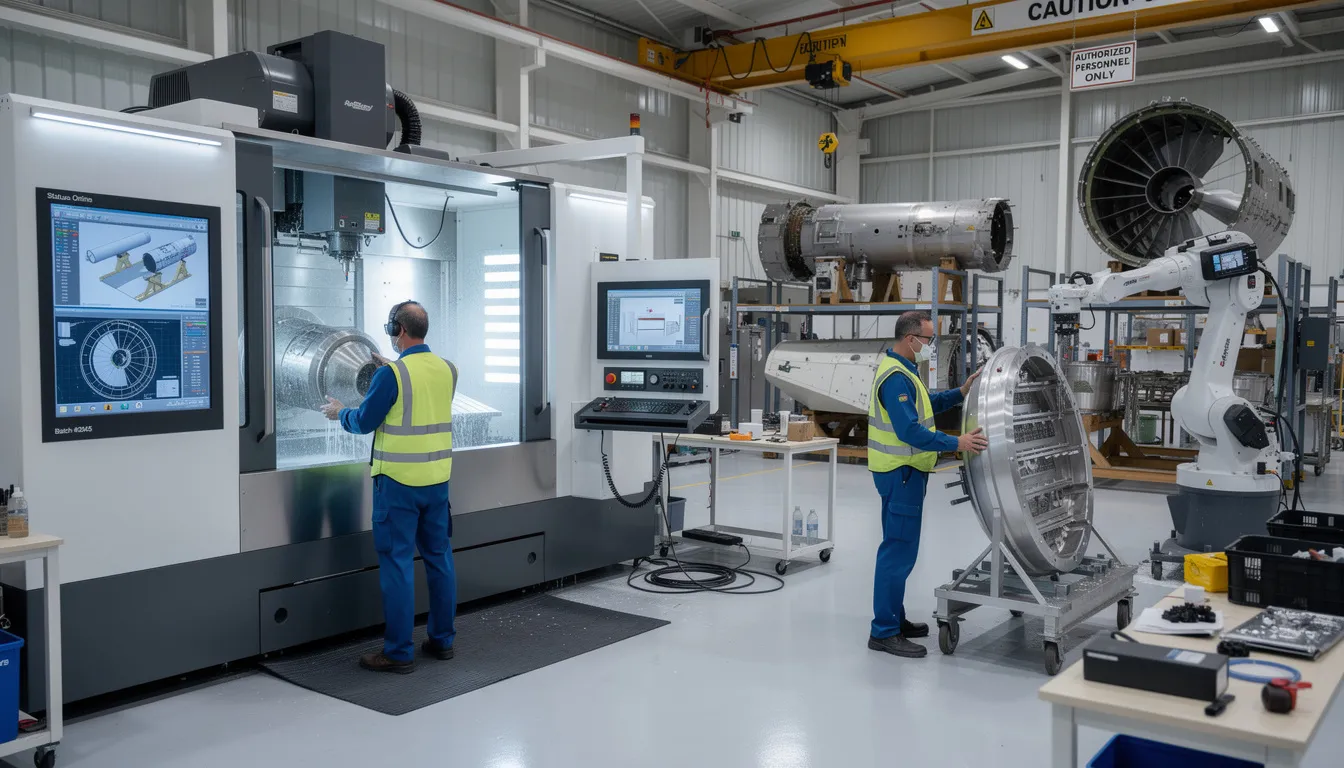
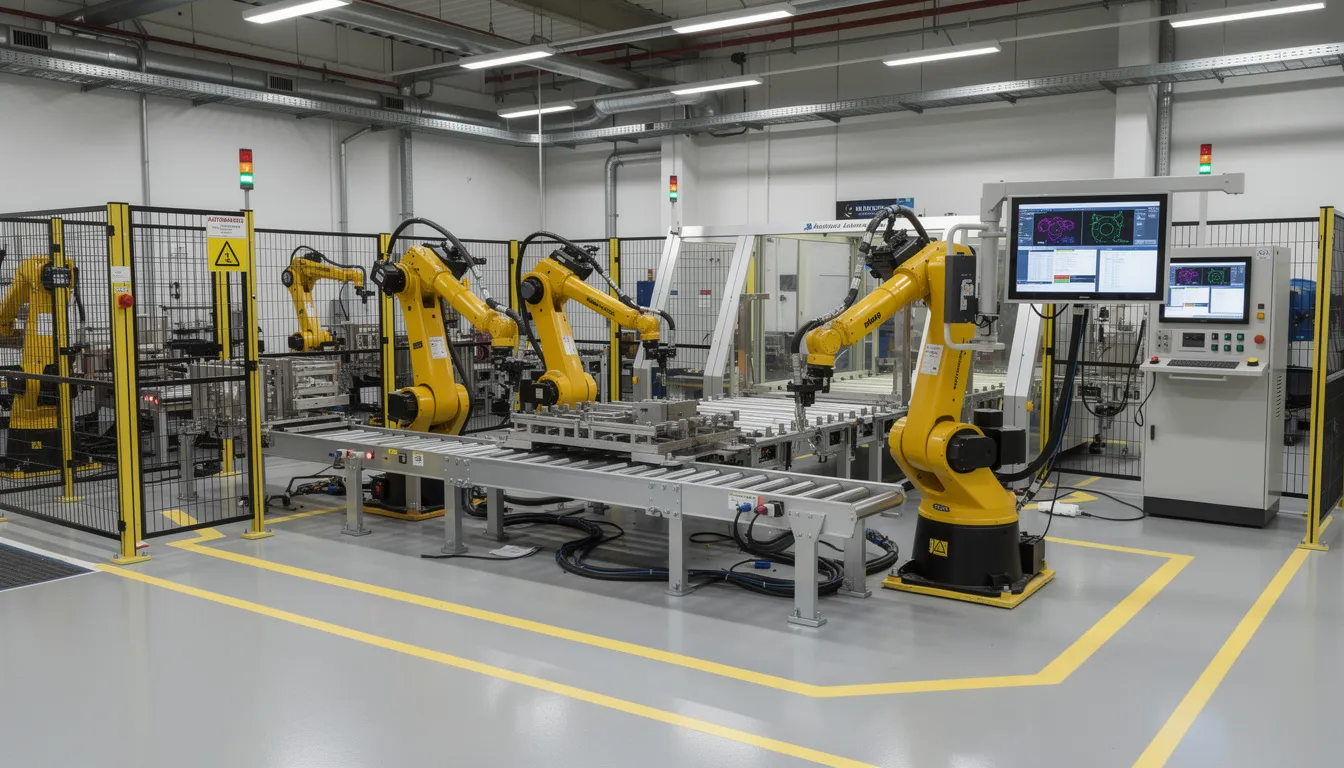
ISO 22400 is focused on manufacturing operations KPIs, especially around equipment utilization, flow, and losses. In aerospace, many shop-floor metrics align well, but program, certification, and airworthiness metrics usually sit outside the standard’s scope. The mapping below assumes you are looking at production operations in a regulated environment, not the full aerospace business stack.
ISO 22400 KPIs that typically map well in aerospace plants
Where your plant has reasonably consistent data definitions and a functioning MES or equivalent, the following mappings are usually straightforward. Names differ by company, but the underlying measures are similar.
In practice, this connects to ISO 22400 KPI governance when teams need to turn the answer into repeatable execution habits.
- OEE (Overall Equipment Effectiveness)
- ISO 22400: Overall Equipment Effectiveness and its components (Availability, Performance, Quality rate).
- Aerospace examples: Cell OEE for machining centers, composite layup cells, special processes (e.g., heat treat, shot peen), and critical test rigs.
- Typical mapping issues: Long changeovers, long cycle times, and qualification runs often need explicit modeling, or OEE will be misleading. You may need to treat qualification/first-article runs differently from serial production.
- Equipment Availability & Utilization
- ISO 22400: Time-based KPIs such as operating time, planned downtime, unplanned downtime, availability, utilization.
- Aerospace examples: Machine uptime for 5-axis CNCs, autoclave utilization, NDI / NDT cell availability, engine test stand utilization.
- Typical mapping issues: Segregating planned vs regulatory-mandated maintenance, calibration, and qualification downtime is crucial for auditability. Many brownfield cells track this via paper or local spreadsheets, so integration and data quality are often the limiting factors.
- Throughput & Output
- ISO 22400: Output-related KPIs such as quantity produced, production rate, throughput time, work-in-process (WIP).
- Aerospace examples: Parts per shift for machining or sheet metal cells, assemblies completed per week, test cycles per stand per day, WIP levels in structural assembly lines.
- Typical mapping issues: High-mix / low-volume and serialized production create complexity. You may need to normalize by standard hours, equivalent units, or routing family rather than raw part counts.
- Scrap, Rework & Yield
- ISO 22400: Quality-related KPIs such as quantity of nonconforming product, scrap, rework rate, yield, first-pass yield at operation or equipment.
- Aerospace examples: Scrap rates by operation (e.g., drilling, milling, bonding), first-pass yield for NDI/NDT, rework rate on engine module assembly, defect rate by special process.
- Typical mapping issues: Nonconformance structures are often owned by QMS tools, not MES. Mapping requires consistent identifiers between operations, NC records, and equipment. Regulatory traceability requirements limit how aggressively you can simplify or aggregate.
- Setup & Changeover
- ISO 22400: Setup time, changeover time, ratio of setup time to operating time.
- Aerospace examples: Changeover for machining fixtures, NC program swaps, tooling setups for composite layup, test stand reconfiguration between engine models.
- Typical mapping issues: In aerospace, some changeover is tied to configuration control or export-control checks. Those activities may be logged as administrative time rather than setup, and you will need clear rules to avoid double-counting.
- Schedule Adherence / Delivery at Operations Level
- ISO 22400: KPIs related to order progress, lead time, and adherence to planned start/finish at the work center.
- Aerospace examples: Operation on-time completion vs planned date at a given cell, routing step adherence, internal delivery reliability to next operation.
- Typical mapping issues: Many aerospace KPIs are defined at work package, program, or shipset level. ISO 22400 is narrower, so you must confine the mapping to shop-floor execution, not overall program milestones.
- Energy & Resource Use (where tracked)
- ISO 22400: Energy and resource efficiency KPIs linked to machines or lines.
- Aerospace examples: Energy consumption for autoclaves and ovens per cured part, test cell energy per test hour, compressed air consumption for machining cells.
- Typical mapping issues: Many brownfield aerospace sites do not have per-asset metering. Data may exist only at building or utility feeder level, so mapping to ISO 22400 often depends on new sensors or additional integration.
Aerospace KPIs that only partially map, or sit above ISO 22400
Several important aerospace metrics are not a clean fit to ISO 22400 because they span beyond the work-center scope or involve regulatory constructs.
- Program & Contract Performance
- Examples: Earned value (EV), cost and schedule variance at program level, contract on-time delivery to customer, fleet induction or retrofit milestones.
- Relation to ISO 22400: Use ISO 22400 KPIs as inputs (capacity, throughput, downtime, yield) but keep program KPIs at a higher aggregation level.
- Certification, Airworthiness & First Article metrics
- Examples: First Article Inspection (FAI) on-time completion, certification test campaign status, conformity backlog.
- Relation to ISO 22400: Underlying shop-floor behavior (e.g., rework, test stand availability) can be measured with ISO 22400 KPIs, but the certification milestones themselves are outside the standard’s scope.
- Regulatory Nonconformance & CAPA KPIs
- Examples: Number of major/minor findings, CAPA closure lead time, repeat NC rate, escape rate to customer.
- Relation to ISO 22400: You can feed in ISO 22400 quality and downtime KPIs to analyze causes, but regulatory classifications and CAPA workflows are QMS-level constructs, not ISO 22400 KPIs.
- Safety & Human Factors metrics
- Examples: Recordable incident rate, near-miss reporting rate, human error contribution to NCs.
- Relation to ISO 22400: These are influenced by operational performance but are not formally defined as ISO 22400 KPIs.
Key dependencies and pitfalls when mapping in real plants
In regulated, brownfield aerospace environments, the difficulty is rarely the math; it is the data and context. Several constraints recur:
- Data ownership is fragmented. MES, ERP, QMS, PLM, and local spreadsheets all carry parts of the KPI story. ISO 22400 assumes reasonably coherent operations data that many legacy sites do not yet have.
- Definitions drift between programs and sites. “Uptime,” “scrap,” or even “completion” may be defined differently by platform, customer, or plant. You must reconcile definitions before claiming compliance with ISO 22400 structures.
- Validation and traceability are nonnegotiable. Any change to KPI algorithms, data pipelines, or dashboards touching regulated metrics will likely require change control and, in some contexts, validation. That slows down wholesale KPI redesigns and favors incremental mapping.
- Equipment lifecycles are long. Many cells predate ISO 22400 and have limited data capture (e.g., only a cycle-start relay). Achieving a faithful ISO 22400 KPI definition may require retrofits, soft-sensors, or conservative assumptions clearly documented for audits.
- “Rip and replace” KPI frameworks often fail. Attempting to throw out existing performance frameworks and force a full ISO 22400 implementation in one step usually runs into qualification burden, downtime constraints, and integration debt. A co-existence strategy is safer: keep current KPIs, map them to ISO 22400 where possible, and slowly shift calculation logic as systems are upgraded.
Practical approach to mapping aerospace KPIs to ISO 22400
A workable method in a regulated aerospace plant is to:
- Inventory existing KPIs at the work-center and line level. Focus on availability, output, quality, rework, and schedule adherence.
- Align terminology with ISO 22400 definitions. Map your current names to the standard (e.g., “machine uptime” → availability; “good parts” → conforming output), and explicitly document any differences.
- Check data provenance and integrity. For each KPI, identify source systems, manual steps, and any transformations. In a regulated context, only map an existing KPI to an ISO 22400 definition if the supporting data is sufficiently complete, accurate, and traceable.
- Pilot on a limited asset set. Choose a cell or line with relatively modern controls and MES connectivity (for example, a CNC cell or a special process line). Validate the KPI calculations against ISO 22400 definitions before rolling out further.
- Maintain coexistence during transition. For a period, run legacy KPIs and ISO 22400-aligned KPIs in parallel. This helps convince skeptical stakeholders and provides a safety net if differences expose prior assumptions.
In summary, many aerospace shop-floor KPIs for utilization, throughput, quality, and losses map well to ISO 22400 once definitions are reconciled and data is reliable. Program, certification, and regulatory metrics usually remain outside the standard’s scope but can consume ISO 22400 KPIs as structured inputs.