
High Impact
High impact refers to events, changes, or risks that can significantly affect safety, quality, cost, delivery, or compliance in industrial operations.


High impact commonly refers to an event, change, risk, or decision that has the potential to significantly affect critical objectives in industrial or manufacturing operations. These objectives typically include safety, product quality, regulatory compliance, delivery performance, cost, and reputation.
What “high impact” usually includes
In regulated manufacturing and industrial environments, something is often classified as high impact when it could reasonably lead to one or more of the following if it goes wrong or is not controlled:
- Safety incidents or hazards for operators, maintainers, or end users
- Significant quality issues, such as widespread nonconformances or field failures
- Regulatory or customer compliance problems, such as reportable events, findings, or sanctions
- Major production disruption, extended downtime, or missed contractual delivery dates
- Material financial loss, such as high scrap or rework costs, charge-backs, or penalties
- Notable damage to customer confidence or organizational reputation
High impact does not necessarily mean high probability. A low-likelihood risk can still be classified as high impact if the consequences would be severe.
Operational use in manufacturing systems
Across OT, MES, QMS, and ERP workflows, “high impact” is often used as a category or flag that drives prioritization, approvals, or controls. Examples include:
- Risk assessments: A failure mode with severe consequences may be rated as high impact in FMEA or similar methods, triggering mitigation actions or design changes.
- Change control: Process or design changes that can affect form, fit, function, safety, or compliance are often labeled high impact and may require formal review, validation, and cross-functional sign-off.
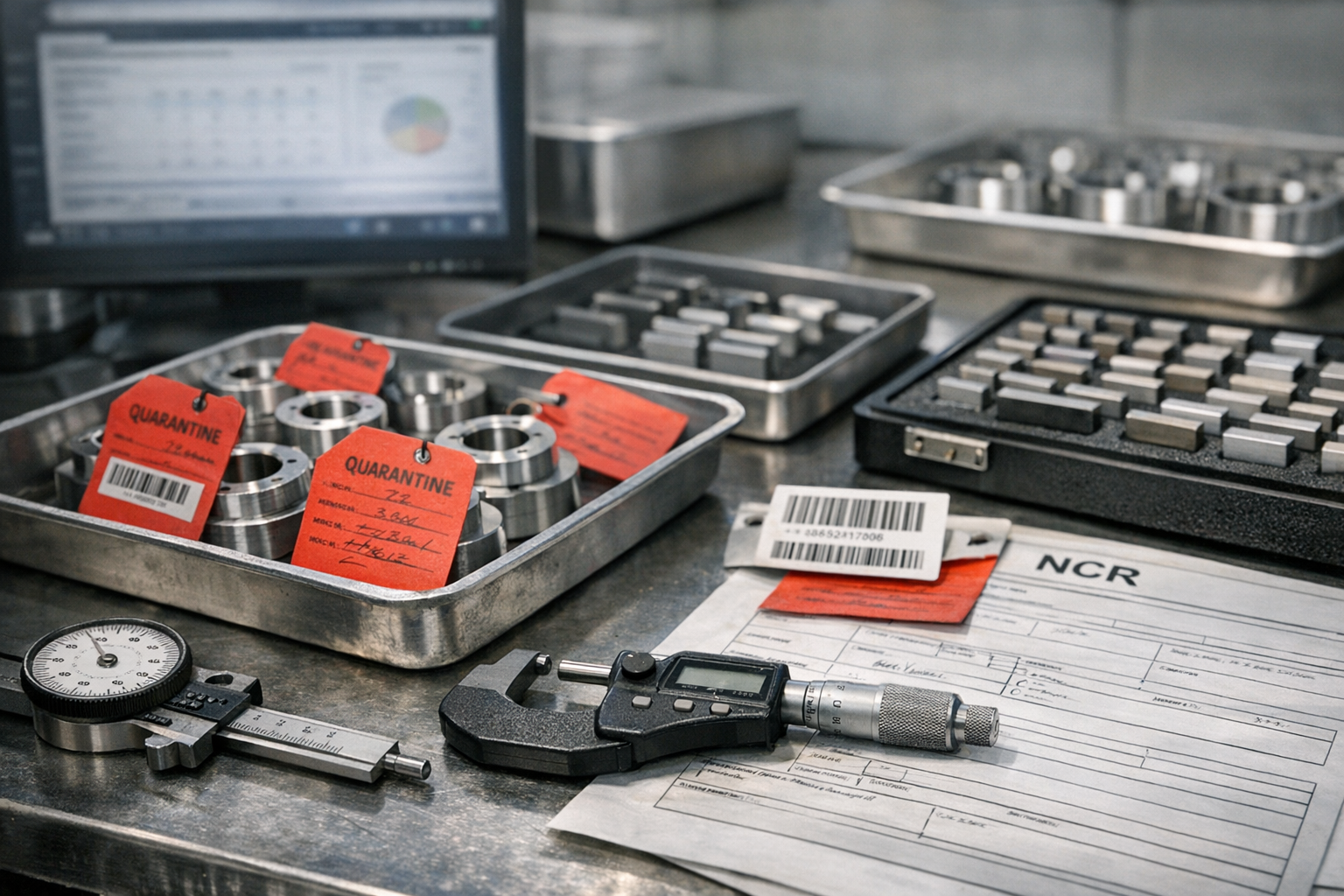
- Nonconformance and CAPA workflows: An NCR or CAPA may be tagged as high impact if it involves safety-critical characteristics, customer escapes, repeated defects, or large financial exposure, which can lead to escalation, more detailed root cause analysis, or broader corrective actions.
- IT/OT events: System outages, cybersecurity incidents, or data integrity issues that disrupt production or records for regulated products are usually classified as high impact and handled under specific incident or business continuity procedures.
Common confusion
High impact vs. high risk: In some frameworks, risk is explicitly defined as a combination of impact (severity) and likelihood (probability). In these cases:
- High impact refers only to the severity of consequences if the event occurs.
- High risk usually means the combined assessment of both high impact and non-trivial likelihood.
In everyday plant discussions, the two terms are sometimes used interchangeably, but in formal risk or quality documentation it is useful to keep the distinction clear.
High impact vs. critical: “Critical” may be a defined classification in product structures, process characteristics, spare parts, or equipment. “High impact” is broader and can apply to any event or decision that significantly affects key objectives, even if it is not tied to a formally defined critical characteristic or component.
Relationship to quality and compliance
In quality management and compliance contexts, the high impact designation is frequently used to:
- Identify issues that require rapid escalation to management or cross-functional review.
- Determine when enhanced documentation, verification, or validation is needed.
- Focus audits, internal reviews, and monitoring on areas where failure would be most consequential.
The exact thresholds and criteria for calling something high impact are typically defined in local procedures, risk matrices, or quality plans.


Related Blog Articles


Related FAQ
Related Glossary
Ready to See How C-981 Can Accelerate Your Factory’s Digital Transformation?
