AS9100 Non-Conformance Requirements: Practical Implementation Guide
Learn how to implement AS9100 non-conformance and corrective action requirements in practical aerospace workflows, what auditors expect to see, and how digital systems support compliance without overcomplicating your QMS.
AS9100 Non-Conformance Requirements: Practical Implementation Guide
In aerospace manufacturing and MRO, a single nonconformance can ground aircraft, disrupt delivery schedules, and raise regulatory concerns. AS9100 raises the bar on how you must control nonconforming outputs and manage corrective action, but many organizations struggle to translate the standard’s language into clear, workable processes.
This guide explains AS9100 non conformance requirements in practical terms: what processes and records auditors expect to see, how to align your NCR and CAPA workflows with the standard, and how digital tools can simplify compliance across sites.
For teams putting non-conformance and capa into daily operation, non-conformance management, quality management workflows, a connected execution platform help connect the concept to traceability, work-order reality, and audit-ready evidence.
The same operating model also depends on Connect 981’s aerospace execution solutions, real aerospace execution examples, Connect 981’s aerospace operations guidance, practical aerospace operations FAQs, especially when decisions have to move across quality, production, suppliers, and program leadership without losing context.
Implementation guidance here is general and must be adapted to your certified scope, processes, and registrar expectations. For exact wording and clause references, always consult the official AS9100 standard.
Overview of AS9100 and Its Scope
What AS9100 covers beyond ISO 9001
AS9100 is built on ISO 9001, then adds aviation, space, and defense-specific requirements. Compared with ISO 9001, it places much tighter expectations on:
- Control of nonconforming outputs (products, services, and processes)
- Configuration management and traceability for safety- and airworthiness-related items
- Risk-based thinking in both planning and corrective action
- Supplier control and flow-down of requirements
For non-conformance management, this means you need more than a basic NCR log. You must demonstrate a systematic, risk-aware approach that is consistently applied and fully traceable.
Why non-conformance control is central in AS9100
AS9100 treats nonconformances as a primary feedback loop in your Quality Management System (QMS). Effective control of nonconforming outputs is closely tied to:
- Flight safety – ensuring no suspect or unverified parts make it onto aircraft
- Regulatory compliance – providing complete records when authorities or prime contractors request evidence
- Customer confidence – demonstrating that quality escapes are quickly contained and prevented from recurring
- Operational performance – reducing rework, scrapped hardware, schedule slips, and AOG events
AS9100 auditors will typically spend significant time reviewing your nonconforming output and corrective action processes because they reveal how effective your QMS truly is.
How AS9100 ties into regulatory and customer demands
While AS9100 itself is not a regulation, it is widely referenced by OEMs and aligns with expectations from authorities such as the FAA and EASA. In practice:
- Regulators expect traceability and documented control of nonconformances that could impact airworthiness.
- Customers often impose additional notification, response time, and reporting requirements on top of AS9100.
- Prime contractors may require structured corrective action (e.g., 8D) and formal approval of supplier responses.
Your nonconformance and CAPA processes must therefore satisfy AS9100 while remaining flexible enough to support customer-specific and regulatory requirements.
AS9100 Clauses Related to Non-Conformance and Corrective Action
This section interprets common expectations without quoting the standard. Always use the latest AS9100 text as your legal reference.
Nonconforming outputs (e.g., Clause 8.7 concepts)
AS9100 requires that nonconforming outputs are identified and controlled to prevent unintended use or delivery. In practice, this means you should be able to show that you:
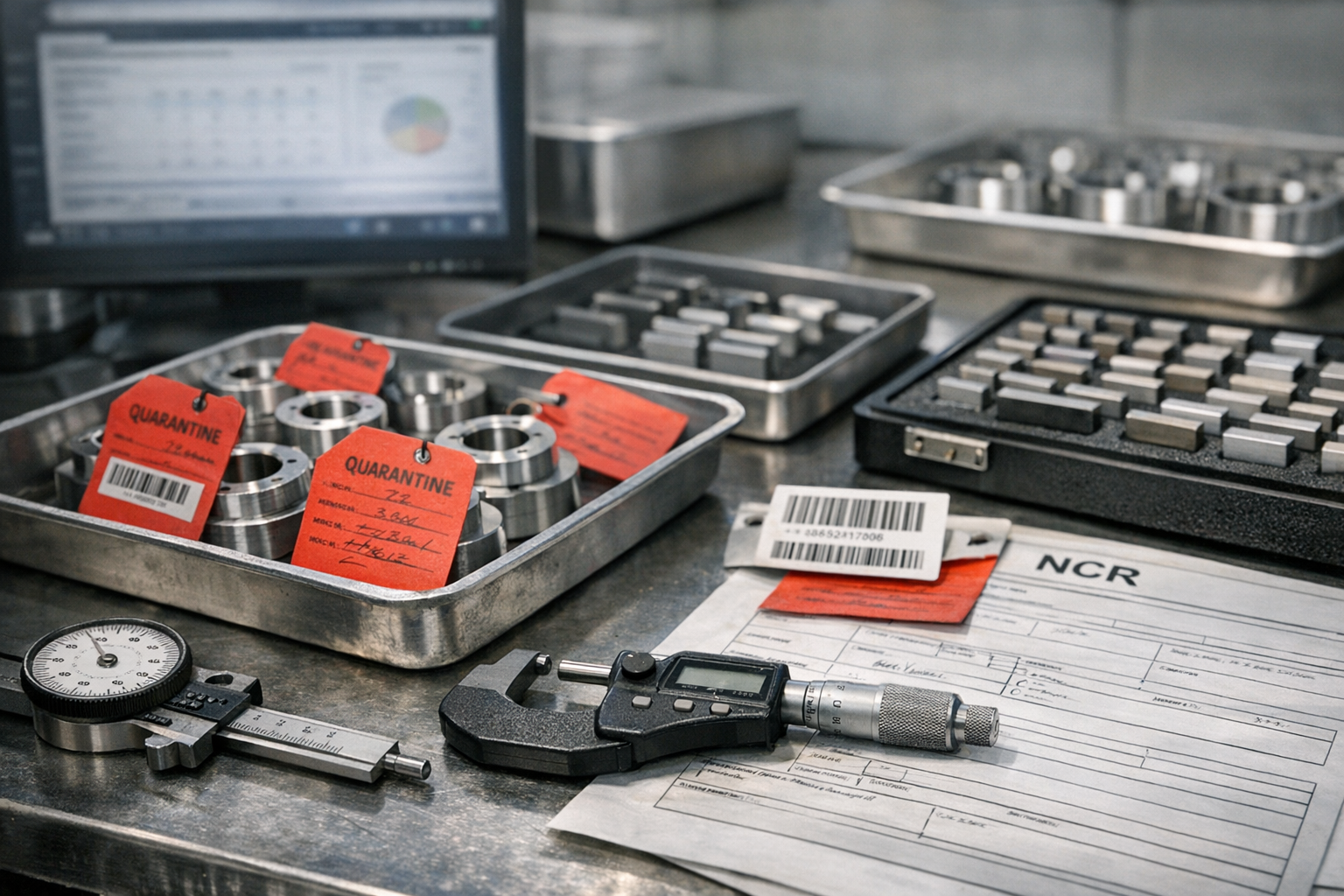
- Detect and clearly identify nonconforming products or services (tags, holds in ERP/MES, quarantine areas).
- Apply containment to all potentially affected material (lots, batches, tail numbers, work orders).
- Assign a disposition (e.g., rework, scrap, repair, return to supplier, or use-as-is with justification).
- Obtain appropriate approvals for each disposition, particularly for use-as-is and repair decisions.
Nonconforming outputs include more than physical parts. They can be services (e.g., incomplete MRO work scopes) or process nonconformances (e.g., missed steps, uncalibrated tooling, unauthorized procedure changes).
Corrective action and risk-based thinking
AS9100 expects organizations to react to nonconformances by:
- Taking immediate corrective action (containment and short-term fixes).
- Determining root cause of significant or recurring nonconformances.
- Implementing systemic corrective actions to prevent recurrence when warranted.
- Evaluating risk when deciding which issues require full corrective action and what level of analysis is appropriate.
Risk-based thinking means not every minor paperwork error requires a full 8D, but safety, regulatory, or major customer-impact issues absolutely do. Your procedures should clearly define when to escalate from an NCR to a formal Corrective Action Request (CAR).
Configuration management and traceability expectations
AS9100 places strong emphasis on configuration management and traceability, especially for safety-critical items. For nonconformance control, that means:
- Linking each nonconformance to specific part numbers, serial numbers, lots, or aircraft tail numbers.
- Tracking affected configurations when design changes or deviations are involved.
- Ensuring records show exactly which hardware or documents were affected, how they were dispositioned, and by whom.
Your nonconformance and corrective action records should tie together parts, documents, revisions, and approvals in a way that supports configuration audits and airworthiness investigations.
Documentation Expectations Under AS9100
Required records for nonconforming outputs
AS9100 requires documented information that provides objective evidence of control. Typical records for each NCR include:
- Unique NCR number and date raised
- Detection source (incoming inspection, in-process, final inspection, customer return, audit, etc.)
- Part number, description, serial/lot number, work order or job number
- Process step or station where detected
- Detailed description of the nonconformance, including measurements and references to drawing or specification requirements
- Photos or attachments where applicable
- Containment actions taken (including inventory scope and locations checked)
- Final disposition (rework, repair, scrap, use-as-is, return to supplier, etc.)
- Names, roles, and approvals of individuals authorizing the disposition
These records must be controlled: stored securely, protected from loss or alteration, and retained for defined periods consistent with customer, regulatory, and contractual requirements.
Evidence of containment, disposition, and approvals
Auditors look for more than completed forms. They want to see a logical chain of events supported by evidence:
- When a defect was found, what was contained and how quickly?
- Which inventory was checked and what were the results?
- What engineering evaluation supported a use-as-is or repair decision?
- Were the right authorities involved (quality, engineering, MRB, customer when required)?
In a digital system, this is often represented by time-stamped workflow steps, electronic signatures, and linked inspection or test records. In a manual system, auditors will review paper trails, stamps, and signatures to verify proper control.
Linking non conformances to CAPAs and design changes
AS9100 expects that significant or repeating nonconformances drive corrective action, and where appropriate, design or process changes. To demonstrate this, your documentation should show:
- Which NCRs led to formal Corrective Action Requests (CARs) or CAPAs.
- How root cause analysis was performed and by whom.
- What process, document, or design changes were implemented.
- How effectiveness was verified (audit, sampling plan, performance metrics, etc.).
Ideally, your system allows you to trace from a single NCR to related CAPAs, Engineering Change Orders (ECOs), training actions, and updated procedures. This traceability becomes very important when demonstrating your aerospace non conformance management framework to customers and auditors.
Aligning Your NCR Workflow With AS9100
Ensuring controlled forms and revision history
Whether electronic or paper-based, your NCR and CAR forms must be treated as controlled documents. That includes:
- Document numbers, titles, and revision levels
- Version control so obsolete forms are not used
- Authorized owners responsible for maintaining and updating templates
- Clear instructions for how to complete each field
In digital systems, this typically means centrally managed form templates with governed change control. In paper systems, it means controlled distribution and clear withdrawal of superseded forms.
Defining authorities for disposition and use-as-is
AS9100 expects that qualified and authorized personnel make disposition decisions. Your procedures should clearly define:
- Who can disposition routine rework or scrap decisions.
- Who sits on your MRB (Material Review Board) or equivalent authority panel.
- When customer or regulatory approval is required for deviations or repairs.
- What engineering analysis is needed before approving use-as-is decisions.
Auditors will compare your documented authority matrices to actual records to confirm the right people are approving the right things.
Meeting response time and closure expectations
AS9100 itself does not prescribe exact timelines, but customers frequently do (e.g., 24-hour containment, 7-day root cause, 30-day closure). Best practice is to:
- Define internal target timelines for containment, root cause analysis, and corrective action closure.
- Configure your workflows to flag overdue items and escalate to management.
- Differentiate timelines by risk or severity level (e.g., safety-related vs. documentation-only issues).
Digital tools make it much easier to track response times and demonstrate control during audits.
Preparing for AS9100 Audits
How auditors typically sample NCR and CAPA records
During certification, surveillance, or customer audits, you can expect auditors to:
- Request a list of open and recently closed NCRs and CAPAs.
- Select a sample across different sources (suppliers, internal production, customer complaints, audits).
- Follow several cases end-to-end: detection, containment, disposition, root cause, corrective action, and effectiveness check.
- Cross-check that changes claimed in CAPAs are actually implemented in procedures, training, and shop-floor practice.
If your information is spread across spreadsheets, emails, and shared drives, this sampling process becomes stressful and time-consuming. Centralized, searchable records make it much smoother.
Common nonconformities found during AS9100 audits
Typical nonconformities raised by AS9100 auditors around nonconformance and corrective action include:
- NCRs without clear or complete descriptions of the defect.
- Nonconforming product not clearly identified or physically segregated.
- Use-as-is dispositions without adequate engineering justification.
- Recurring issues without evidence of root cause investigation.
- CAPAs closed without documented effectiveness verification.
- Inconsistent application of procedures across sites or shifts.
Reviewing your recent NCRs and CAPAs against this list is a helpful way to prepare for audits and pre-empt findings.
Using audit findings to strengthen your process
Audit findings should feed into your continuous improvement process, not just be treated as “items to close.” For each audit nonconformity related to NCR/CAPA, consider:
- Is this an isolated error, or does it reveal a systemic weakness in training, tools, or oversight?
- Should the finding trigger a formal corrective action with root cause analysis?
- Can we improve our standard forms, checklists, or digital workflows to prevent similar issues?
Documenting this thinking shows auditors that you use their feedback to mature your QMS.
Leveraging Digital Systems to Demonstrate Compliance
Controlled electronic records and signatures
Digital QMS platforms, MES systems, and specialized nonconformance tools can strongly support AS9100 compliance when implemented correctly. Key capabilities include:
- Centralized records for NCRs, CARs, and related approvals.
- Electronic signatures tied to unique user IDs and time stamps.
- Audit trails showing who changed what and when.
- Access control by role, location, or responsibility.
These functions help demonstrate control over documented information, a recurring theme throughout AS9100.
Dashboards and reports that support audit readiness
Well-designed dashboards make it easy to answer typical audit questions such as:
- How many NCRs are open, and what is their aging profile?
- What are the top recurring defect types or root causes?
- Which suppliers have the highest nonconformance rates?
- Are we meeting our targeted closure timelines?
Rather than manually compiling spreadsheets before every audit, you can generate these reports on demand, demonstrating ongoing control rather than one-time preparation.
Maintaining consistency across multiple sites
For multi-site aerospace organizations, consistency is a major AS9100 concern. Digital workflows help by:
- Standardizing NCR and CAR templates across facilities.
- Ensuring common disposition codes, defect categories, and root cause taxonomies.
- Providing cross-site visibility to trends and best practices.
- Supporting central QA oversight while allowing local execution.
This reduces variation in how nonconformances are handled and provides a more uniform demonstration of compliance to auditors.
Putting It All Together
AS9100 non conformance requirements are not just about filling out forms. Aerospace organizations need:
- Clear, risk-based processes for detecting, containing, and disposing of nonconforming outputs.
- Robust documentation that links NCRs to corrective actions, design changes, and effectiveness checks.
- Defined authorities and timelines that match the risk and customer expectations.
- Digital workflows that replace fragmented spreadsheets and email with traceable, auditable records.
When these elements are in place, nonconformance management becomes a powerful driver of continuous improvement, audit readiness, and customer trust—rather than a bureaucratic burden.
To understand how these practices fit into a broader aerospace quality strategy, see the related discussion of a modern non-conformance management framework in aerospace operations.
As you refine your processes, keep alignment with AS9100, your certified scope, and your customers’ specific requirements at the center of your design, and leverage digital tools to enforce consistency and provide the evidence auditors and regulators expect to see.



Related Blog



Built for Speed, Trusted by Experts
Whether you're managing 1 site or 100, Connect 981 adapts to your environment and scales with your needs—without the complexity of traditional systems.
