special processes
Manufacturing or service processes whose outputs cannot be fully verified by inspection and must be controlled through qualification.


Core meaning
In manufacturing and regulated industries, **special processes** are processes whose resulting output **cannot be fully verified by subsequent inspection or testing**, and therefore must be controlled primarily through:
– prior qualification of the process,
– qualification of equipment and facilities,
– qualification and ongoing approval of personnel, and
– tightly controlled parameters and documentation.
The quality of the product is assured by demonstrating that the process is consistently capable, rather than by checking every characteristic of the finished item.
Common examples include:
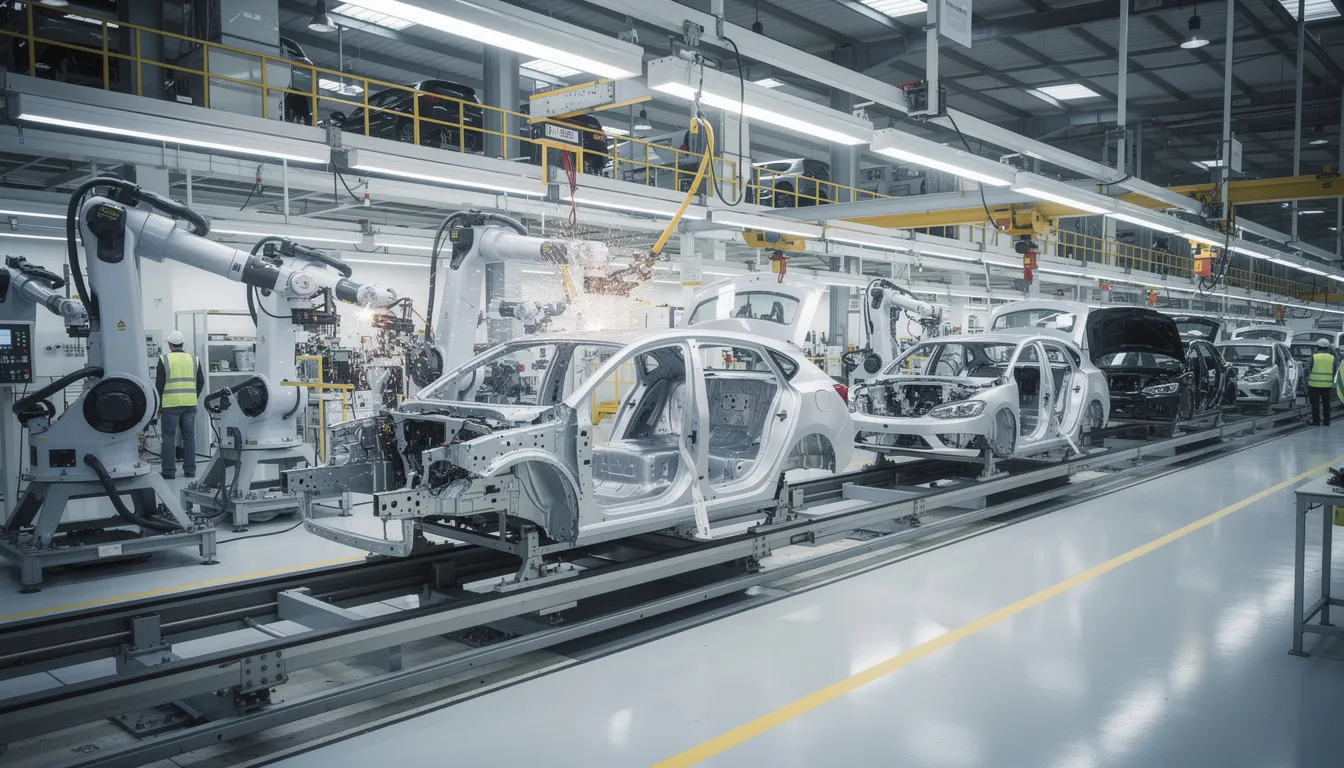
– welding, brazing, soldering
– heat treatment
– non-destructive testing (NDT) and some surface treatments
– plating, anodizing, coating and painting
– certain composite layup and curing operations
Use in industrial and regulated environments
In regulated environments (such as aerospace, medical devices, and pharmaceuticals), special processes typically:
– require **formal procedures, work instructions, and records** that prove the process was followed as qualified,
– are often governed by **industry standards or customer specifications**, and
– are subject to **periodic requalification or reapproval** when equipment, materials, methods, or key parameters change.
Manufacturing execution systems (MES), quality systems, and ERP integrations may:
– track which operations in a routing are designated as special processes,
– enforce that only **qualified operators, certified equipment, and approved materials** are used, and
– capture **full traceability** of process parameters (e.g., temperature profiles, torque settings, lot numbers).
Boundaries and what it is not
Special processes:
– **are defined by verifiability**, not by importance or cost; an operation can be critical but not a special process if all characteristics can be fully inspected afterward.
– are **not limited to a specific industry**; the concept appears in aerospace, automotive, energy, medical, and others.
– are **not the same as critical-to-quality (CTQ) characteristics**, though CTQs often exist within special processes.
A standard machining operation with measurable dimensions is usually **not** considered a special process if all relevant features can be reliably inspected and defects can be detected without destructive testing.
Common confusion and misuse
Special processes are commonly confused with:
– **Critical or key processes**: Many organizations use “critical process” to mean any operation that strongly influences product performance or safety. A process may be critical but not “special” if its output is fully verifiable.
– **Special cause variation (SPC)**: In statistical process control, “special cause” refers to a type of variation, not to the concept of special processes.
When using the term in quality or compliance discussions, it is helpful to confirm whether the intended meaning is **“not fully verifiable by inspection”**, which aligns with how many standards, customers, and auditors use the term.
Site-context application: aerospace and high-cost waste
In aerospace and similar highly regulated sectors, special processes are tightly controlled because:
– parts may rely on **invisible attributes** (e.g., material microstructure after heat treatment, weld integrity) that cannot be checked without damaging the part,
– process failures can force **scrap or extensive rework** of high-value, previously qualified components, and
– significant **revalidation, investigation, and documentation** effort may be triggered when a special process is suspected to be out of control.
As a result, waste or rework involving special processes often has a cost impact far beyond the direct material value, due to lost qualified parts, additional testing, and schedule risk.


Related Blog Articles

Related FAQ
Related Glossary
Ready to See How C-981 Can Accelerate Your Factory’s Digital Transformation?

