Aerospace Non-Conformance Reports (NCRs): Step-by-Step Process and Best Practices
Learn how aerospace organizations should structure the non-conformance report (NCR) process—from detection and containment through root cause, disposition, and closure—to improve traceability, reduce cycle time, and stay compliant with stringent regulatory and customer requirements.
Aerospace Non-Conformance Reports (NCRs): Step-by-Step Process and Best Practices
In aerospace, a single non conformance can ground an aircraft, trigger regulatory scrutiny, or delay a key delivery. That is why the aerospace non conformance report process must be structured, repeatable, and fully traceable from first detection through final closure.
This article explains the aerospace non conformance report (NCR) lifecycle in practical terms. You will see what information belongs in an NCR, how work should flow between quality, engineering, production, and suppliers, and where digital tools can eliminate delays and blind spots. For a broader view of how NCRs fit into the wider quality ecosystem, see our hub article on aerospace non conformance management.
What Is an Aerospace Non-Conformance Report (NCR)?
Definition of an NCR in Aerospace Manufacturing and MRO
An aerospace non-conformance report (NCR) is a formal record used to document any deviation from approved requirements in design, manufacturing, maintenance, repair, or overhaul activities. It captures the details of the discrepancy, its impact, and the actions taken to contain, investigate, and disposition the issue.
In AS9100-based quality systems, NCRs are a primary mechanism for demonstrating control of nonconforming product and for feeding issues into corrective action and continuous improvement processes.
Common Triggers for Raising an NCR
Typical triggers for issuing an NCR in aerospace include:
- Dimensional out-of-tolerance conditions identified during inspection
- Incorrect material, heat treatment, or special process certification
- Surface defects such as scratches, pits, corrosion, or coating damage
- Assembly errors (wrong part installed, incorrect torque, missing hardware)
- Software or configuration mismatches relative to the approved baseline
- Deviations from approved work instructions or process parameters
- Equipment used past calibration or outside specified limits
- Field or in-service performance issues reported by operators or customers
Any time product, documentation, or process execution does not conform to the approved specification or procedure, an NCR should be raised to preserve traceability and ensure structured follow-up.
Minor vs. Major Non Conformances and Risk Categorization
Aerospace organizations typically categorize non conformances according to risk. Terminology and criteria may be defined by internal procedures, AS9100-compliant QMS documents, customer contracts, or regulatory expectations, so each organization must follow its own approved definitions. A common pattern is:
- Minor non conformance: A deviation that does not affect safety, airworthiness, form/fit/function, or regulatory compliance. Examples include cosmetic blemishes within agreed limits or certain documentation errors that can be corrected without product impact.
- Major non conformance: A deviation that may affect safety, airworthiness, performance, reliability, or compliance. Examples include dimensional issues on critical features, missing inspections, process escapes on special processes, or unapproved design changes.
Risk categorization helps determine priorities, containment urgency, who must approve dispositions, and which NCRs must be reported to customers or authorities.
Core Stages of the Aerospace NCR Process
While each organization’s procedures differ, most aerospace NCR workflows contain the same core stages.
1. Detection and Initial Documentation
The process starts when someone detects a deviation. This might be an inspector, production technician, engineer, supplier quality representative, or field service technician. Key steps include:
- Recognize the non conformance: Confirm that an actual requirement is violated (drawing, specification, procedure, or contract).
- Open the NCR: Create an NCR record in the approved system with a unique identifier.
- Capture basic details: Part number, serial/lot, work order, operation, discrepancy description, and who found it.
- Record immediate risk notes: Is product already delivered? Is there potential impact to in-service aircraft?
Fast, accurate initial documentation is essential. Incomplete information at this stage often causes rework and investigation delays later.
2. Containment and Segregation of Nonconforming Product
Containment prevents the nonconformance from spreading or reaching the customer. Typical actions:
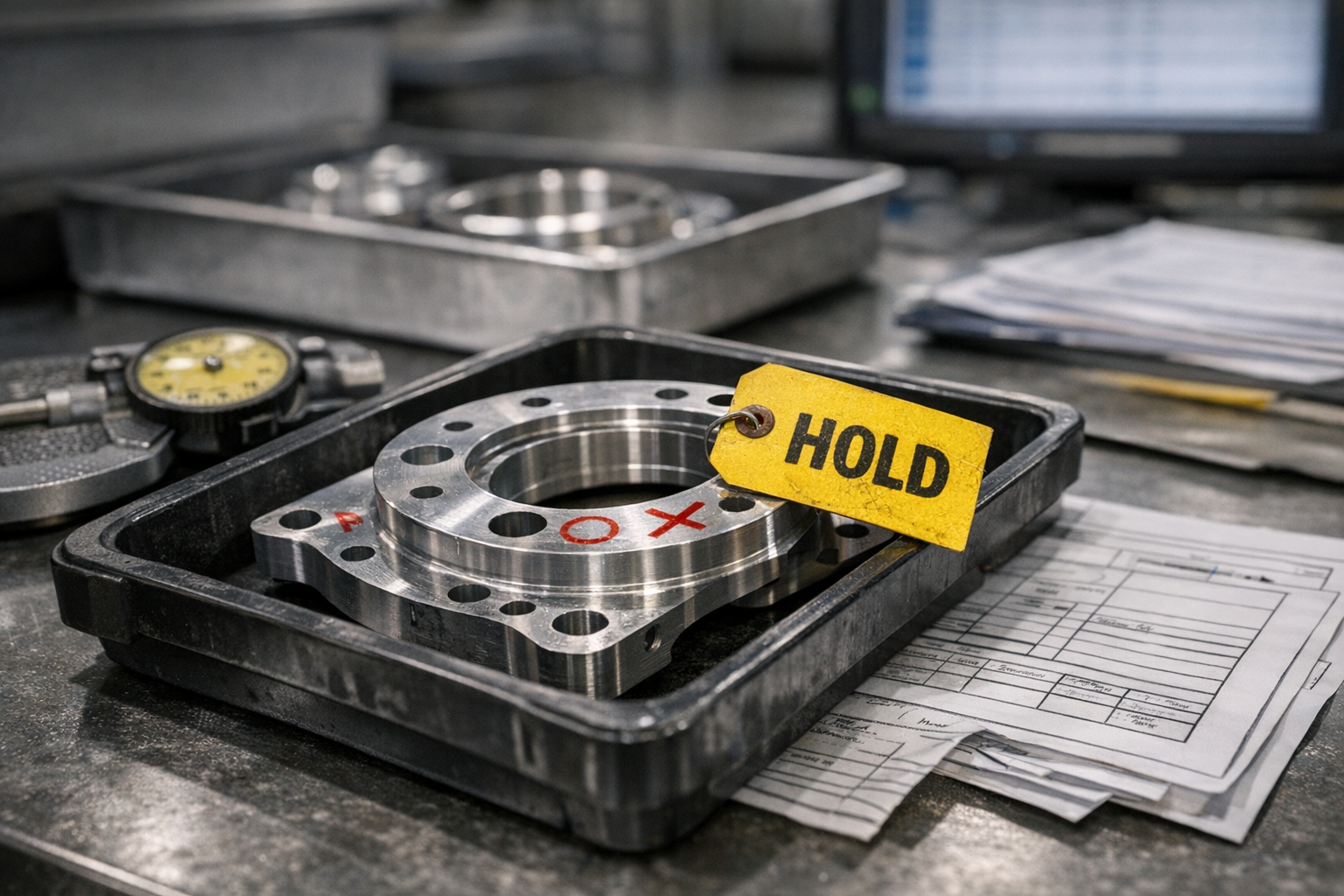
- Physically segregate affected parts or assemblies in a clearly marked hold area.
- Place electronic or physical hold tags on related work orders or lots.
- Stop or limit production steps that could worsen the issue.
- Assess potential impact on delivered product or fielded aircraft and initiate additional containment if required.
The objective is to protect flight safety and customer operations while the investigation proceeds. The effectiveness and timeliness of containment are key metrics for a healthy NCR process.
3. Root Cause Investigation and Analysis
Once the situation is stable, a structured investigation begins. Common practices include:
- Assign an owner: Typically a quality or manufacturing engineer responsible for coordinating the investigation.
- Use a formal method: 5-Why, Ishikawa/fishbone, 8D, or similar approaches suitable for aerospace applications.
- Consider multiple cause categories: Human (training, workload), method (procedure), machine (equipment), material, measurement, and environment.
- Review historical data: Previous NCRs, process capability data, maintenance logs, and supplier history to determine if the issue is isolated or systemic.
In aerospace, superficial root cause analysis is a recurring audit finding. Investigations must go beyond operator error and identify underlying system or process contributors.
4. Disposition, Corrective, and Preventive Actions
Disposition is the formal decision on what to do with the affected product. Common aerospace dispositions are:
- Use-as-is: The product is acceptable in its current state, and engineering analysis confirms no negative impact to form, fit, function, or safety.
- Rework: The product will be processed to bring it fully back into conformance with the original specification.
- Repair: A controlled deviation from the original design is accepted according to an approved repair scheme, often documented in a repair order or engineering deviation.
- Scrap: The product is not recoverable or is not economical to rework or repair and is permanently removed from use.
Around the disposition decision, the team defines:
- Immediate corrective actions: What must be done now to fix the specific occurrence.
- Systemic corrective actions: Changes to procedures, tooling, training, or controls to address the root cause.
- Preventive actions: Proactive measures to prevent similar issues in adjacent processes or products, even if they have not yet failed.
Who can approve which disposition is usually defined by internal procedures and may depend on part criticality, regulatory requirements, and customer contracts.
5. Verification and Formal Closure
An NCR should only be closed when:
- The disposition has been implemented and documented.
- All required inspections, tests, or verifications are completed.
- Corrective and preventive actions are implemented and verified for effectiveness according to internal criteria.
- All required approvals and signatures are captured in the record.
Verification might include follow-up audits, review of process performance data, or sampling inspections after the corrective action is in place. Only then is the NCR closed in the system. The data should still be accessible for trend analysis, audits, and continuous improvement.
Standardizing NCR Data Capture
Standardizing the information captured in each non conformance report is one of the fastest ways to improve investigation quality and reduce cycle time.
Mandatory Fields: Part, Serial, Work Order, References
At minimum, an aerospace NCR should consistently record:
- Identification: Part number, nomenclature, revision level, and configuration baseline.
- Traceability: Serial number, lot/batch number, heat number (if applicable), and work order or routing.
- Location: Station, process step, or facility where the non conformance was found.
- References: Drawing or model ID, specification, procedure, or customer requirement that was violated.
- Detection method: Incoming inspection, in-process inspection, final inspection, test, or field report.
- Discrepancy description: Clear, objective description including what was expected vs. what was actually observed.
Many organizations define checklists or electronic forms to ensure these data elements cannot be skipped.
Capturing Visual Evidence and Measurement Data
High-quality NCRs include objective evidence, such as:
- Photographs of the condition with clear context and scale
- Dimensional measurements compared to tolerance bands
- Screen captures or logs from test systems and automated equipment
- Copies or links to relevant certifications, travelers, or process records
Digital systems make it easier to attach this evidence directly to the NCR, improving communication between inspectors, engineers, and suppliers.
Ensuring Completeness at the Point of Entry
Data gaps at the start of the process are a major cause of NCR delays. To minimize this:
- Use mandatory fields with validation rules in electronic forms.
- Provide clear guidance and training for personnel who open NCRs.
- Leverage dropdown lists for common defect codes and locations to standardize terminology.
- Integrate with ERP/MES to auto-populate part, work order, and customer data where possible.
Doing the hard work upfront enables faster, more accurate root cause work later on.
Roles and Responsibilities Across the NCR Workflow
Quality Engineering Ownership
Quality often owns the overall NCR process. Typical responsibilities include:
- Ensuring NCRs are opened when required and contain sufficient detail.
- Coordinating containment and verifying that affected product is controlled.
- Driving root cause analysis and ensuring use of structured methods.
- Monitoring timelines, escalations, and adherence to procedures.
- Maintaining the integrity of the NCR database and reporting.
Production, Design Engineering, and Supplier Roles
Beyond quality, other functions play key roles:
- Production / Operations: Implement containment and rework, provide process knowledge, and support root cause investigations.
- Manufacturing / Industrial Engineering: Analyze process capability, tooling, and workflow; propose process changes.
- Design Engineering: Evaluate impact to form/fit/function and safety, approve use-as-is or repair dispositions, and initiate design changes when required.
- Supplier Quality and Suppliers: Investigate and correct issues originating at the supplier, provide supporting data, and implement corrective actions in their own processes.
Escalation Paths for Safety-Critical Issues
For safety-critical parts, systems, or in-service events, escalation paths must be clear and documented. These may include:
- Immediate notification of engineering leadership and airworthiness authorities within the organization.
- Triggers for reporting to customers according to contract or quality agreement clauses.
- Internal safety review boards or material review boards (MRBs) for high-risk dispositions.
Timelines, communication channels, and decision-making authority should be defined in approved procedures rather than improvised after a serious event occurs.
Common Bottlenecks in Manual NCR Processes
Email-Based Approvals and Spreadsheet Tracking
Many aerospace facilities still manage NCRs via email, shared folders, and spreadsheets. Typical consequences include:
- Approvals that sit in inboxes for days with no visibility to quality or management.
- Conflicting versions of NCR forms across various shared drives.
- Manual copying of data between systems, leading to errors and omissions.
These delays directly impact mean time to closure, on-time delivery, and audit readiness.
Lost Context and Incomplete Audit Trails
When conversations occur in email threads and hallway discussions, critical context is easily lost:
- Decisions are not fully documented in the NCR record.
- Investigations are difficult to reconstruct during audits.
- Lessons learned cannot be effectively reused across the organization.
Aerospace regulators and customers expect complete and retrievable records, not scattered files and partial histories.
Missed Deadlines for Customer and Regulatory Commitments
Some customers and authorities specify response times for acknowledging and resolving non conformances. Manual monitoring makes it easy to miss these commitments. Consequences can include:
- Formal audit findings or certification risk.
- Customer dissatisfaction and increased oversight.
- Pressure on internal teams as due dates slip without early visibility.
Without real-time dashboards and automated reminders, quality managers often spend significant time just chasing status updates.
Digitizing the NCR Workflow
Digital tools do not change the fundamental steps of the NCR process, but they dramatically improve speed, visibility, and consistency.
Configurable Electronic NCR Forms
Electronic forms allow organizations to:
- Standardize mandatory data fields for all NCRs.
- Configure specialized forms for different categories (e.g., design, supplier, in-service).
- Embed guidance, checklists, and drop-down codes to improve data quality.
- Attach supporting documents and multimedia evidence directly to the record.
This reduces errors and rework compared with handwritten or static PDF forms.
Automated Routing and Notification Rules
Workflow engines can route NCRs automatically based on criteria such as product line, customer, risk level, or part criticality. Typical capabilities include:
- Automatic assignment of NCRs to the responsible quality or engineering group.
- Parallel routing for approvals when multiple sign-offs are required.
- Escalation emails or alerts when tasks remain open beyond defined thresholds.
This reduces dependency on manual coordination and helps ensure issues progress steadily toward closure.
Dashboards for Tracking Open NCRs and Cycle Time
Digital dashboards give real-time visibility into:
- Total open NCRs by status, product line, or facility.
- Average and median cycle times.
- Backlogs at key workflow steps (e.g., pending engineering disposition).
- Top recurring defect codes, suppliers, or processes.
With this information, leaders can allocate resources, remove bottlenecks, and prioritize high-risk items proactively.
KPIs for Measuring NCR Process Performance
To continuously improve the aerospace non conformance report process, organizations track key performance indicators (KPIs) and use them in regular reviews.
Mean Time to Closure (MTTC)
Mean time to closure is the average time between NCR creation and final closure. It is often broken down by category, product family, or facility. Trends in MTTC help identify:
- Whether the process is becoming more efficient over time.
- Where specific groups or steps are causing delays.
- How process changes or digital tools are affecting responsiveness.
Some organizations also track time by phase (e.g., from detection to containment, from containment to disposition) for finer analysis.
First-Pass Containment and Investigation Effectiveness
It is not enough to close NCRs quickly; actions must be effective. Two useful concepts are:
- First-pass containment effectiveness: Percentage of non conformances where the initial containment fully prevents further escapes or rework.
- Investigation and corrective action effectiveness: Measured by repeat non conformance rates on the same part, process, or defect code over a defined period.
Low effectiveness often indicates that root causes were not correctly identified or that corrective actions were too narrow or insufficiently verified.
Rework, Scrap, and Cost of Poor Quality (COPQ) Impact
The NCR process should feed into cost analysis to support data-driven decision-making. Common metrics include:
- Rework hours and cost associated with NCRs.
- Scrap quantities and value by part family or process.
- Cost of Poor Quality (COPQ): A holistic measure including internal failure costs (rework, scrap), external failure costs (returns, concessions), appraisal costs, and prevention costs.
Linking technical NCR data with financial metrics helps prioritize improvement projects with the highest return on investment.
Connecting NCRs to Broader Non-Conformance Management
NCRs are a central building block of broader aerospace non conformance management. A mature approach:
- Integrates NCRs with CAPA, risk management, and configuration management processes.
- Supports trend analysis across multiple sites, programs, and suppliers.
- Ensures that lessons learned are shared and embedded into standards, training, and design rules.
By standardizing and digitizing the NCR process, aerospace organizations improve traceability, reduce cycle time, and protect safety and compliance, while building a stronger foundation for continuous improvement across their entire operation.



Related Blog


Built for Speed, Trusted by Experts
Whether you're managing 1 site or 100, Connect 981 adapts to your environment and scales with your needs—without the complexity of traditional systems.
