
Aerospace manufacturing operates under constraints that most industries never face. A single missed fastener on a fuselage section can ground an entire fleet. A procedural gap discovered ten years into production might require retrofitting hundreds of aircraft already in service. When programs run for 20 to 40 years and every serial number must maintain traceable documentation for its entire operational life, the systems that guide shop floor execution become foundational to both safety and business viability.
Digital work instructions in aerospace are structured, interactive procedures delivered to operators through tablets, workstations, or dedicated HMIs. Unlike static documents or paper build books, these instructions connect directly to ERP, MES, and quality systems, creating a continuous record of what happened, when, by whom, and with what result. This page focuses specifically on aerospace and defense manufacturing and MRO work, covering airframes, engines, structures, and avionics rather than generic factory use cases. The stakes in this environment make the difference between paper based instructions and connected digital systems a matter of compliance, safety, and program survival.
Digital work instructions improve build consistency, reduce errors, and are central to AS9100, NADCAP, FAA, and EASA compliance. One aerospace manufacturer reduced work instruction creation time from four days to one hour, while another eliminated assembly errors entirely, dropping from a 0.12% error rate to zero. These results reflect what becomes possible when instructions are no longer static documents but active guides that enforce standard work and capture data at the point of execution. Connect981 is built specifically for aerospace and MRO teams, unifying instructions, travelers, ERP and MES data, and supplier workflows in one digital layer. This article serves as the pillar overview, with deeper content available on digital travelers, version control, operator guidance systems, and MES integration.
From Traditional Paper Work Instructions to Digital Manufacturing Instructions
Aerospace factories have traditionally relied on layered paper-based systems to control work. Engineering drawing sets filled large binders at each station. Printed work instructions defined sequences, tool requirements, and acceptance criteria. Paper travelers moved physically with work orders, collecting signatures and dates as assemblies progressed through production. This approach emerged when aerospace was built in smaller volumes with longer cycle times per unit, and it worked adequately for that environment.
The physical artifacts are familiar to anyone who has spent time on an aerospace shop floor. Paper travelers clipped to work orders, printed CAD screenshots with handwritten annotations, binder-based process documentation updated by hand, and tribal knowledge passed during shift handovers. On a narrow-body final assembly line, a work order arrives with a multi-part traveler showing part numbers, serial numbers, work center routing, and space for operator sign-offs. Next to the workstation sits a binder with printed instructions covering fastener installation, torque values, and required tools.
Concrete examples illustrate how this plays out across different aerospace environments. Final assembly of aircraft sections involves hundreds of fastener holes, with operators manually checking off each location on paper checklists. Composite layup procedures from programs launched in the 2010s still rely on printed ply orientation tables and manual cure cycle logs. Engine MRO shops manage teardown, inspection, reconditioning, and reassembly through stacks of paper travelers that must be manually reconciled before an engine can be released.
The terminology in this space can be confusing because different organizations use overlapping terms:
- Work instructions are detailed, step-by-step guides for specific operations, tied to part numbers and configurations
- Manufacturing instructions often serve as engineering-owned baselines from which site-specific work instructions are derived
- Digital travelers are the digital equivalent of route cards, tracking work order progress and collecting data at each step
- Routing sheets define the sequence of work centers and operations
- Process documentation is the broad category encompassing all technical instructions, drawings, and standards
Digital work instructions represent the structured, current source of truth that replaces these fragmented paper artifacts with a single controlled system.
Long certification cycles compound the challenges. Programs spanning 20 or more years accumulate complexity as work instructions undergo dozens of revisions. Supplier changes, design improvements, service bulletins, and lessons learned from in-service issues all drive updates. In paper systems, controlling which version is current across multiple sites and suppliers becomes nearly impossible.
Limitations of Paper and File-Based Instructions in Aerospace Operations
Paper-based instructions create concrete operational risks that aerospace and defense manufacturers know well. Rework on major assemblies when a procedural step is discovered missing during final inspection. Concessions to OEMs when deviations from approved instructions are found. Missed first article inspection requirements because documentation cannot demonstrate that procedures were followed correctly.
The core limitations include:
- Version confusion: When a revised instruction is issued, it must be printed, distributed to every relevant site and supplier, and old versions must be physically removed from circulation. This rarely happens uniformly. A technician in one MRO facility might work from a 2015 revision while the official current version dates from 2023. There is no enforcement mechanism in paper systems, and auditors cannot definitively answer which version was used for a specific serial number.
- Disconnected systems: ERP holds work orders and part master data. PLM stores engineering drawings and BOMs. QMS manages nonconformances. Paper travelers exist outside all of these systems. When a defect is discovered, quality must manually transcribe findings. When engineering issues a change, travelers in the field do not automatically update. Data silos proliferate, and no single system knows the complete history of a serial number.
- Slow change management: Engineering changes are frequent in aerospace, especially during early production. In paper systems, the change process takes days or weeks: engineering issues a notice, manufacturing engineering revises instructions, quality reviews, documents are printed and distributed, operators are briefed, and old versions are collected. For urgent safety issues, this gap is dangerous.
- Limited traceability: A traveler might show that a part visited a machining center and was signed off, but there is no link to which specific instruction revision the operator used. If a torque value was recorded manually, there is no verification that it was within tolerance. When an FAA auditor requires evidence that a specific process step was performed correctly, paper systems force weeks of manual record searching.
Compliance gaps are particularly acute. AS9100 clause 8.5.1 requires controlled conditions for work execution, but paper systems cannot prove every operator used the current revision. FAA and EASA require traceable maintenance sign-offs, which paper logs struggle to provide definitively. NADCAP special processes require real-time parameter capture that manual worksheets filled out after the fact cannot deliver. ITAR controls on defense programs demand role-based access that printed documents cannot enforce.
File-share and PDF-based approaches that appear digital create similar problems. Static pdf documents can be printed, emailed, or edited locally. There is no audit trail showing which version was actually used. Virtual versions stored on shared drives perpetuate the same version confusion as paper. These pseudo-digital systems provide none of the traceability or control that aerospace compliance requires.
Operational impacts are measurable. Engineering changes reach the line late, causing rework. High-value titanium parts are scrapped due to procedural errors caught too late. Engine MRO turnaround time extends because technicians must call engineering for clarification on unclear instructions.
Digital Work Instructions: Core Capabilities for Aerospace and MRO
Modern digital work instructions are structured, interactive procedures delivered to manufacturing workers through connected devices. Each instruction guides the operator through a sequence of steps where actions can be validated, data can be captured automatically, and progression can be blocked when requirements are not met. The system connects directly to ERP, MES, and quality systems, ensuring that every execution is tied to a specific work order and serial number.
A properly designed aerospace digital work instruction includes step-by-step flow with mandatory checks, embedded images and 3D views showing component locations, torque values with automatic validation against spec limits, and certified tool requirements verified before progression. Operators see guided workflows rather than static documents. The system actively prevents advancement to the next step until the current step is completed correctly.
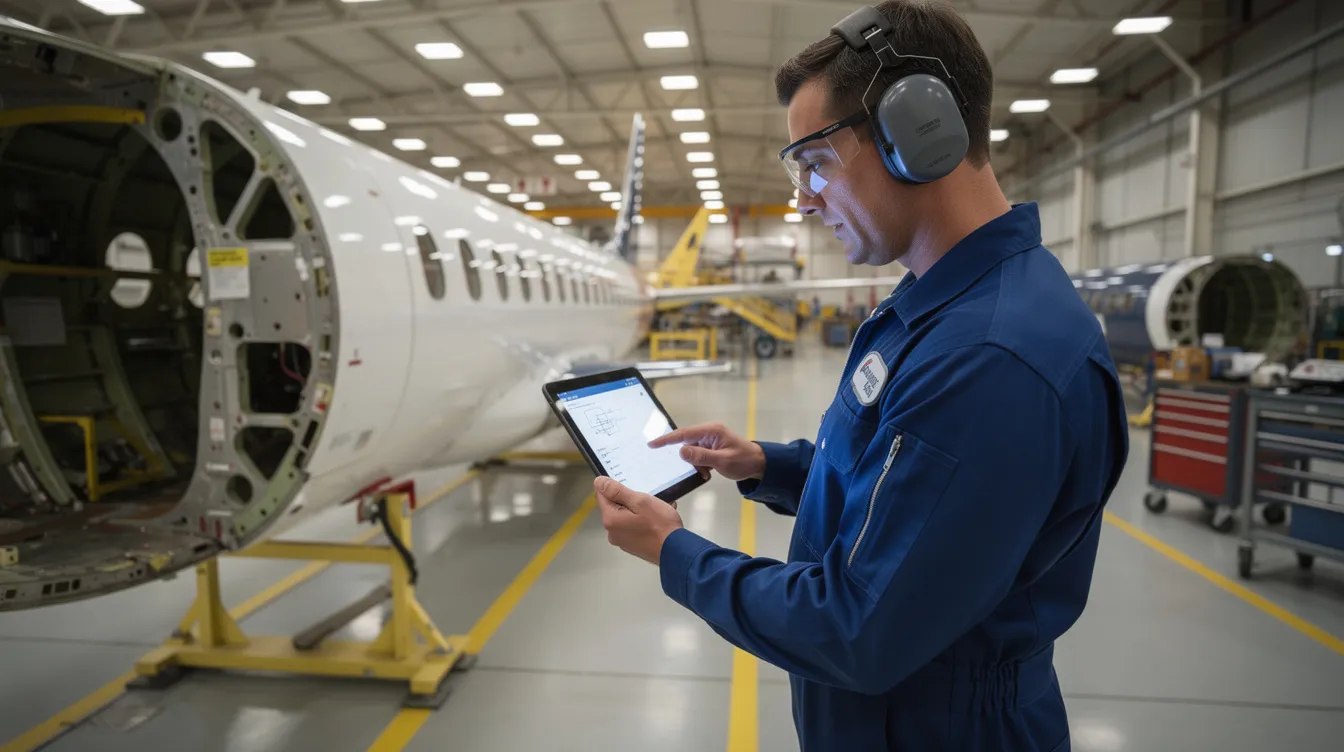
Connect981 addresses these capabilities specifically for aerospace environments:
- Embedded digital travelers showing routing and status, tied to each work order and serial number
- Revision control and approval workflows ensuring only released instructions reach the shop floor
- Part-level and serial-level traceability recording which operator performed which step, when, with what result
- Integrated defect logging and nonconformance capture directly from the instruction screen
- Support for final assembly lines, composite layup rooms, engine MRO cells, avionics repair benches, and supplier facilities
- Connection to iot devices and torque tools for automatic data collection
- Visual content including annotated drawings, 3D views, and photos from actual stations
The glossary terms that recur throughout aerospace digital work instruction systems have specific meanings in practice. A digital traveler is the persistent record of a work order’s journey through manufacturing, holding routing information and collecting data at each operation. Revision control manages multiple versions of instructions, enforcing draft versus released states and documenting approvals. Manufacturing instructions are the procedural documents specifying how products should be manufactured. Process documentation is the broad category encompassing all technical guidance.
How Digital Work Instructions Reduce Errors and Standardize Work
Aerospace realities make error reduction essential. Escape defects can ground entire fleets. Concession costs run into millions. Flight safety incidents trigger regulatory scrutiny and program delays. Customer penalties for quality failures compound financial pressure on margins already stretched thin.
Digital work instructions reduce errors through multiple mechanisms:
- Guided step sequencing: Operators follow a defined sequence that prevents out-of-order execution. The system blocks progression until current steps are verified complete.
- Required data entry: Certain fields cannot be left blank. Measurements, observations, and confirmations must be recorded before advancement.
- Automatic validation: Tolerance checks compare recorded values against spec limits. Out-of-range entries are flagged immediately, before the operator moves on.
- Tool verification: Connected torque tools, vision systems, and calibrated instruments auto-capture values and confirm correct tool usage.
- Stop conditions: The system verifies prerequisites before allowing progression. If training records are missing or a previous step requires rework confirmation, execution is blocked.
Results from aerospace implementations demonstrate the impact. Error rates dropped from 0.12% to zero. Scrap and rework reduced by 64%. Training time for new workers decreased by 50%. First time quality improved because defects were prevented rather than detected after the fact.
Specific aerospace examples illustrate how this works in practice. Fuselage sections require hundreds of fasteners. Digital instructions can highlight each fastener location on a 3D model, require confirmation of each installation, and block completion until all positions are verified. Composite layup procedures demand precise fiber orientation. Digital systems track each ply, verify orientation, and log cure cycle parameters automatically from connected oven controllers. C-check and D-check MRO events involve hundreds of inspection steps. Digital instructions require evidence for each inspection, whether photos, measurements, or borescope images, ensuring nothing is marked complete without actual execution.
Integration with inspection and measurement devices eliminates transcription errors. Real time data flows from torque wrenches, digital calipers, CMMs, and borescopes directly into the instruction system. Values are validated against tolerance bands instantly. This creates audit trails that prove not just what was recorded, but what actually happened.
Standard work becomes enforceable across shifts and factories. Every operator at every site follows the same sequence, uses the same tools, and captures data in the same format. Multi-language and multi-unit variants operate under a single master revision. When instructions are updated, the update is instantly available everywhere. This standardization prevents the procedural drift that accumulates when frontline workers at different locations develop local variations.
Supporting Compliance: AS9100, FAA/EASA, ITAR, and NADCAP
Digital work instructions in aerospace are not primarily efficiency tools. They are compliance enablers that encode regulatory requirements and create audit ready records automatically. The documentation demands of aerospace and defense manufacturing make digital systems essential rather than optional.
Core compliance themes addressed by digital work instructions:
- AS9100: Clause 8.5.1 mandates controlled conditions for work execution. Digital systems prove control by maintaining revision history, tracking which instructions were used for which serial numbers, and linking execution to operator training and qualification records. Records retention becomes automatic rather than a manual archival project.
- FAA/EASA: Maintenance documentation requirements demand traceable sign-offs tied to specific technicians and timestamps. Digital instructions capture exactly who performed each step, when, with what result. The complete maintenance history for an aircraft or engine becomes immediately accessible rather than scattered across filing cabinets.
- NADCAP: Special processes like heat treat, non-destructive testing, and composite curing require parameter capture at the point of execution. Digital systems connected to oven controllers, NDT equipment, and cure monitoring systems log data in real time. The gap between process execution and parameter recording that exists in manual systems is eliminated.
- ITAR: Defense programs require controlled access, data residency compliance, and role-based permissions that paper cannot provide. FedRAMP-ready cloud deployment or on-premises installation addresses these requirements. Access can be restricted to authorized personnel, with complete audit trails of who viewed or modified instructions.
Connect981 maintains full audit trails covering who changed what instruction, when changes were approved, where instructions were executed, and which serial numbers were affected. Digital signatures tied to specific operators and timestamps replace handwritten initials that cannot be verified. Mandatory checklists ensure required steps are completed before progression. Automated escalation triggers when required approvals are skipped or when tolerance limits are exceeded.
Maintaining compliance becomes an output of normal operations rather than a separate documentation exercise. Quality standards are encoded into the instruction workflow itself.
Integration with ERP, MES, PLM, QMS, and Supplier Systems
Digital work instructions function as the execution layer that sits on top of existing enterprise systems rather than replacing them. The goal is not to rip out ERP or MES but to create a connected layer that translates high-level work orders into guided shop floor execution and captures granular data for quality and compliance.
Integration architecture for aerospace operations:
- ERP sends work orders, part numbers, and due dates. As operators execute work, status updates flow back to ERP for accurate work-in-progress visibility.
- PLM provides CAD drawings, BOMs, and engineering change data. Instructions reference the latest design, and when changes are issued, affected instructions are flagged for review.
- MES or legacy systems track high-level routing while Connect981 manages detailed operator steps. The MES dispatches work to a work center; the digital instruction system guides what happens at that center.
- QMS handles nonconformance workflows and CAPAs initiated directly from the instruction screen. When an operator discovers a defect, a nonconformance record is created automatically with all relevant context attached.
Digital travelers pull and push data to these systems, creating a single consistent history per serial number. The digital thread connects design, manufacturing, and quality data into a traceable record that follows each part through its lifecycle.
Multi-tier supplier integration extends visibility across the supply chain. Suppliers receive controlled access to work instructions, specifications, and change notifications through secure portals. As suppliers complete work, data returns to the OEM automatically. This visibility enables early defect detection and ensures supplier-manufactured parts meet the same quality standards as internal production.
Real-time reporting becomes possible when manufacturing operations data flows from instruction execution. Production dashboards show WIP, bottlenecks, and quality trends without requiring manual data collection. Cycle time analysis, defect correlation, and operator performance tracking emerge from the same data captured during normal work.
Digital Work Instructions Across Aerospace Use Cases
Digital work instructions apply across the entire aerospace lifecycle, from prototype builds through rate production and into MRO and retrofit programs. The specific requirements vary, but the core need for controlled, traceable execution remains constant.
Key aerospace scenarios:
- New program industrialization: Early flight-test builds require rapid instruction updates as process issues are discovered. Digital systems enable same-day revisions with complete traceability of which serial numbers were built under which instruction version. A/B testing of different approaches becomes possible, with data showing which methods produce better outcomes.
- Rate increases: Production ramps from 10 units per month to 40 units per month demand standardization across multiple assembly lines and sites. Digital instructions ensure every operator follows the same procedure regardless of location. New hires ramp faster because guided instructions reduce dependence on tribal knowledge and expert knowledge transfer.
- Defense programs: Configuration control across multiple blocks (Block 1, Block 2, Block 3) requires instructions tied to specific configurations. Long service lives of 40 or more years demand documentation systems that can maintain records indefinitely. ITAR compliance requires controlled access that paper cannot enforce.
- MRO and heavy checks: C-checks and D-checks involve hundreds of inspection and maintenance steps. Digital routing and instructions create complete maintenance histories tied to aircraft serial numbers. If a defect is discovered in service, the MRO work can be reviewed immediately to determine if the issue existed before maintenance or resulted from it.
- Supplier manufacturing: Tier 1 and Tier 2 suppliers receive OEM-provided instructions to ensure consistency. Digital delivery with traceable completion data replaces paper packages sent via purchase order. The OEM gains visibility into supplier execution without requiring on-site audits for every operation.
Connect981 adapts to mixed-model lines and complex options including customer-specific modifications, service bulletins, and retrofit kits. Instructions can be configured by variant, with the system automatically determining which version applies based on work order configuration.
Designing Effective Aerospace Digital Work Instructions
Manufacturing engineers and process owners responsible for authoring instructions need practical guidance for creating effective digital work instructions that operators can actually follow.
Best practices for aerospace instruction design:
- Start from validated templates tailored to aerospace tasks. Assembly, test, inspection, and rework operations each have common structures that can be standardized and then customized for specific applications.
- Use clear, operator-focused language rather than pure engineering jargon. Reference spec IDs and drawing callouts accurately, but write for the person executing the work rather than the engineer who designed the process.
- Include visual aids. Annotated drawings, 3D views, and photos from actual stations reduce ambiguity, especially for complex assemblies and harness routing. Videos demonstrating correct technique can accelerate training for new employees.
- Build in checks and balances. Required data fields prevent progression without complete information. Automatic tolerance checks validate measurements against spec limits. Stop conditions block advancement when prerequisites are not met.
- Consider training needs. Design instructions that can serve as on-the-job training content for new operators and cross-training programs. Include explanations of why steps matter, not just what to do.
- Structure for multi-site deployment. Localizations for language, metric versus imperial units, and local tooling should be variants under one master process. When the master is updated, all variants update simultaneously.
Connect981 offers drag-and-drop templates and zero-code workflow tools so process owners can design and deploy instructions without heavy IT involvement. This enables rapid iteration during early production when instructions change frequently and eliminates the bottleneck of waiting for IT resources to implement updates.
Change Management, Revision Control, and Digital Travelers
Unmanaged change is a primary source of defects in aerospace manufacturing. Engineering changes are frequent, especially during early production. When instructions change but operators use old versions, mixed lots and traceability gaps result. Paper systems cannot reliably control which version is current across distributed operations.
Proper revision control in digital systems operates through defined states and workflows:
- Draft vs. released states: Engineers work on draft revisions without affecting the shop floor. Only released revisions are visible to operators, preventing half-finished instructions from reaching production.
- Approval workflows: Before release, revisions require approval from manufacturing engineering, quality, and sometimes customer representatives. Approval records are timestamped and archived.
- Automatic archival and comparison: Every revision is stored with full metadata. Comparison tools show exactly what changed between versions.
Digital travelers in Connect981 are always tied to the correct revision of work instructions for a given work order and serial number. The system enforces this binding automatically.
Practical mechanisms for managing change:
- Operators cannot access obsolete documents. The system presents only the current released revision for each work order.
- Emergency deviations and temporary revisions can be implemented with controlled scope and automatic rollback when the deviation expires.
- Complete records show which serial numbers were built under each revision. If a defect is traced to a procedural issue, affected units can be identified immediately for inspection or retrofit.
- Version control prevents the scenario where an auditor asks which procedure was in effect for a specific build and no one can answer definitively.
Data, Analytics, and Continuous Improvement from Instruction Execution
Because every step of a digital work instruction is logged with timestamps, operator IDs, and measured values, the system generates granular data that powers continuous improvement and predictive quality. This data exists as a byproduct of normal work rather than requiring separate data collection efforts.
Analytics capabilities from instruction execution data:
- Step-level cycle times identify bottlenecks on assembly lines or MRO cells. If one step consistently takes longer than expected, investigation can reveal tooling issues, training gaps, or procedural inefficiencies.
- Defect correlation connects quality issues to specific steps, tools, shifts, or operators. If a particular assembly step shows elevated defect rates, root cause analysis can focus there. If defects spike during a specific shift, workforce or supervision issues might be the cause.
- Rework rate tracking by process, program, or supplier prioritizes improvement projects. Increasing rework rates signal growing problems before they become critical.
- Operator performance monitoring compares execution across operators to identify training needs, skill certifications, and optimal task assignments. New hires can be tracked over time to measure ramp-up effectiveness and accelerate training programs.
- Tool usage patterns reveal when equipment is drifting out of calibration or approaching end of life.
Connect981 includes real-time dashboards and AI-assisted root cause analysis focused on aerospace operations data. Artificial intelligence can identify patterns that would take humans hours to spot, accelerating problem resolution.
These insights directly support audit readiness. When an OEM auditor or FAA inspector asks for evidence that a specific procedure was followed correctly, reports can be generated in minutes rather than weeks. The execution history provides complete, timestamped documentation of every action.
Analytics tie back to strategic initiatives like rate readiness and smart factory programs. The ability to continuously improve based on actual execution data rather than assumptions transforms digital work instructions from documentation tools into operational intelligence platforms.
Implementing Digital Work Instructions in an Existing Aerospace Environment
Implementing digital work instructions in established aerospace operations requires a practical approach that works alongside existing systems rather than forcing a complete infrastructure replacement.
Phased adoption roadmap:
- Assessment: Map current travelers, instructions, and compliance requirements across key programs and sites. Identify where paper processes create the most friction and where compliance gaps present the greatest risk.
- Pilot: Choose a representative line or MRO cell to prove value and refine templates. A complex assembly operation or engine module works well because it exercises the full range of instruction capabilities without putting entire programs at risk.
- Standardization: Define global templates for common process types and governance rules for authors. Establish who can create and approve instructions, what review processes are required, and how revisions flow to the shop floor.
- Integration: Connect to ERP, PLM, MES, and QMS systems with focus on a few high-value data flows first. Work order dispatch and status updates typically provide immediate value. Broader integration can follow as the deployment matures.
- Scale: Roll out to additional lines, sites, and suppliers using lessons learned and standardized training materials. The pilot team becomes champions who can support broader adoption.
Involving manufacturing engineers, quality, IT, and frontline operators from the outset ensures the system is designed for actual use cases and builds buy-in for adoption. Operators who see the system reduce their daily frustrations become advocates rather than resistors.
Connect981 is designed to run alongside existing ERP and MES with low IT overhead. The goal is deployment in months rather than the multi-year cycles associated with full system replacements. Digital transformation happens incrementally, proving value at each stage before expanding scope.
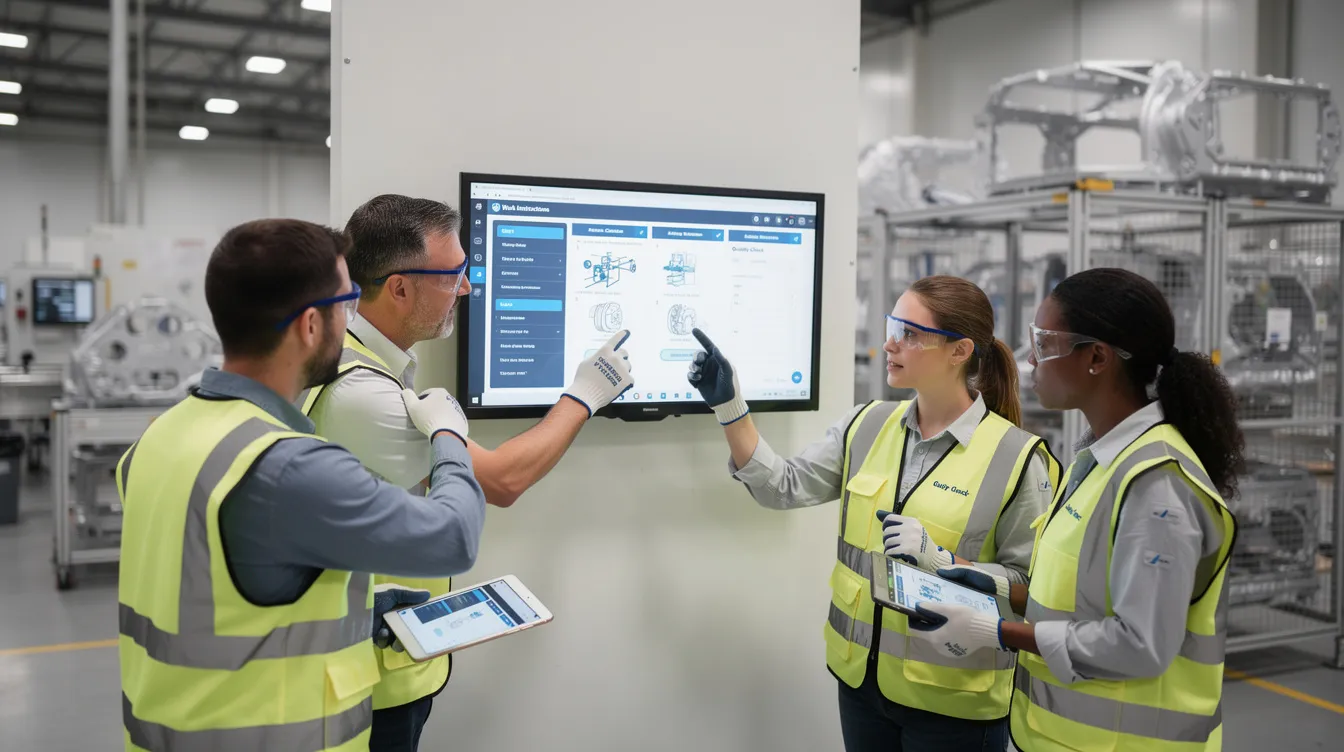
How Connect981 Supports Digital Work Instructions for Aerospace Teams
Connect981 acts as a unified operations layer specifically tuned for aerospace and MRO digital work instructions. The platform addresses the unique requirements of aerospace manufacturing, from serial number traceability to configuration control to the documentation structures required by AS9100 and FAA environments.
Key capabilities that differentiate Connect981 for aerospace operations:
- Aerospace-native data model: Serial number focus, configuration control, and documentation structures built for aerospace compliance rather than adapted from generic manufacturing systems.
- Zero and low-code workflow builder: Manufacturing engineers can build and maintain instructions without heavy IT projects. Drag-and-drop templates and visual workflow builders eliminate paper and enable rapid deployment.
- Cross-factory and cross-supplier visibility: One environment for OEM plants, MRO shops, and external suppliers with appropriate access controls.
- Integrated quality and traceability: Defect capture, inspection checklists, and full audit trails tied to each instruction step create audit readiness as a byproduct of normal operations.
- Fast deployment: Pilot to multi-line rollout in months rather than multi-year MES replacement cycles.
- Mobile devices support: Operators access instructions on tablets and workstations appropriate for their work environment.
- Connected tool integration: Torque tools, iot devices, and measurement equipment integrate directly for automatic data capture.
The platform saves time by eliminating manual documentation, paper reconciliation, and the compliance scramble that precedes audits. Efficiency gains compound across operations as standardized processes replace scattered tribal knowledge.
Next Steps and How to Get Started
Conclusion digital work instructions: the shift from paper based work instructions to connected digital systems is foundational to consistent, compliant aerospace manufacturing. Error reduction, standardized work, and audit ready documentation emerge naturally when instructions guide operators through validated procedures and capture data at the point of execution. The technology exists today to eliminate paper and transform how aerospace and defense manufacturers control factory floor operations.
For manufacturing engineers, operations leaders, and quality managers evaluating this transition, start by identifying one pilot area where digital work instructions would provide immediate value. Look for processes with high rework rates, compliance pressure, or reliance on tribal knowledge that does not scale.
Related content for deeper exploration:
- Digital travelers and routing management
- Work instruction version control and approval workflows
- Operator guidance systems and error proofing
- MES integration and connected shopfloor architecture
- Reducing human error through digital guidance
Request a demo of the Connect981 platform to see how these capabilities apply to your specific programs. Demos can be tailored to commercial, defense, or MRO operations and your existing system landscape. The path from paper to connected digital work instructions is shorter than most organizations expect when the platform is designed specifically for aerospace realities.