First Article Inspection Software: Stand-Alone FAIR Tools vs Connected Aerospace Execution Platforms
Overview: How This Guide Helps You Choose the Right FAI SoftwareFirst article inspection software automates the verification process to ensure a manufacturing line can produce parts that meet engineering specifications before full production begins. In aerospace and MRO, that decision affects release timing, supplier corrections, audit readiness, and whether article inspection reports can be trusted…

Overview: How This Guide Helps You Choose the Right FAI Software
First article inspection software automates the verification process to ensure a manufacturing line can produce parts that meet engineering specifications before full production begins. In aerospace and MRO, that decision affects release timing, supplier corrections, audit readiness, and whether article inspection reports can be trusted under pressure.
This guide compares stand-alone fai software with connected execution platforms like Connect 981 that link quality, operations, and system data. The question is practical: when is a basic FAIR tool enough, and when do ERP, MES, QMS, and PLM integrations become critical?
First article inspection, often shortened to first article inspection fai in buyer documents, depends on a defensible ballooned drawing, clear characteristic accountability, and a compatibility evaluation against the engineering drawing, CAD model, and specification requirements. The article inspection process must show that every design characteristic is properly understood, measured, and recorded.
Connect 981 is a B2B SaaS platform for digital industrial operations, focusing on aerospace manufacturing and MRO workflows. It is not just article inspection software; it connects ERP, MES, supplier data, documentation, and work execution into a unified operations layer.
Fast Comparison: Stand-Alone FAI Tools vs Connected Execution Platforms
Use this as a quick buyer snapshot before the detailed examination.
Stand-alone FAI / FAIR tools
Connected execution platforms (e.g., Connect 981)
Best for ballooning, form creation, and first article inspection reports.
Best for end-to-end execution, quality control, routing, and traceability.
Usually uses manual uploads of PDFs, CAD exports, and measured values.
Pulls data from ERP, MES, QMS, PLM, supplier portals, and shopfloor execution.
Traceability often ends at the fai report or shared folder.
Links FAI, work order, serial number, lot, defect, concession, and material certifications.
Supplier collaboration is usually email, upload, or net inspect style portal exchange.
Supports real time collaboration, supplier buy-off, field level comments, and shared status.
Works well for one site and limited production process change.
Scales across factories, programs, suppliers, and MRO workflow management.
Lower cost and faster setup.
Higher value where compliance exposure, integration, and process control matter.
Better choice for a few FAIs per month, single site, stable work.
Better choice for dozens of FAIs, multi-site programs, AS9100/ITAR pressure, and tight OEM turnarounds.
Many organizations start with stand-alone inspection software, then move to a connected platform when volume, risk, or customer quality requirements grow.
First Article Inspection Basics: What FAIRs Need to Prove
First Article Inspection (FAI) is a critical quality assurance process that ensures manufactured parts meet design specifications before full production begins, particularly in industries such as aerospace, automotive, and medical devices. It is also central to the aerospace industry, automotive industry, medical manufacturing, and defense industries where product safety and reliability depend on early proof of capability.
The fai process involves a detailed examination of the first sample produced from a manufacturing run, known as the first article, and includes checking dimensions, materials, and features against design specifications. FAI is mandated by various industry standards, including AS9102 for aerospace, which requires comprehensive documentation and verification of production methods to ensure compliance and quality. The AS9102 specification, developed by the international aerospace quality group, outlines requirements for first article inspection in the aerospace industry, ensuring that all aspects of design, manufacturing, and inspection are verified and documented.
An article inspection report documents dimensions, tooling, material specifications, testing processes, product accountability, number accountability, parts lists, routing, process certs, CMM outputs, and customer forms against the technical data package. The FAI report serves as a record for the company, addressing government regulations that require detailed documentation of production methods, tooling, material specifications, and testing processes.
FAI is mandated as a purchase order requirement in the aerospace and defense industries, ensuring compliance with strict quality standards to prevent safety risks and costly corrective actions. Implementing FAI helps mitigate risks by identifying potential issues before mass production, thus preventing costly corrective actions and ensuring product safety and reliability.
Example: before a 2025 supplier releases a machined bracket to full scale production, the inspection plan and fai plan should prove every balloon on the bubble drawing has inspection results, measured values, and proper documentation.
What Stand-Alone First Article Inspection Software Does Well
Stand-alone first article inspection software is usually a desktop or cloud tool focused on the ballooning process and standardized AS9102 or PPAP output. FAI software digitizes the creation of FAI reports (FAIRs), mandated by industries like aerospace (AS9102) and automotive (PPAP).
The most effective FAI software options focus on automating drawing ballooning, extracting Geometric Dimensioning and Tolerancing (GD&T) data, and exporting standardized reports like AS9102 or PPAP. Automated Ballooning automatically identifies and numbers dimensions on 2D engineering drawings. Data Extraction in FAI software pulls nominal values, tolerances, and notes from CAD models or PDFs. Modern FAI software automates the extraction of geometric dimensioning and tolerancing (GD&T) characteristics directly from CAD drawings, significantly reducing manual data entry and errors.
Typical functions include optical character recognition, GD&T capture, AS9102 Forms 1–3, ballooned drawings, limited CMM upload, and export to PDF, Excel, or portals. Digital Measurement Capture imports data directly from calipers, micrometers, and Coordinate Measuring Machines (CMM). Many tools can import cmm data from coordinate measuring machines, cmm software, and modern cmm technology.
FAI software eliminates human error by removing manual typos when transferring complex dimensions to spreadsheets. It also accelerates the ballooning, measurement, and AS9102 reporting process, significantly reducing human error. FAI software reduces inspection time by cutting drawing ballooning and data entry time by up to 80%, and FAI software can reduce the time required for the First Article Inspection process by as much as 50%, streamlining this crucial process without sacrificing quality or dependability.
A Tier-3 shop doing 5–10 FAIs per month for AS9102 and PPAP may use a low-cost tool to move from days to hours. Net-Inspect is widely utilized in the aerospace sector for cloud-based supplier collaboration and AS9102 compliance.
Limits of Keeping FAI Software Disconnected
Problems appear when first article inspections stay isolated from the quality assurance process and operations stack. FAIRs become static PDFs, weakly tied to work orders, serials, lots, nonconformance records, concessions, and fai data.
Manual data entry creates transcription errors when teams retype part numbers, rev levels, tolerances, drawing notes, and product specifications from ERP or PLM. If the engineering drawing changes mid-program, a disconnected FAIR may still reference the wrong revision.
Cross-site work adds more risk. Each plant or supplier may use different formats, different ballooned drawing conventions, and inconsistent characteristic accountability. In 2024, a multi-site aerospace supplier failed an OEM audit because FAIRs could not be tied reliably to work orders, lots, and concessions across three plants.
Stand-alone tools rarely manage contract review, PO inspection requirements, supplier buy-off, or automatic alerts when a change notice affects an existing fai inspection.
When a Connected Execution Platform Becomes Essential
A connected execution platform unifies ERP, MES, QMS, PLM, supplier workflow, shopfloor execution, and quality checks, including FAI. The tipping points are clear: dozens of FAIs per month, multiple sites, complex assemblies, strict AS9100 or ITAR programs, frequent changes, and OEM portals with tight turnaround.
FAI software catches defects early by validating production processes, tooling, and raw materials on the first run, decreasing scrap, rework, and waste. FAI software speeds up production by allowing faster FAI approval, enabling manufacturing lines to begin full production sooner. FAI software facilitates faster release to full-rate production by accelerating the First Article Inspection Report (FAIR) creation and approval process.
Integration creates the digital thread. FAI software creates a secure, searchable digital thread of dimensional records and testing. FAI software improves traceability by storing digital records centrally for easy auditing and historical quality tracking. FAI software standardizes workflows by ensuring all inspectors follow the same verification procedures.
In a 2025 MRO operation, a connected platform can trigger FAI automatically when a repair route or drawing for a flight-critical component changes, then tie the outcome to tail number, serial history, material certifications, and inspection results.
How Connect 981 Supports First Article Inspections End-to-End
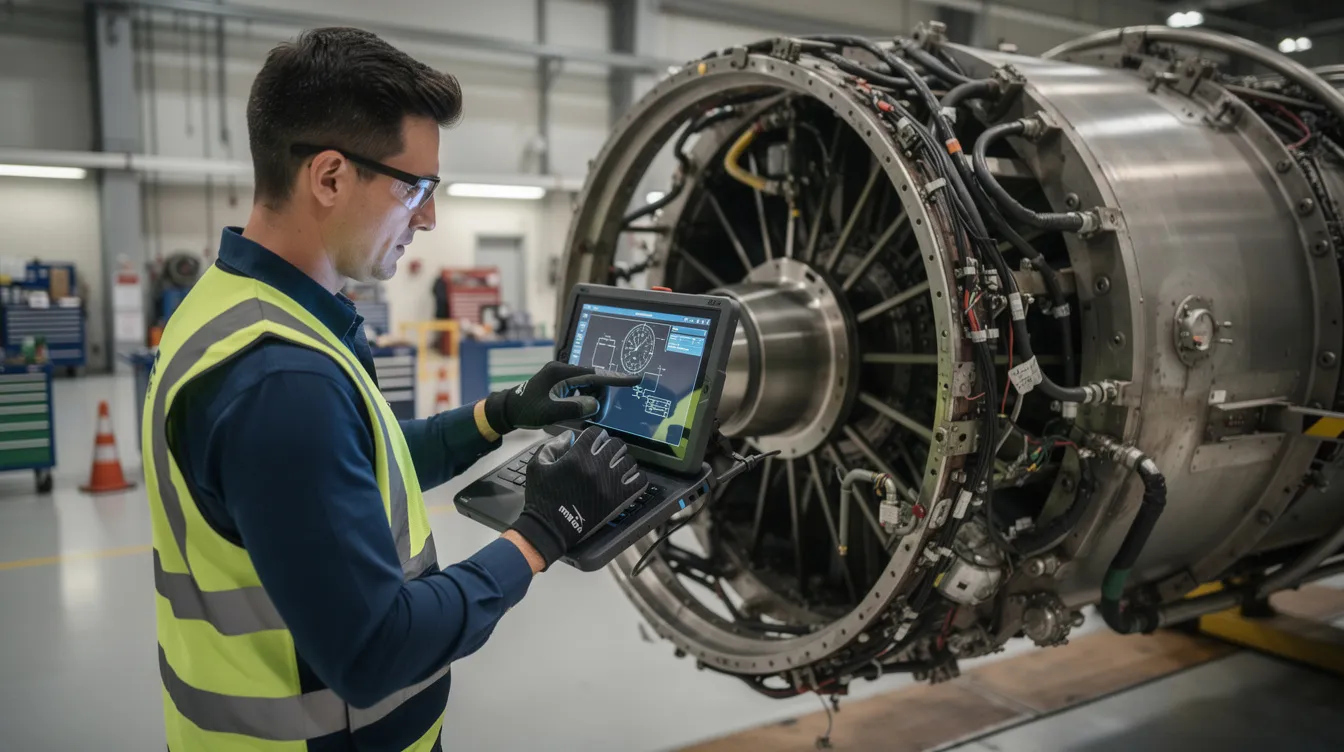
Connect 981 embeds first article inspection into production and MRO execution rather than treating it as a disconnected app. FAI steps can sit inside digital work instructions, routing sheets, supplier workflows, quality checks, and defect logging.
Connect 981 can ingest drawings and specifications from PLM, sync part and BOM data from ERP, and anchor FAIRs to work orders and serials in MES or existing systems. This helps ensure accuracy when a design characteristic, lot, or supplier process changes.
For quality assurance, Connect 981 links characteristic accountability to actual measured values, defect records, balloon numbers, certifications, customer correspondence, and fai related documentation. Modern FAI software solutions allow for the electronic review and approval of inspection reports, facilitating quicker corrections and enhancing compliance in industries with stringent standards.
Connect 981 enables real-time reporting, dashboards, and predictive analytics for decision-making in manufacturing workflows. Connect 981 supports zero and low-code workflow builder for rapid deployment in aerospace manufacturing environments.
Buyer Decision Criteria: Stand-Alone FAI Tool or Connected Platform?
Use the criteria below with a quality manager, manufacturing engineering, supply chain, IT, program managers, technical professionals, and other technical professionals.
Criterion
Stand-alone fit
Connected platform fit
FAI volume
Few per month
Dozens per month
Sites
Single plant
Multi-site standardization
Assemblies
Simple, stable parts
Complex builds and MRO histories
Compliance
Limited customer exposure
AS9100, AS9102 Rev C, NADCAP, ITAR, FAA, EASA
System landscape
Minimal integration need
ERP, MES, QMS, PLM data continuity
Supplier network
Small, mature base
Multi-tier supply chain
IT capacity
Quick win
Hybrid or phased path
Ask vendors: how are rev changes from engineering drawings handled; how is characteristic accountability maintained across re-inspections; what ERP/MES/QMS/PLM integrations exist; how is ITAR/CUI data protected; and how are electronically recorded approvals locked?
High QA is a comprehensive, modular manufacturing quality suite that integrates FAI data into broader operations like Statistical Process Control (SPC) and Non-Conformance Reports (NCR). That category shows why buyers should evaluate whether FAI belongs alone or inside broader quality operations.
Integration and Traceability: What to Verify Before You Buy
For aerospace and defense, integration and digital traceability can matter as much as speed when selecting article inspection software. Verify part and lot data from ERP, latest drawings from PLM, nonconformance links in QMS, supplier portal status, and MES work order context.
A strong digital thread ensures the article inspection report reflects the correct configuration, revision, manufacturing process, and process history for each first article. Digital tools enable the automation of GD&T extraction from CAD drawings, which populates structured audit records and enhances the efficiency of the FAI process.
Compatibility evaluation should cover APIs, data models, CUI controls, legacy MES constraints, and whether the platform can layer over existing systems. Connect 981 is designed as that unified operations layer, not a rip-and-replace MES project.
Practical Implementation Paths: From Manual FAIRs to a Connected FAI Workflow
The transition from traditional paper-based methods to digital records has revolutionized the First Article Inspection (FAI) process, significantly reducing errors and speeding up the inspection process.
Stage 1 is manual FAIRs on spreadsheets, paper packets, and shared folders. Focus on clean templates, revision control, and proper documentation.
Stage 2 is a stand-alone FAI and ballooning tool. Focus on repeatable ballooned drawings, consistent AS9102 forms, digitally recorded measurements, and fewer spreadsheet errors.
Stage 3 connects FAI into an execution platform like Connect 981. Focus on system integrations, cross-site standards, supplier workflows, automatic change triggers, and audit trails.
Pilot on one program, such as a 2026 narrow-body airframe package or a high-value engine component. Track FAIR preparation time, rejected FAIs, rework, audit findings, and on-time delivery impact. For many teams, this is a game changer because the inspection process becomes part of execution, not an after-the-fact document task.

Conclusion and Next Steps: Evaluating First Article Inspection Software for Your Operation
Stand-alone first article inspection software is excellent for accelerating FAIR creation, ballooning, measurement capture, and reporting. Connected execution platforms unlock the integration, traceability, supplier collaboration, and cross-factory consistency now expected in modern aerospace and MRO.
Base the decision on FAI volume, compliance risk, number of sites, current systems, supplier maturity, and OEM expectations for digital FAIRs. Map your current article inspection process and identify where disconnected files, approvals, or revisions cause delays and prevent errors.
If your team is ready to connect FAIs with shopfloor execution, supplier collaboration, and ERP/MES/QMS/PLM data, request a Connect 981 demo focused on your FAI workflows, article inspection reports, and integration needs.



Related Blog


Built for Speed, Trusted by Experts
Whether you're managing 1 site or 100, Connect 981 adapts to your environment and scales with your needs—without the complexity of traditional systems.
