nonconformance
A documented failure of a product, process, or system to meet specified requirements, standards, or approved procedures.


Core meaning
Nonconformance (often written as **non-conformance** or **nonconformity**) commonly refers to a documented failure of a product, process, service, or management system to meet specified requirements. These requirements may come from:
– Internal specifications, drawings, or work instructions
– Customer requirements or contracts
– Regulatory or industry standards
– Quality management system procedures
In regulated manufacturing, a nonconformance typically triggers formal recording, evaluation, disposition, and follow-up actions.
How nonconformance is used in operations
In industrial and regulated environments, nonconformance is a structured quality event, not just a generic defect. It is usually managed through a defined workflow that may include:
– **Detection and recording**: A deviation is found during incoming inspection, in-process checks, final inspection, testing, or post-delivery feedback and logged in a quality or MES/NCR system.
– **Classification**: The issue is categorized (e.g., critical, major, minor; product vs. process vs. documentation).
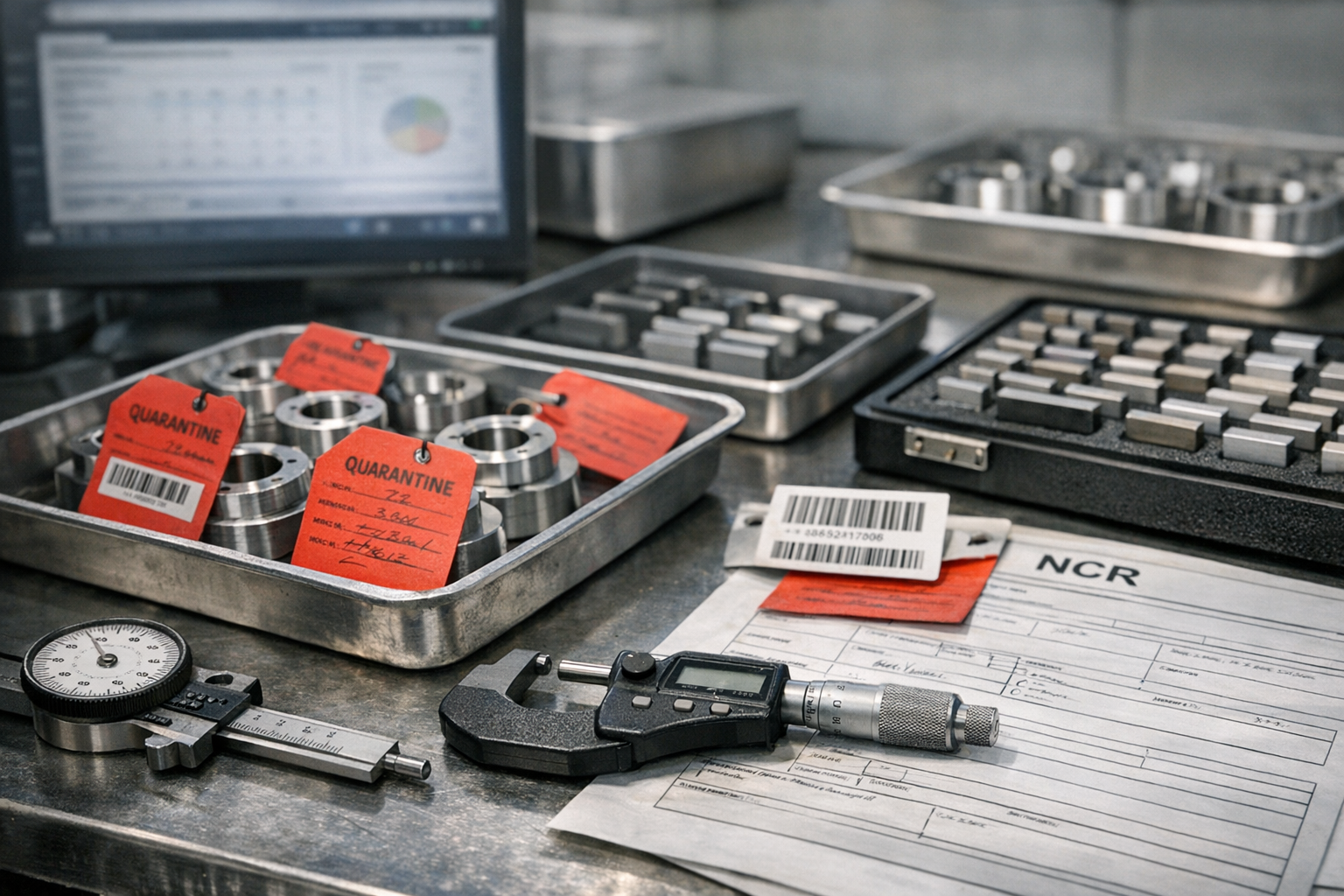
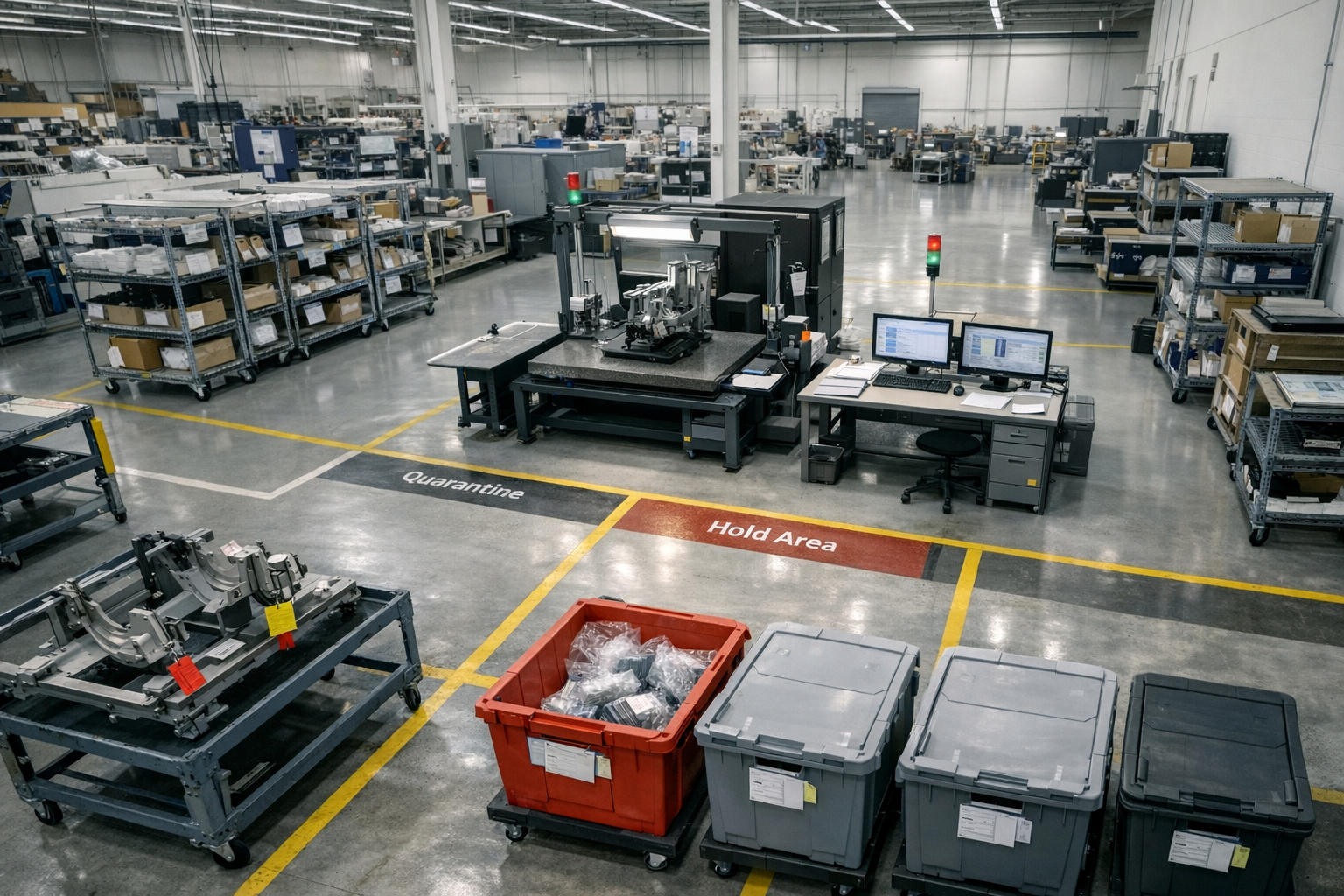
– **Containment**: Affected material, product, or documentation is identified, segregated, or placed on hold to prevent unintended use.
– **Disposition**: A formal decision is made, such as scrap, rework, repair, use-as-is under concession/waiver, or return to supplier.
– **Investigation**: Root causes and contributing factors are analyzed, often linking to corrective and preventive action (CAPA) processes.
– **Documentation and traceability**: Records are retained to demonstrate control, trace impact, and show compliance during audits.
Examples in manufacturing:
– A machined aerospace component exceeds a critical dimensional tolerance.
– A batch record is incomplete or signed by an unauthorized operator.
– A software change to an MES recipe is implemented without following the approved change-control procedure.
Boundaries and what it is not
To avoid confusion, it is useful to distinguish nonconformance from related terms:
– **Nonconformance vs. defect**: A defect is a specific flaw in a product or service. A nonconformance is the broader event of not meeting a requirement and may be tied to product, process, system, or documentation.
– **Nonconformance vs. deviation**: “Deviation” often refers to a temporary, pre-approved departure from a requirement. Nonconformance usually refers to an unplanned or undesired departure discovered after it occurs.
– **Nonconformance vs. noncompliance**: Noncompliance is generally used for failures to meet laws or regulatory obligations. Nonconformance is commonly used for failures against internal or contractual requirements, though some organizations use the terms interchangeably.
– **Nonconformance vs. CAPA**: Nonconformance is the event; CAPA is the structured follow-up activity intended to correct causes and prevent recurrence.
Nonconformance does **not** imply regulatory enforcement action by itself, and it is not by definition a safety incident, though it may be related to one.
System and data perspective
In OT/IT and quality systems, nonconformance is typically represented as a specific record type, such as a **Nonconformance Report (NCR)** or **Nonconformity record**, which may include:
– Unique identifier and date/time stamps
– Linkage to batches, lots, serial numbers, equipment, and operators
– Description of requirement and how it was not met
– Classification (severity, type, source, detection point)
– Disposition decisions and approvals
– Links to investigations, CAPA, and rework instructions
MES, QMS, ERP, and PLM systems often integrate nonconformance data to support traceability, material status control, and cost-of-quality analysis.
Site context: nonconformance in high-risk, regulated manufacturing
In sectors such as aerospace, pharmaceuticals, and medical devices, nonconformance events are tightly controlled and highly traceable. Managing a nonconformance in these environments may:
– Invalidate qualified parts or certified materials
– Require engineering review, revalidation, or requalification
– Trigger supplier notifications or customer concessions
– Introduce schedule risk due to investigations and approvals
Because of this, nonconformance management is a central element of quality systems and risk control in regulated, high-cost manufacturing operations.
Common confusion and terminology variants
Organizations and standards use slightly different terms, including:
– **Nonconformance** and **nonconformity** (both widely used; many quality standards use “nonconformity”)
– **Non-conformance** (hyphenated spelling)
– **NCR (Nonconformance Report)** or **NCMR (Nonconforming Material Report)** for the record documenting the issue
When precision matters, it is useful to:
– Reserve **nonconformance/nonconformity** for the condition or event.
– Use **NCR/NCMR** for the specific document or record that captures it.
– Distinguish between product nonconformance, process nonconformance, and system/procedural nonconformance in reporting and analysis.


Related Blog Articles


Related FAQ
Related Glossary
Ready to See How C-981 Can Accelerate Your Factory’s Digital Transformation?

