nonconforming material
Material that does not meet documented specifications or requirements at any point in a regulated manufacturing process.


Core meaning
Nonconforming material is any raw material, component, intermediate, or finished product that does not meet one or more documented requirements. These requirements can come from specifications, drawings, bills of materials (BOM), control plans, work instructions, regulatory filings, or approved standards.
The term applies to:
– Incoming materials that fail receiving or quality checks
– In-process parts that deviate from defined process or product parameters
– Finished goods that do not meet release criteria
Nonconforming material may be discovered through inspections, automated checks, operator observations, or system validations in MES, LIMS, QMS, or ERP.
Use in manufacturing workflows
In industrial and regulated environments, nonconforming material is typically:
– **Identified**: Labeled or flagged (physically and/or in systems) as nonconforming when a defect, deviation, or out-of-spec condition is detected.
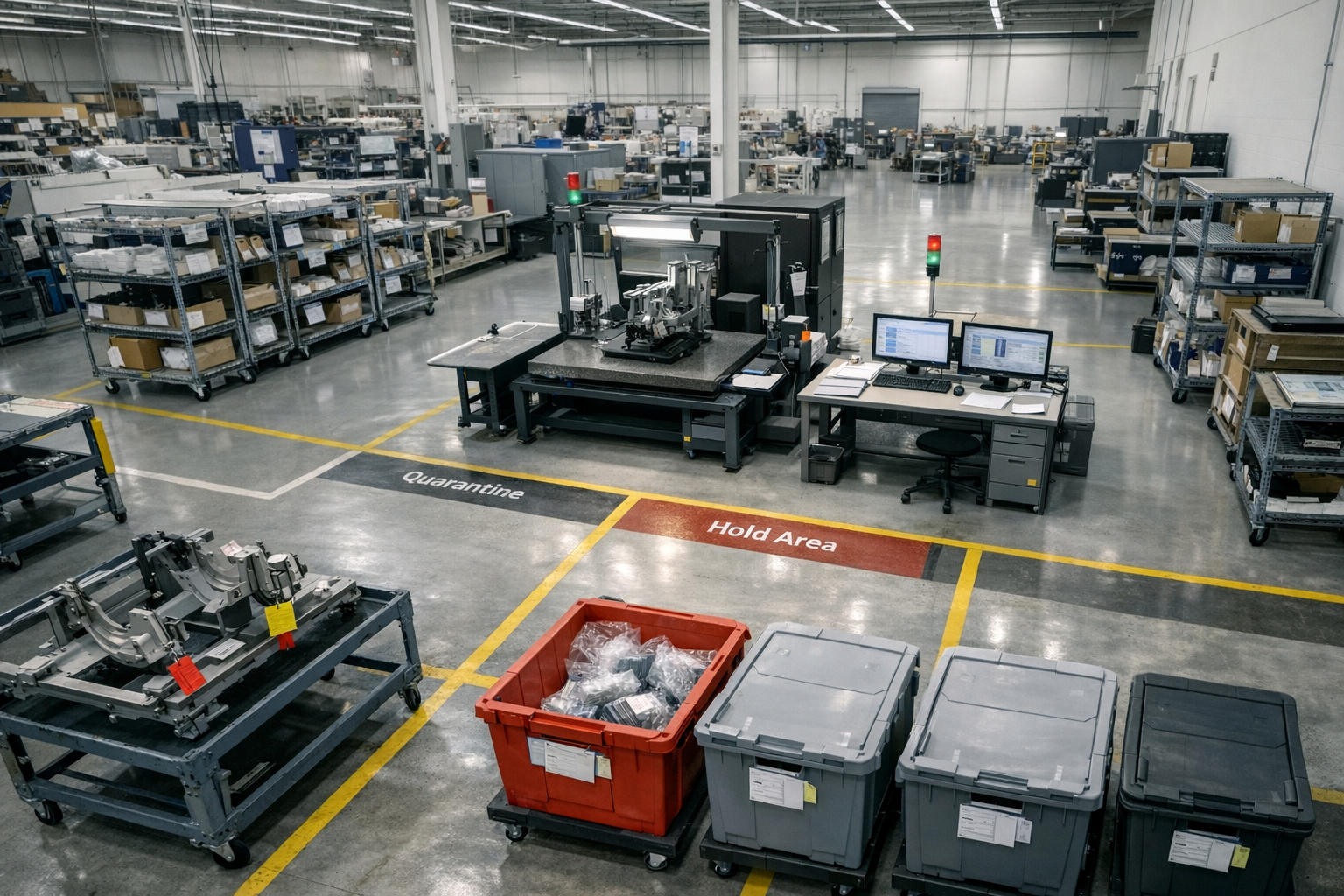
– **Segregated**: Quarantined or moved to a designated area or status to prevent unintended use in production or shipping.
– **Documented**: Recorded via nonconformance reports (NCRs), deviation records, or quality notifications, including lot/batch, defect type, detection point, and traceability data.
– **Dispositioned**: Evaluated and given a formal decision such as scrap, rework, repair, use-as-is with justification, downgrading, or return to supplier.
– **Analyzed**: Used as input to root cause analysis, corrective and preventive actions (CAPA), and continuous improvement activities.
MES, QMS, and ERP systems often integrate to manage nonconforming material status, ensure traceability, and block further processing or shipment until disposition is approved.
Boundaries and what it is not
Nonconforming material:
– **Includes**: Any material that does not meet defined internal or external requirements, even if it could still function or be reworked.
– **Includes**: Both isolated defects and systemic issues affecting entire lots or batches.
– **Does not automatically equal scrap**: Some nonconforming material can be reworked, repaired, or reclassified according to approved procedures.
– **Is not the same as a process deviation**: A process deviation describes a departure from a defined method; nonconforming material is the physical result that fails requirements. A deviation may or may not produce nonconforming material.
In regulated settings, nonconforming material management is separated from final product release decisions, which typically require additional review and documented justification before any use-as-is decision.
Relationship to quality and waste metrics (site context)
In operations that track material waste and yield, nonconforming material is a key input to performance indicators, for example:
– **Scrap rate**: Portion of nonconforming material that is ultimately scrapped.
– **Rework rate**: Portion of nonconforming material that requires additional processing to meet requirements.
– **Yield and first-pass yield**: Nonconforming material reduces effective yield, especially where it cannot be reworked.
– **Cost of poor quality**: Direct and indirect costs associated with nonconforming material, including extra labor, materials, and capacity usage.
Accurate identification and coding of nonconforming material in MES/ERP/QMS enables plants to link waste KPIs to specific products, lines, suppliers, or process steps.
Common confusion and related terms
– **Nonconforming material vs. defective product**: “Defective product” often implies material that cannot meet requirements and must be rejected. “Nonconforming material” is broader and includes items that might be recoverable through allowed rework or repair.
– **Nonconforming material vs. nonconformance (NCR)**: A nonconformance is the documented event or record; nonconforming material is the physical item(s) associated with that record.
– **Nonconforming material vs. scrap**: Scrap is usually the final disposition category for material that will not be used. All scrapped product is nonconforming material, but not all nonconforming material becomes scrap.
Understanding these distinctions supports consistent classification, traceability, and reporting across shop floor, quality, and enterprise systems.


Related Blog Articles



Related FAQ
Related Glossary
Ready to See How C-981 Can Accelerate Your Factory’s Digital Transformation?

